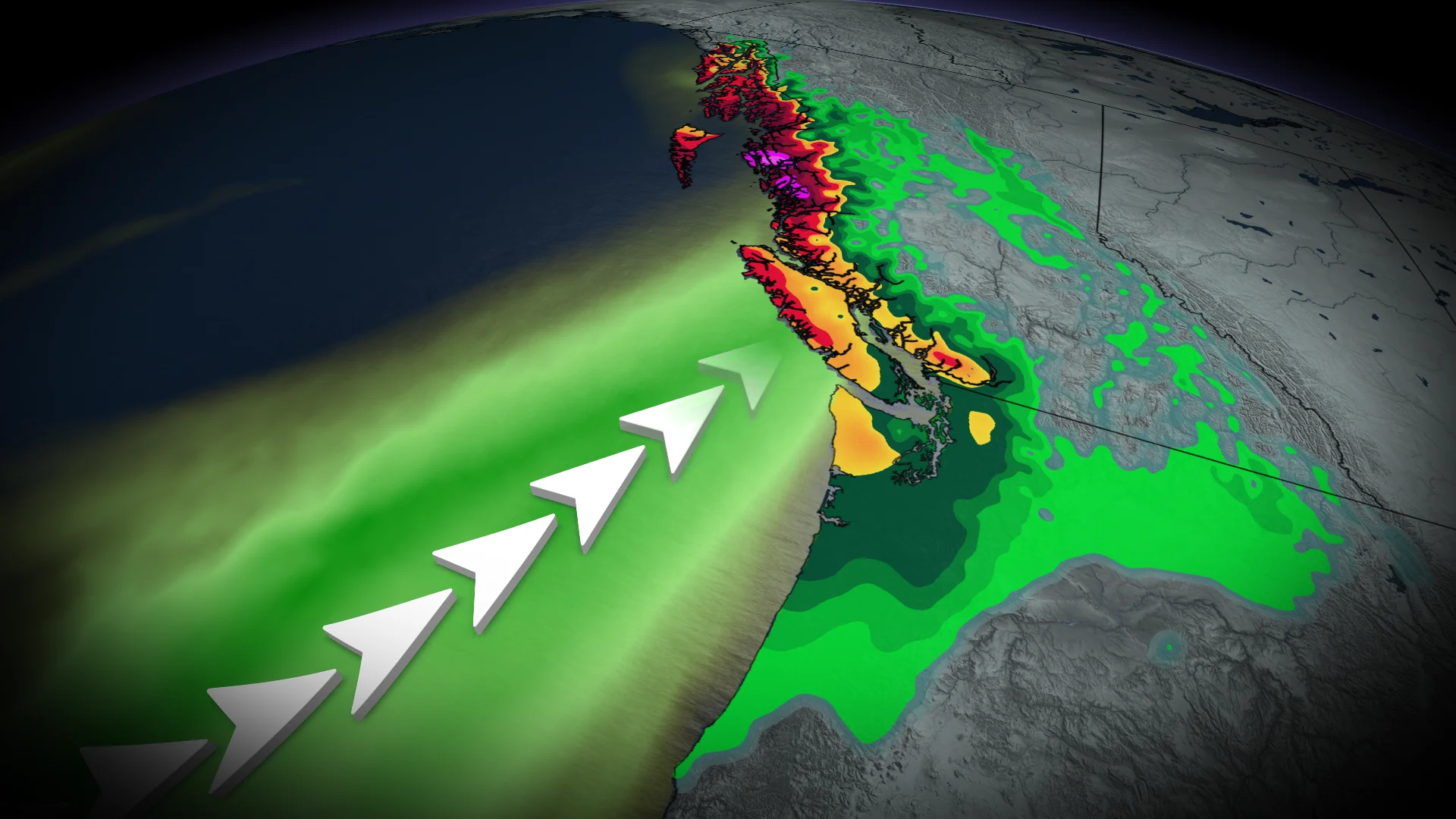
British Columbia is bracing for a sharp change in the weather: after a record-dry October, an atmospheric river is moving into the province, bringing torrential rain, mountain snow and strong winds, with a risk of flooding and power outages. Meanwhile, the Civil Resolution Tribunal has overturned a fine imposed on X, ruling that geoblocking an intimate image was a reasonable measure under Canadian jurisdiction and underscoring the challenges of regulating global platforms. And the resort village of Harrison Hot Springs is preparing to open Lights by the Lake, its largest-ever free winter light display. Running from November 21 to January 10, it will draw visitors with light installations, an ice rink and holiday festivities.
Atmospheric river to end British Columbia’s dry fall
After an unusually dry and record-warm October, British Columbia is preparing for a sharp change in the weather: an atmospheric river is moving into the province, bringing torrential rain and mountain snow. November is the wettest month of the year on Canada’s south coast, and forecasts suggest it will get off to a powerful start—a striking contrast with last month’s near-total lack of precipitation.
According to The Weather Network, Vancouver International Airport recorded just 38.8 mm of precipitation in all of October, only 32 percent of the monthly average. Now the situation is changing dramatically: Vancouver could receive 50 to 80 mm of rain over the next few days. The irony is that such a rapid change in the weather poses a particular hazard: after remaining dry for too long, the ground may not absorb water right away, increasing the risk of localized flooding. Strong winds will add to the trouble, with possible power outages, high waves along the coast and ferry delays.
The first wave of rain will arrive Wednesday evening, as a cold front moves across the south coast. This initial phase will be relatively mild: rain will come and go in Vancouver and the Lower Mainland through Thursday, while Vancouver Island will see more prolonged precipitation. Coastal winds will begin to strengthen over the Strait of Georgia toward Thursday evening, with gusts of 40–60 km/h, rising to as much as 70 km/h by the weekend as another sharp cold front arrives with the atmospheric river.
The worst of the storm is expected from late Saturday into Sunday. Forecasters estimate that the atmospheric river will reach AR-3 strength on the west coast of Vancouver Island and AR-2 across the rest of the south coast. Gusts on the island’s west coast could reach 60–90 km/h, while Victoria, Vancouver and the rest of the Lower Mainland will see weaker winds of around 40–60 km/h. Another active weather system could develop as early as the second week of November, bringing further chances of heavy rain, although forecasts that far ahead remain uncertain and specialists are continuing to monitor developments.
Two key terms help explain what is happening. An atmospheric river is a long, narrow stream of moist air in the lower atmosphere that carries huge amounts of water vapour from the tropics toward higher latitudes. When it reaches land, it can unleash intense rainfall. The AR-1 to AR-5 scale classifies these systems by strength and potential impact: AR-3 is a strong but not extreme event that can cause significant effects, while AR-2 is moderate. The second important point is the paradox of dry soil: it is often assumed that parched ground readily absorbs moisture, but after a prolonged drought the top layer can become hydrophobic, or water-repellent. Water then runs off the surface, increasing the risk of flooding. That is why the abrupt shift from a record-dry October to a rainy November calls for particular attention.
The takeaway is simple: the province is entering its wettest season with a powerful storm, and residents of the south coast should prepare for possible power outages, transportation delays and localized flooding. Forecasters say they will update their predictions as the atmospheric river approaches, since the eventual intensity of the rain and wind could still change.
B.C. tribunal overturns fine against X: why geoblocking took precedence over removing an intimate image
British Columbia’s Civil Resolution Tribunal has found itself caught in a legal paradox that exposes a fundamental tension between national law and the global nature of the internet. The case concerns platform X, formerly Twitter, which was ordered to remove an intimate image of a woman that had been shared without her consent. Instead, the platform restricted access to the image in Canada. The tribunal initially deemed that insufficient and fined the company $100,000 in September 2025 for failing to comply with its order. But on Tuesday, it emerged that tribunal vice-chair Eric Regehr had overturned the penalty, finding geoblocking to be a reasonable measure and ruling that a demand for the image to be removed worldwide would exceed Canadian jurisdiction. The case was reported by CityNews Vancouver.
The dispute dates back to March 2025, when the tribunal issued what is known as a protection order requiring X to remove the applicant’s intimate image. The platform instead opted for “geoblocking”: the image could no longer be viewed from Canadian IP addresses, but it was not erased from the global database. The tribunal treated this as non-compliance and imposed a fine that September. X challenged the penalty, arguing that the tribunal had no authority to demand more than a geographic restriction on access. Regehr ultimately sided with the platform, not out of sympathy for the corporation, but on grounds of legal reasoning and international law.
The decision’s key argument rests on the principle of international comity, which governs how far one country’s laws may reach beyond its borders. Regehr stated directly that requiring the image to be removed in every country would, in effect, mean regulating a foreign corporation’s operations in other countries. He also said that such an order would interfere with X’s contractual relationships with users around the world, which would be incompatible with the principle of sovereignty. “Where laws may impact the sovereignty of other countries, the principle of comity informs how those laws are interpreted,” the publication quotes Regehr as saying. This is not merely a technical caveat but an important precedent: a domestic regulator has recognized that even a worthy goal—protecting a victim of harassment—does not justify the extraterritorial application of the law.
Notably, the tribunal rejected another request from X: that the applicant be ordered to pay the platform’s legal costs. This tempers the impression of a complete capitulation to the corporation: the woman whose image was shared without her consent will not be further penalized for trying to obtain justice. The fact that the case ended with the fine being overturned highlights the difficulty of regulating global platforms. Geoblocking, which the tribunal ultimately deemed sufficient, is a compromise: the content remains online for the rest of the world but is no longer accessible where the law considers it illegal. For the applicant, this means the image still exists on X’s servers, and anyone outside Canada may be able to see it unless the platform takes additional steps.
In this context, “geoblocking” means technically restricting access to content based on a user’s location, usually determined by their IP address. It is filtering, not deletion: the file remains in the system but is hidden from users in a particular region. The principle of comity mentioned in the decision is an informal legal doctrine under which courts in one country show respect for the laws and sovereignty of other countries, especially in cross-border disputes. In this case, the tribunal relied on the doctrine to justify not forcing X to remove the image globally, since doing so would have looked like an attempt by Canada to dictate the rules beyond its borders.
For victims of non-consensual sharing of intimate images, the decision may be a troubling signal: even with a protection order, it can be extremely difficult to make content disappear from the global internet when a platform is based in another jurisdiction. For X, it is a tactical victory, allowing it to avoid a fine and retain control over its content without complying with demands the company considers excessive. But a shadow of doubt remains: if geoblocking is considered sufficient, does that give platforms an incentive to do the bare minimum and limit themselves to formal compliance with orders? The tribunal appears to have focused on whether X took “reasonable steps,” rather than on the moral dimension of the case. Ultimately, the case illustrates how technological globalization blurs the boundaries of legal responsibility, and how even the best of intentions can run up against the principles of sovereignty and corporate autonomy.
Lights by the Lake: how Harrison Hot Springs becomes a winter wonderland
As winter approaches, the resort village of Harrison Hot Springs, about a two-hour drive from Vancouver, is preparing to welcome back one of the region’s best-loved holiday festivals. The annual Lights by the Lake festival returns in November and promises to be the biggest in its history. The two-kilometre waterfront path will be transformed into a festive promenade, where visitors can stroll among hundreds of light displays. Organizers stress that this is not a commercial show but a free public space open to everyone—and that accessibility is a big part of the event’s appeal to residents and tourists alike.
The festival will run daily from November 21, 2026, to January 10, 2027, from dusk until 11 p.m. As Daily Hive reports, it is now the largest free winter light display in the Lower Mainland, the densely populated part of British Columbia that includes Vancouver and surrounding municipalities. In a region where most major light festivals are either ticketed or held in urban parks, a free, two-kilometre route in a natural setting stands out, turning the village into a destination throughout the holiday season.
The signature attraction remains the installation devoted to Sasquatch, the legendary “Bigfoot” who serves as a kind of mascot for the Harrison River Valley. This year, illuminated figures show him doing all sorts of things: sitting by a campfire, hiking, cycling, kayaking, skiing, fishing, camping and even windsurfing. The scenes are no accident—they play on the festival’s central idea, linking a mythical figure with the natural surroundings and outdoor activities for which the area is known. For families with children, the displays also make a convenient spot for memorable photos.
According to Stephanie Gallamore, executive director of Tourism Harrison River Valley, the festival is about more than beautiful lights: “Lights by the Lake is really about bringing people together. The festival was originally created to invite visitors and locals to celebrate our connection to the region’s natural beauty and Sasquatch’s story. We’re proud to keep building on that vision with new displays that complement our signature ‘wild’ theme, while keeping the experience free and accessible to everyone.” The quote captures the spirit of the event: it is meant not as an attraction, but as a reason for the community and visitors to come together in one place.
The season’s opening on November 21 promises to be a celebration in its own right. Starting at 5 p.m., visitors can meet Sasquatch Santa, hear Christmas carols performed by choirs, watch a pet parade and enjoy a festive fireworks display over the lake. Organizers are offering free hot chocolate to the first 1,000 visitors—a small but telling detail that sets a warm, almost homey tone rather than that of a large commercial event. This year’s expanded displays include a giant holiday train, polar bears, an igloo and towering candy canes, adding to decorations visitors already know.
In addition to the walk, visitors can enjoy the free Starlight Rink, with skate rentals available on select festival days. For those travelling without a car, Parkbus offers a special two-day trip to Harrison timed to coincide with the world’s largest winter gathering of bald eagles, as well as other local attractions. To clarify, hundreds and even thousands of eagles really do gather in the Harrison River Valley in winter to feed on salmon, making this natural spectacle another reason to visit the village during the colder months.
A few terms in the description may be unfamiliar to readers. The “Lower Mainland” is the southwestern part of mainland British Columbia around Vancouver, home to most of the province’s population. Sasquatch is a figure from North American folklore, similar to the “Yeti,” and is celebrated locally as part of the area’s identity and even used in tourism branding. Parkbus is a service that organizes bus trips from cities to natural attractions for people without cars, making the festival accessible to city residents without their own transportation.
The takeaway is simple: Lights by the Lake remains a rare event that combines spectacle with free admission and a natural setting. The festival extends the village’s tourism season, attracts families and nature lovers, and strengthens the local brand built around the Sasquatch legend and proximity to the wilderness. For those planning a visit, the dates to remember are November 21, 2026, to January 10, 2027, every evening until 11 p.m., with free admission. Organizers are clearly counting on the event’s simplicity and warmth—not just the scale of its lights—to bring visitors back again.