Three reports describe different emergencies: a shooting at a house party in Taunton, Massachusetts; a powerful hurricane approaching Hawaii; and mass cases of suspected food poisoning at schools in Indonesia. Yet they share a common storyline: public safety depends not only on the scale of the threat, but also on how quickly national and local institutions can recognize the risk, warn people, organize assistance, and address the systemic causes of what happened.
These stories also highlight the difference between sudden and accumulating threats. A shooting unfolds within minutes, a hurricane over several days, while school-meal safety problems become apparent through repeated incidents. In every case, authorities operate with incomplete information: the number of victims is initially unknown, the storm’s track may change, and the precise causes of illnesses are determined only after investigations.
According to WCVB’s report on the Taunton shooting, police received reports of gunshots at around 12:37 a.m. Sunday near Weir and Sumner streets. Responding officers found several people with gunshot wounds and learned that other victims had gone to hospitals on their own. Police were initially unable to confirm either the exact number of injured people or the severity of their conditions. Massachusetts State Police detectives joined the investigation, but no arrests had been made at the time of publication.
The situation in Taunton illustrates the challenges of the first hours after an emergency. Initial information is often fragmentary: some victims remain at the scene, others leave for medical facilities, witnesses provide conflicting accounts, and investigators must secure the area, collect evidence, and establish the circumstances of the conflict at the same time. In this context, the phrase “several victims” does not mean the incident was minor—it indicates that the official assessment is not yet complete.
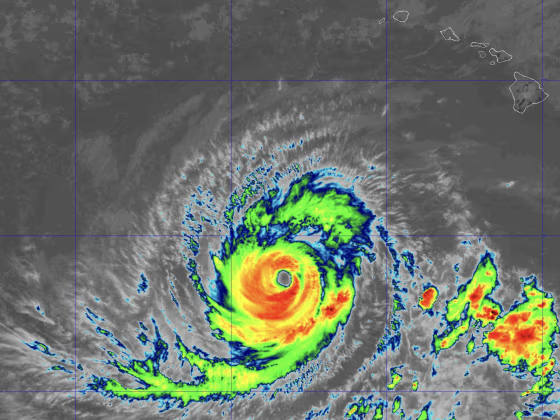
In NBC News’ report on Hurricane Lowell, the risk is described in advance, but is no less concerning. The storm was expected to pass west of the main Hawaiian Islands, yet its proximity could bring dangerous surf, heavy rain, landslides, and flooding. Lowell reached Category 5 strength, meaning sustained winds of at least 157 miles per hour, before weakening to Category 4, with winds of 130 to 156 miles per hour. At the time of the report, sustained winds were 145 miles per hour, and the hurricane was about 640 miles southwest of Honolulu.
Particularly important was the comment by National Weather Service meteorologist John Bravender: “Just because we’re on the edge of the cone doesn’t mean we’re safe.” The “forecast cone” is a graphic representation of the probable path of a tropical cyclone’s center; it does not show the precise area where all damage may occur. Dangerous surf, heavy rainfall, and strong winds can extend far beyond the projected track. Thus, even a hurricane passing west of the islands does not rule out serious consequences for coastal and inland areas.
Hawaii’s governor urged residents to complete their preparations in advance, monitor official warnings, and avoid floodwaters and dangerous coastal areas. Authorities reinforced harbors, deployed emergency services, and monitored dams. This clearly illustrates the role of preventive management: the goal is not to wait for damage to occur, but to reduce the number of victims and the scale of destruction beforehand.
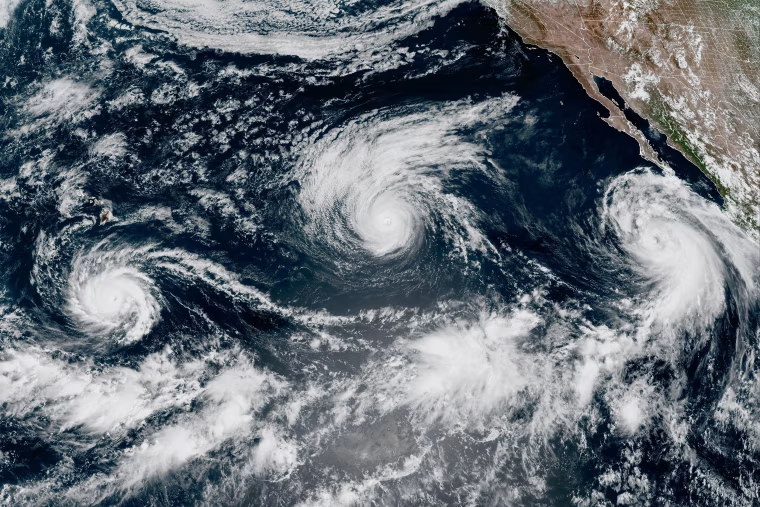
The report also connects the threat posed by Lowell to broader climatic and oceanographic factors. Three tropical systems were simultaneously present in the northeastern Pacific. Experts said unusually warm waters and El Niño may have contributed to the formation of more intense cyclones. Meteorologist Daniel Gilford compared the warm ocean surface to additional fuel: the more “fuel” there is, the faster storms can develop and the more powerful they can become. El Niño is a periodic change in the temperature of surface waters in the equatorial Pacific that affects global atmospheric circulation and rainfall patterns. The article also notes that global warming is changing the nature of this phenomenon, increasing concern about extreme weather.
The third report—an ABC News story on mass illnesses in Indonesia—shows neither an isolated episode nor an approaching natural disaster, but rather the challenge of scaling up a government program. Nearly 1,950 students, teachers, and students at Islamic schools fell ill between September 1 and 3 after eating free meals provided through the Free Nutritious Meals, or MBG, program. Illnesses were reported in several provinces, including East and Central Java, West Sumatra, Aceh, and South Sulawesi.
The largest episode occurred in Rembang Regency, where 752 students and 25 teachers developed diarrhea, nausea, vomiting, and abdominal pain. In Sidoarjo, 730 people were affected, primarily students at an Islamic boarding school; most had been discharged by the time of publication. Hundreds of additional cases were reported in West Sumatra and South Sulawesi. No deaths were reported, but the scale of the incidents turned food quality into a national issue.
The central significance of this story is that the new cases do not appear to be entirely isolated. According to Indonesian Health Ministry monitoring as of September 2, suspected MBG-related food poisoning had affected 50,059 people in 560 cases recorded across 245 districts and cities in 36 provinces since the program began in January 2025. A representative of the National Nutrition Agency said that 80 to 90 percent of previous incidents were linked to failures to follow safety procedures, including improper food storage, violations during ingredient acceptance, inadequate temperature control, and exceeding the permitted time before consumption.
These figures move the issue from the category of isolated error into the realm of infrastructure management. The program is intended to serve nearly 90 million schoolchildren, young children, and pregnant women and is expected to become one of President Prabowo Subianto’s main social initiatives. Its projected cost through 2029 is about $28 billion. The faster such a system expands, the harder it becomes to monitor suppliers, kitchens, logistics, and sanitary procedures. If safety does not scale alongside coverage, isolated violations can produce mass consequences.
Authorities said they were inspecting approximately 27,000 meal-distribution centers. Inspectors found hundreds of allegedly fictitious facilities, while at least 833 kitchens were closed for failing to meet sanitation and hygiene standards. This shows that the government program faces not only challenges in food preparation, but also inadequate contractor oversight and unreliable administrative data. In other words, the state may allocate substantial funds and set ambitious social goals, but the final result is determined by what happens at the level of an individual kitchen, container, refrigerator, and school cafeteria.
All three cases reveal a gap between the formal existence of a response system and its actual effectiveness. In Taunton, police arrived quickly, but initially lacked complete information about the number of victims. In Hawaii, authorities prepared infrastructure and warned the public in advance, but uncertainty about the hurricane’s track continued to pose a threat. In Indonesia, the government is conducting inspections and closing unsafe kitchens, but these measures came after tens of thousands of illnesses and new mass outbreaks.
Another common feature is the importance of communication. During emergencies, people need not only facts but also clear instructions. The warning that “the edge of the cone doesn’t mean safety” is useful precisely because it corrects a common misunderstanding about forecasts. In a shooting case, public information must be accurate and cautious: prematurely announcing the number of victims or a motive could harm the investigation and increase anxiety. In the case of school meals, transparency is especially important for restoring parents’ trust. They need to know where violations occurred, how food is being tested, and which procedures have changed.
The key conclusion is that safety is not a single action but a chain of processes. Preventing harm requires threat detection, reliable data, prepared services, compliance with standards, timely warnings, and follow-up inspections. A weak link anywhere in the chain increases risk. A hurricane may be forecast accurately, but people may not have enough time to prepare. Police may arrive quickly, but witnesses may fail to report important information. A meal program may have a worthy goal, but a lack of sanitary controls can undermine its public benefit.
The reports also reveal a distinction between responsibility for the immediate event and responsibility for the conditions that made its consequences so extensive. In Taunton, the investigation must determine who fired the shots and why. In the case of Lowell, authorities’ task is to reduce the impact of a natural phenomenon that cannot be completely stopped. In Indonesia, it is necessary to determine not only the source of a particular contamination incident, but also why violations keep recurring in different regions. The latter is the more systemic question: repetition points to shortcomings in oversight, training, resources, or incentives for suppliers to follow the rules.
These stories do not suggest that every crisis can be prevented. Crimes, hurricanes, and infectious or toxic outbreaks have different causes. But they show that the consequences depend greatly on the quality of institutions. In cases of sudden violence, speed of response and accuracy of the investigation are decisive. In the face of a natural threat, advance warning and an understanding of forecast uncertainty are essential. In mass food programs, continuous sanitary controls, independent inspections, and a willingness to temporarily suspend unsafe facilities are critical.
The main trend running through all the sources is the growing demand placed on risk-management systems. Modern threats often extend beyond a single location: a hurricane affects an entire archipelago, a centralized meal program spans dozens of provinces, and a local shooting requires coordination between municipal and state police. Effectiveness therefore depends on information-sharing across levels of government and the ability to quickly turn local signals into national decisions.
In a broader sense, these events are a reminder that the scale of a project or threat cannot be measured only by the immediate number of victims. Sometimes what matters more is how often incidents recur, how vulnerable the infrastructure is, and whether authorities are capable of learning from experience. For Taunton, this means establishing the circumstances of the shooting and providing support to those affected. For Hawaii, it means developing early-warning, coastal-protection, and flood-management systems in a changing climate. For Indonesia, it means linking the social goal of free meals to strict, verifiable safety standards. Otherwise, a program intended to improve children’s health could itself become a source of danger.