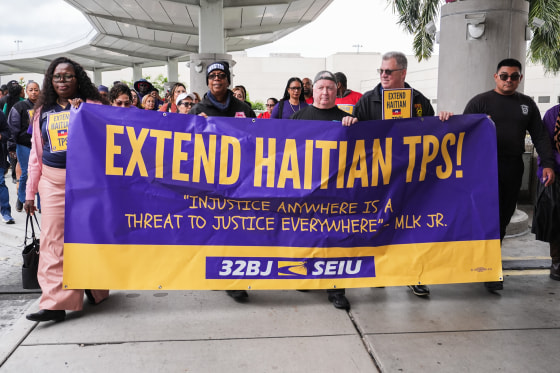
This is not just another immigration dispute in the United States. It is a telling example of how today’s U.S. Supreme Court is defining the boundaries of judicial interference with decisions by the executive branch. Through the case over Temporary Protected Status for Haitian and Syrian immigrants, it becomes clear that the central story here is not only immigration itself, but the question of who ultimately decides who gets to stay in the country and who does not. The Supreme Court ruling, reported by NBC News, continues a line in which the Trump administration is gaining even more freedom to dismantle humanitarian immigration programs. Against that backdrop, reports of an earthquake in Japan’s northeast from Kyodo News and a major deal by the “Chicago Blackhawks” covered by Yahoo Sports seem to belong to a completely different sphere. But placing them side by side highlights the shared media backdrop: the world is living in a state of constant turbulence, where legal, natural, and sports events compete for attention—and momentous decisions are often made quickly, under pressure.
If you focus on the main storyline, it centers on the Temporary Protected Status program, or TPS. This is a temporary legal status that the United States has provided since 1990 to citizens of countries experiencing war, natural disasters, or other extraordinary circumstances. Its purpose is to prevent people from being sent back to places where returning could be dangerous, while also giving them a lawful way to live and work in the United States for a limited period—typically up to 18 months, with the possibility of extensions. That mechanism is now under attack: by a 6–3 vote along ideological lines, the Supreme Court allowed the Trump administration to remove protections for roughly 350,000 Haitians and 6,000 Syrians. As NBC reports, the majority—led by Justice Samuel Alito—concluded that lower courts “overstepped their authority” when they began reviewing the executive’s decision. In other words, the court did not so much rule that the underlying assessment of conditions in Haiti and Syria was correct as it limited judges’ ability to intervene in an administrative decision.
It’s important to recognize that this is not a one-off case. NBC notes that the year before, the Supreme Court already allowed Trump to end a similar status for 600,000 Venezuelans. Now the administration is using that as precedent: if the court gave the green light in Venezuela, then, according to the logic of the White House, it should do the same for Haiti and Syria. The materials also mention that Solicitor General D. John Sauer argued that former Department of Homeland Security Secretary Kirstjen Noem’s decisions to end TPS were “not subject to judicial review.” That is an extremely strong position, because it effectively shifts the center of gravity from the courts to the executive branch.
But behind the legal formula lies a human cost. NBC cites arguments from human-rights advocates and lawyers warning that people “risk their lives” if they are sent back to Haiti. This is not rhetorical exaggeration. The U.S. State Department still advises Americans not to travel to either Haiti or Syria. For Haiti, it points to a state of emergency declared in March 2024 and to the prevalence of armed violence, robberies, carjackings, sexual violence, and kidnappings for ransom. For Syria, the wording is even harsher: “no part of Syria is safe from violence.” Against this backdrop, the administration’s claim that conditions in those countries “have improved to such a degree that the basis for protection no longer exists” looks, at best, disputed—and calls for not only political scrutiny, but factual verification.
The Haitian portion of the case has been especially sensitive. In February, a Washington judge found that Noem did not follow proper procedure when ending TPS for Haiti and also pointed to signs of possible racial and anti-Haitian bias. The judge cited, among other things, Noem’s post on X in which she wrote about immigrants: “WE DON’T WANT THEM. NOT ONE,” as well as Trump’s long-standing statement about Haiti as a “shithole country.” Those words are not only politically toxic. In a courtroom context, they can become an argument that the decision may have been driven not merely by a security assessment of the country, but by hostility toward a specific ethnic group. That is why, in later court filings by the plaintiffs, there was an assertion that the government relied on a “knowingly false statement” claiming that Noem had consulted with the State Department, when in fact she had not. If that is confirmed, the dispute will go far beyond immigration law and touch a core principle of administrative good faith.
The Syrian case is different in form, but the point is the same. In November, a federal judge in New York sided with seven Syrians who already had TPS or had applied for it. The appeals courts did not pause those decisions, but the Supreme Court still stepped in—and in an extraordinary, expedited manner. Lawyers for the Syrian plaintiffs argued that the current situation in the region remains dangerous, and also questioned why the government demanded an urgent ruling when some TPS holders have been living in the United States for more than ten years. That is an important point: in practice, temporary protection often stops being “temporary” and turns into a long-term legal and human reality, in which people build families in the U.S., work, pay taxes, and effectively become part of society—even though, formally, their status remains precarious.
So the story of TPS is a story of tension between humanitarian logic and the logic of executive sovereignty. On the one hand, the program was created specifically for situations where returning would be unsafe. On the other hand, administrations from both parties increasingly use it as a political tool: first expanding it, then winding it down, while courts increasingly refuse to get involved. According to the National Immigration Forum, as of March 2025, TPS applied to about 1.3 million people from 17 countries. This is no longer a marginal arrangement, but a substantial part of America’s immigration framework. And the more people there are under such programs, the higher the stakes—and costs—of any mass decision to revoke status.
It is also worth noting that the TPS decision fits into a broader course of the Trump administration aimed at cracking down on immigration policy. NBC reminds readers of another measure the Supreme Court also allowed to take effect: the elimination of a temporary stay program for more than 500,000 migrants from Cuba, Haiti, Nicaragua, and Venezuela that had been adopted under Biden. So this is not just a single dispute, but a sequential restructuring of a system in which humanitarian exceptions are becoming less and less durable.
Amid these legal battles, news like Kyodo News reporting a revision of the earthquake magnitude in Japan’s northeast to 7.2 serves as a reminder of another side of modern life: the world remains vulnerable to natural disasters, and governments must quickly clarify the scale of the threat. At the same time, a Yahoo Sports report about a major trade in the NHL shows how, in another arena, decisions are also made as a bet on the future. “Chicago” gave up a high draft pick and several assets for defenseman Bowen Byram—meaning it took a risk in order to strengthen itself immediately. This is, of course, a completely different kind of risk, but the logic is similar: large institutions make decisions with long tails of consequences, and you can only truly assess them later. In immigration law, that tail is measured not in points and contracts, but in people’s lives.
When it comes to difficult concepts: TPS is not asylum and it is not a full, permanent path to residency. It is temporary humanitarian protection. The phrase “judicial review” refers to the courts’ ability to determine whether an agency’s decision was lawful and whether proper procedure was followed. When the Supreme Court says that lower courts “overstepped their authority,” it effectively narrows the space for that kind of review. And the phrase “anti-Black and anti-Haitian bias” does not simply refer to crude language—it points to the possible influence of hostile racial attitudes on an administrative decision, which in law is an extremely serious accusation.
The key takeaway across all three pieces is that modern public power increasingly operates in a mode of acceleration and concentration of authority: courts are reluctant to restrain the executive branch, immigration regimes are becoming more fragile, and humanitarian mechanisms are becoming more politicized. In the TPS case, this is especially clear. Formally, the dispute concerns procedures and status—but in essence, it comes down to whether the United States will continue to recognize that a person’s safety may depend on conditions in their home country, not only on the government’s desire to tighten the rules. That is why the Supreme Court’s decision regarding Haitians and Syrians is not just an immigration headline, but an indicator of how today the boundaries of compassion, administrative power, and judicial oversight are being redrawn.