The three articles focus on entirely different spheres—U.S. federal politics, motorsports, and a rescue operation at a reservoir. Yet they share a common theme: the moment of transition, when the familiar order is temporarily suspended or permanently changed. Congress passed a temporary budget to postpone a heated conflict until after the election; Eli Tomac announced the end of his long sporting career; and the search at the reservoir showed how quickly an ordinary outing can turn into an emergency. In each case, time, preparation, and the consequences of decisions made under uncertainty become crucial.
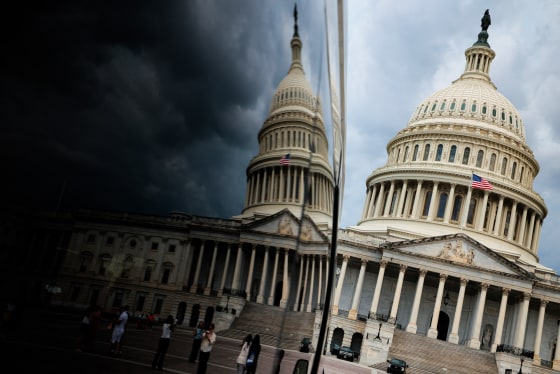
In an NBC News report, the U.S. House of Representatives approved a short-term government funding bill. The measure passed by a substantial margin—370 votes to 48—and extends funding for government agencies through December 11. Since the bill had already passed the Senate, President Donald Trump was expected to sign it.
At first glance, this appears to be a technical measure, but politically it has much broader significance. Congress avoided a government shutdown at the end of September, but it did not resolve the central dispute: what a full budget for the entire fiscal year should look like. The law therefore does not eliminate the conflict; it postpones it. The article explicitly describes it as a “punt”—a delay of negotiations until after the November 3 midterm elections.
The disagreement is primarily connected to the scale of defense spending. Democrats opposed Trump’s demand to increase the military budget to $1.5 trillion. That would represent a further increase after the record $1 trillion level Congress had already approved. Because overcoming a filibuster in the Senate requires 60 votes, even the Republican Party, which controls both chambers of Congress, cannot pass a budget entirely on its own. A filibuster is a procedural mechanism that allows a minority to delay consideration of a bill; ending one requires a qualified voting threshold.
The political cost of the temporary solution may emerge after the election. House Budget Committee Chairman Tom Cole noted that the election results would change both parties’ calculations: “All the math changes. Everybody’s perspective changes.” The winning party will gain additional leverage in negotiations, particularly during the so-called lame-duck period—the interval between the election and the swearing-in of the new Congress. At that point, the current lawmakers still make decisions but already know that the political balance will soon change.
Rosa DeLauro’s statement that she hopes to lead the Budget Committee again if Democrats win highlights another aspect of the situation. Despite the struggle for partisan advantage, she says all 12 appropriations bills need to be passed before the start of the new fiscal year. This shows that the issue is not merely electoral but institutional as well: temporary measures can avert a crisis today while simultaneously increasing the burden on future negotiations.
A similar transitional moment is described in a Motocross Action Magazine report. Eli Tomac announced that he would stop competing after the three SMX finals in September 2026. Unlike Congress’s political decision, this is not a postponement but a definitive boundary marking the end of a career. Yet here too, the decision is based on timing: the athlete emphasizes that “the time has come” and that it feels right to him.
Tomac is ending a 17-season professional career while retaining his status as one of the most successful riders in the history of American motocross and supercross. He has 57 premier-class 450SX race wins—the second-highest total in the discipline’s history—and 32 victories in the 450MX class. He won the AMA 450 Supercross Championship twice, became 450 National champion four times, and helped the U.S. team win the 2022 Motocross of Nations at RedBud.
The article also lists less obvious achievements that reveal the scale of his career: the 250SX West Division championship in 2012, the 250 National title in 2013, his eighth Daytona Supercross victory in 2026, the 2024 FIM World Supercross Championship, and the 2022 ESPY Award for Best Action Sports Athlete. These results matter as more than statistics. They show that Tomac is not leaving because he has lost his competitiveness: during the current season, he still won four 450SX main events and contended for victories.
His own words give the decision a personal meaning: “Racing was the only thing I woke up for and lived for the last 25 years, but I have no regrets.” He describes leaving the profession as a change in identity. For an athlete of his stature, retirement means more than simply ending competition; it means giving up a way of life that shaped his adulthood and public standing.
Red Bull KTM manager Ian Harrison’s comment emphasizes the collective dimension of Tomac’s departure. According to Harrison, Tomac was the kind of rider every team would want, and his discipline and work ethic became just as important as his victories. In this respect, the athlete’s retirement resembles the budget compromise in Congress: a decision affecting one individual directly also affects the entire system around him—the team, competitors, fans, and the future structure of the sport.
The third text, a KTVZ report on the death of Ricardo Toribio Amescua, presents not a managed transition but a sudden crisis. The 39-year-old Redmond resident died while kayak fishing at Prineville Reservoir. According to the Crook County Sheriff’s Office, he was the only person in the boat and was not wearing a life jacket. Investigators found no evidence of foul play.
Emergency services received several calls at around 5:49 p.m. Saturday. Poor cell service complicated the collection of information, so rescuers were initially unable to establish what had happened. They found an overturned kayak, a backpack, and a fishing rod, but the man himself was missing. The search involved the sheriff’s office, the county fire and rescue service, an Airlink medical helicopter, Prineville police, and other agencies.
The search continued the next day with side-scan sonar and dive teams from neighboring counties. The sonar located the body at a depth of about 90 feet, or approximately 27 meters. Equipment problems delayed its recovery until Monday morning. This detail shows that rescue operations depend not only on professional expertise but also on technical readiness, weather conditions, depth, and the characteristics of the terrain.
The story also demonstrates the importance of coordination between agencies. Local law enforcement, firefighters, rescue divers, state park services, medical personnel, and forensic authorities took part in the operation. As a result, the incident became not only an individual tragedy but also a complex multi-agency response.
When the three texts are considered together, it becomes clear that time operates differently in each. Congress uses delay as a political tool: the temporary law prevents an immediate government shutdown but does not eliminate the future conflict. Tomac, by contrast, chooses a predetermined end date, turning retirement into a controlled and prepared transition. In the case of Amescua, time becomes a critical resource for rescuers: the first minutes, the quality of communication, and the readiness of equipment directly affect the operation, although in this instance the search ended with the discovery of a body.
Responsibility is another common theme. In politics, it is expressed through the need to pass a full budget rather than continually replace it with temporary measures. In sports, it means an athlete’s ability to decide when to leave and preserve his dignity after retirement. In an emergency, it involves following basic safety rules—above all, wearing a life jacket—as well as ensuring that agencies are prepared to work together quickly.
The articles also show different types of uncertainty. Congress does not know what the political balance will look like after the election. Tomac’s team must prepare for the departure of its leader even though the season is not yet over. During the first hours of the search, rescuers lacked precise information about the incident and had to act despite poor communications. In every case, uncertainty requires not passive waiting but a concrete strategy: compromise, planning, or the mobilization of resources.
The main conclusion is that temporary solutions and transitional periods are rarely neutral. Temporary funding allows the government to continue operating but shifts political risk into the future. Tomac’s retirement opens a new chapter in his life while also creating a vacuum in the sport’s hierarchy. The reservoir tragedy is a reminder that being unprepared for risks on the water can have irreversible consequences. In all three cases, what matters is not only the events themselves but also how prepared people and institutions are for the moment when the familiar order stops working.
Key trends include the growing complexity of collective decision-making, the importance of planning an appropriate ending, and the need for technical and organizational readiness in emergencies. The political article demonstrates how electoral cycles affect governance. Tomac’s story shows that a lasting legacy is built not only on achievements but also on the ability to end a career at the right time. The KTVZ report underscores the practical value of prevention: a life jacket, reliable communication, and compliance with safety rules can be decisive.
Terms and details that may be difficult to understand help clarify the meaning of these events. A “filibuster” is a procedure for delaying debate on a bill in the U.S. Senate; ending one typically requires 60 votes. A “lame duck” is the period after an election when the current officeholders still retain their powers but no longer reflect the future political balance. SMX is a racing series that combines elements of supercross and motocross; its postseason consists of final rounds that determine the competitors’ overall standings. Side-scan sonar is a device that uses sound waves to create images of underwater objects and helps locate people or items at depth.