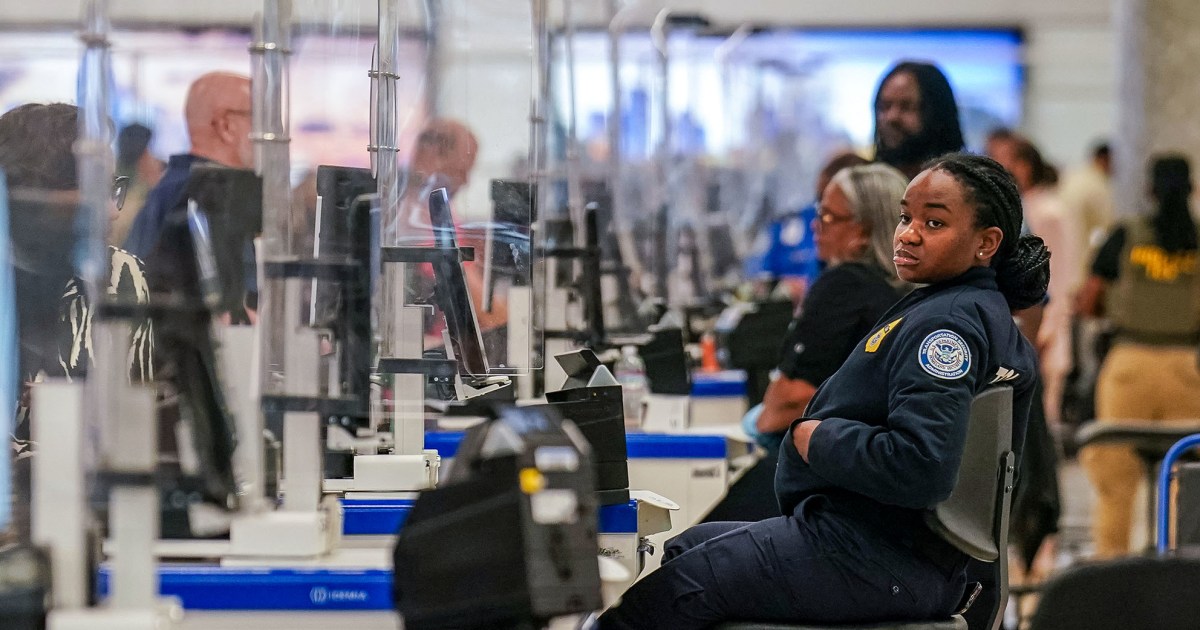
At the center of these pieces is not so much the news itself as their hidden connection: chronic political dysfunction in Washington is turning into a protracted management crisis that directly damages basic government functions — from aviation security to the operation of the Department of Homeland Security. Meanwhile, amid big political fights and loud statements, life goes on: ordinary people stand in multi‑hour lines at airports, federal employees go months without pay, and the news of Tiger Woods’s crash shows how public attention instantly shifts to dramatic incidents, leaving systemic problems in the shadows.
Connecting all the sources — NBC News’s report on collapsing airport lines due to unpaid TSA work (NBC News), ABC News’s piece on the Congressional impasse over DHS funding (ABC News), and Golf Channel’s brief item about Tiger Woods’s crash (Golf Channel) — a common storyline becomes apparent: how fragile everyday security becomes when governmental institutions are turned into a battleground for endless political warfare and media spectacle.
NBC News clearly shows the human and operational scale of a partial government shutdown: Transportation Security Administration (TSA) employees had been coming to work unpaid for more than 40 days until President Donald Trump signed an executive order allowing them to be paid again. The piece emphasizes that this is not a solution but a “temporary patch” — former TSA head John Pistole says plainly: “This is a temporary fix,” noting that the key question is how many people will actually return to work after such a crisis. According to the Department of Homeland Security (DHS), more than 500 employees resigned during the shutdown, and thousands took sick leave or missed shifts because they “cannot cover basic expenses.” Essentially, the air travel security system that passengers take for granted as reliable and almost automatic began to crumble.
Notably, the so‑called callout rate — the share of employees who did not show up for shifts — rose. NBC News, citing DHS, reports that the rate reached 12.35% of staff, which means more than 3,560 people absent in one day. For context: services of this type typically expect a relatively low “normal” level of no‑shows and leave, and the annual natural turnover at TSA is about 7%. When you add thousands of people forced to miss work due to lack of pay, the system begins to run ragged. Pistole realistically notes that even if workers start getting paid on Monday, one should not expect an immediate return to normal: it will take “a few days to a couple of weeks,” and only if a significant portion of staff does come back.
This situation shows that any complex security infrastructure — whether airport screening or the functioning of ministries — relies not only on laws and budgets on paper but on the basic trust of employees in the government as an employer: that paychecks will come, and that the rules of the game will not change monthly because of the next political fight. When that trust is undermined, even swift presidential orders, like Trump’s memorandum to pay TSA workers, act as a temporary painkiller rather than a cure.
ABC News illustrates a second level of the same problem: political bargaining over funding the Department of Homeland Security is turning key structures into hostages of partisan games. The House passed a short‑term bill to fully fund DHS through May 22, but Senate Democratic leader Chuck Schumer said in advance the bill would be “dead on arrival” in the Senate. A source stresses that both chambers are heading into two‑week recesses, and the “partial shutdown” has already lasted 42 days and, in effect, will continue while politicians argue over exactly how and whom to fund.
For readers less familiar with the American system, two key concepts are worth explaining. First, a partial shutdown is when, due to the absence of an approved budget, certain agencies do not receive funds and are forced either to suspend operations or to have employees work “without pay,” with a promise of pay later. This is not a formal collapse of the state but a painful managerial paralysis. Second, DHS — the Department of Homeland Security — is an umbrella for a range of agencies: from TSA and the Coast Guard to cybersecurity. So when its funding becomes the object of political extortion, many different aspects of security are at risk, from airports to the border.
ABC News notes that the Senate passed an alternative: to fund most of DHS (including TSA, FEMA, the Coast Guard, and the Cybersecurity and Infrastructure Security Agency), but to exclude Immigration and Customs Enforcement (ICE) and certain parts of Customs and Border Protection (CBP). ICE and portions of CBP are temporarily funded from money allocated in a larger spending package, and the dispute centers on another issue: Democrats demand reforms of these enforcement agencies after federal ICE agents shot and killed two U.S. citizens in Minneapolis earlier this year. Schumer calls ICE and CBP “Trump’s brutal and deadly militia” in the ABC News piece and prides Democrats on having “held the line” and not providing extra funding without reforms.
Republicans led by Senate Majority Leader John Thune respond in kind: they accuse Democrats of wanting “politics, not a solution,” and promise to push a larger ICE and CBP funding package later this year through reconciliation. This is another important term: reconciliation is a budgeting procedure that in some cases allows bypassing the 60‑vote threshold in the Senate and passing a law by simple majority, effectively sidelining the minority’s position. Republican Senator Eric Schmitt openly says this future package should “supercharge deportations.”
Returning to the TSA employees from the NBC News piece, it becomes clear that at one end of this chain are political leaders using funding for enforcement agencies as a tool to pressure and mobilize their electorate, and at the other end are rank‑and‑file federal employees living months without pay, resigning, missing shifts, or simply trying to find more stable private‑sector jobs. When Pistole muses that many of the 500 who resigned may already have found other positions and are just waiting to receive their final paycheck before formally notifying TSA, he is effectively describing a structural outflow of personnel from a system where political risk has become too great.
This strain is immediately reflected in ordinary citizens’ lives. NBC News describes how staff shortages cause multi‑hour lines, missed flights, and “growing uncertainty around air travel.” Pistole says plainly that many will look for alternatives: driving, trains, buses, because “the last thing I want is to go to George Bush Intercontinental Airport in Houston and wait four hours.” The paradox is that airports and flight security are one of the few areas where people expect predictability from the government; a prolonged shutdown destroys that predictability and effectively pushes people away from air travel, which harms airlines, the tourism industry, and the economy at large.
Against this background, Golf Channel’s brief about Tiger Woods’s rollover on Jupiter Island, Florida, is not just an isolated incident: it illustrates how the media agenda instantly pivots to personalized, emotional stories. The item notes that the crash was reported by the Martin County Sheriff’s Office and that Woods’s condition “was not immediately known.” For the general audience, such a story—especially involving a global sports figure—easily overshadows complex, layered stories about DHS funding or why airport security workers were unpaid.
At the same time, the crash is a reminder of another level of vulnerability: regardless of political battles, state and local emergency response services (like the Martin County Sheriff’s Office) must act instantly when a serious crash involves an ordinary driver or a celebrity. Their ability to respond quickly and adequately is also a function of funding, training, and institutional stability. If the shutdown were to spread more deeply into law enforcement or emergency services, such incidents could have very different outcomes.
The chain emerging from NBC News, ABC News, and Golf Channel yields several key takeaways. First, prolonged political crises in the U.S. have stopped being an abstract backdrop and now affect fundamental services on which everyday safety depends: airport screening, border protection, emergency management agencies. Second, funding for these structures has been weaponized as partisan leverage: Democrats use ICE and CBP as symbols of “Trump’s harsh immigration policy” and push for reforms, while Republicans promise to “supercharge deportations” and accuse opponents of preferring political fights to solutions. The result hurts those with the least leverage — rank‑and‑file federal employees and the citizens who rely on their work.
Third, even when the executive branch implements targeted measures like Trump’s order to pay TSA workers, these act as temporary fixes that do not remove the root cause — the unpredictability of the budget process and turning the machinery of government into a continual crisis zone. This drives professionals out of service, increases turnover, and reduces the long‑term resilience of security systems. Finally, the information environment where news of a multi‑week DHS shutdown and flight disruptions due to TSA problems sits alongside a terse “Tiger Woods in a crash” story shows how easily public attention shifts to singular, shocking events while deep systemic risks become normalized and fade into the background.
Taken together, this paints a worrying picture: the U.S. still has a powerful state apparatus, but the resilience of that apparatus increasingly depends not on institutional rules but on tactical choices by political leaders and their willingness to use vital functions as bargaining chips. Long lines at airports, tired TSA employees without pay, politicians proudly declaring another bill “dead on arrival,” and readers seeing a photo of a famous golfer’s overturned car — these are links in one story about how a democracy consumed by perpetual political struggle quietly erodes the safety and comfort of everyday life.