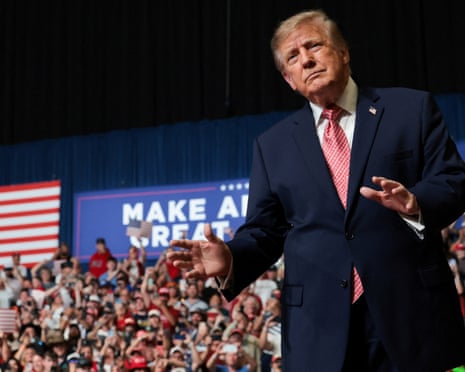
The materials provided show that the 2026 US congressional elections are unfolding around more than just partisan rivalry. Their overarching theme is a struggle for voters’ trust amid a high cost of living, foreign-policy crises, and politics’ growing dependence on major financial resources. Donald Trump is turning the campaign into a personal plebiscite on his ability to retain the Republican majority, while Democrats are trying to capitalize on economic discontent and controversial administration decisions. Early voting is already becoming a crucial indicator of mobilization. At the same time, financial expectations surrounding SpaceX and its large-scale investments in artificial intelligence are a reminder that political risks are closely tied to markets, government spending, and access to capital.
The Republicans’ main political problem is that presidential popularity does not guarantee success for candidates from his party. As The Guardian reports, Trump has begun a seven-day tour of states he won in 2024, seeking to support Republicans ahead of the midterm elections scheduled for November 3. His visit to North Carolina is intended to help Michael Whatley in the race for a Senate seat, but Whatley is trailing the state’s former governor, Democrat Roy Cooper, by a noticeable margin. Significantly, the Republican super PAC previously canceled a $71 million advertising campaign in North Carolina, redirecting the funds to a more competitive race in Kansas. The decision appears to acknowledge that retaining the state is becoming less likely for the party.
Kansas is particularly important as an example of the changing political map. For decades, the state was considered reliably Republican: Democrats had been unable to elect a senator there since 1932. But now even Kansas Republicans are being forced to spend substantial resources and bring in the president. At a rally supporting Senator Roger Marshall, Trump acknowledged that the state was becoming “more purple,” meaning politically competitive. The term “purple state” refers to a state where neither party has a stable advantage and the election outcome depends on the specific candidates, turnout, and current public sentiment.
Economic difficulties are becoming a central campaign issue. In Kansas, Trump announced $8 billion in aid for farmers because of a sharp rise in diesel prices. According to the report, diesel costs nearly $6 per gallon—roughly twice as much as a year ago. The administration attributes the increase in costs to the war with Iran, but voters are more concerned with the immediate impact: transportation, farm machinery, food, and production in general are becoming more expensive. Financial assistance may temporarily ease tensions among farmers, but it also demonstrates the government’s vulnerability: shortly before voting, the president is being forced to offset the consequences of policy through direct budget payments.
Republicans are having to respond to several sources of discontent at once. Rural residents are suffering from fuel costs and tariff policy, ranchers are unhappy with plans to lower beef prices through imports, and, according to the report, tough immigration raids have caused some farmworkers to stay home. As a result, measures intended to strengthen Trump’s support among conservative voters may also be creating new economic problems in industries dependent on migrant labor.
In Michigan, the contest is also moving beyond an ordinary partisan conflict. Democrat Abdul El-Sayed is facing former Republican congressman Mike Rogers. The campaign has been accompanied by racist and Islamophobic statements, including attempts to link El-Sayed’s Muslim faith to extremist organizations without evidence. Trump’s participation in such attacks shows that cultural and religious issues remain one of the main tools for mobilizing the conservative base. However, this strategy may backfire, particularly in states with more diverse populations and a large share of independent voters.
Foreign policy is also directly affecting the midterm elections. Trump’s dispute with Ukrainian President Volodymyr Zelenskyy intensified after the US decision to suspend broad sanctions and tariffs against Russia for 60 days. Kyiv and some allies view this as a concession to Moscow. Following a conversation with Secretary of State Marco Rubio, Zelenskyy said that deliveries of ballistic-missile interceptors and early-warning systems, as well as access to Starlink and Starshield, needed to be restored. These systems are of practical importance to Ukraine’s air defense and communications.
Rubio, for his part, rejected accusations that Washington had deliberately restricted the transfer of intelligence to Ukraine. He called the claim that US actions were causing the deaths of Ukrainians “outrageous” and attributed the disruptions to technical problems. The episode shows how difficult it is for the administration to control the political consequences of foreign-policy decisions. Even if the outages were genuinely technical, their coincidence with a change in sanctions policy raises suspicions and gives opponents an opportunity to accuse the president of weakening US allies.
Another example of international events being used in domestic politics is Trump’s response to unrest in France. The president linked the unrest to mass migration, although French authorities, according to the report, provided no evidence supporting that explanation. At the Kansas rally, a Fox News report on looting and destruction was shown before Trump’s speech. This was not merely an editorial choice but a political technique: a foreign crisis was being used to intensify themes related to borders, security, and migration. Such an approach is aimed primarily at emotional mobilization rather than at explaining the causes of what is happening.
The election outcome will depend not only on public sentiment but also on the parties’ ability to turn support into actual votes. WESH reports that early and mail-in voting has already begun in several states, with millions of ballots submitted before Election Day. The outlet uses data from the University of Florida’s Election Lab, which has tracked early voting since 2008. The interactive map includes both early votes and accepted mail-in ballots. In 31 states and Washington, DC, it also shows voters’ party registration where such data is available.
It is important to note that early-voting statistics are not a prediction of the result. They show how many ballots have already been submitted, but not whom voters supported, and they do not always allow direct comparisons between states with different registration and counting rules. Nevertheless, the data help assess the intensity of mobilization. Early voting is strategically important for the parties: the more supporters vote in advance, the lower the risk that bad weather, transportation problems, work obligations, or political scandals at the last minute will reduce turnout.
A Yahoo Finance report on SpaceX’s financial results may initially appear unrelated to the elections, but it adds to the broader picture of pressure on the US economy and financial markets. SpaceX is preparing to report its third-quarter results for only the second time since going public. Revenue is expected to reach about $12.7 billion, compared with $7.8 billion in the second quarter, while adjusted earnings per share may come to $0.15. After falling by nearly 30% shortly after the listing, the shares have recovered to roughly their debut price.
For investors, the key question concerns not so much current revenue as spending on artificial intelligence. SpaceXSI reported an operating loss of $1.26 billion in the previous quarter, while AI spending reached $15.8 billion, compared with $7.7 billion in the first quarter. The company is investing in data centers, including Colossus, and products such as Grok and Grok Bot. Morgan Stanley analyst Adam Jonas called the need for additional financing a “key overhang” for market sentiment and warned that an inability to raise capital would have broader consequences for the economy and investment portfolios.
This reveals an important connection between politics and corporate finance. Ahead of the elections, the administration is having to support farmers and soften the impact of expensive energy, while major technology companies require enormous investments in computing infrastructure. Government decisions on energy, sanctions, trade, and regulation affect voters, businesses, and the cost of capital simultaneously. If political instability increases, investors will assess more cautiously companies that need multibillion-dollar loans to carry out long-term projects.
The overall trend across the sources is a shift from stable partisan geography toward more competitive and volatile politics. Even traditionally Republican Kansas is now viewed as potentially problematic, while North Carolina requires substantial presidential support. Republicans are trying to offset economic discontent through presidential activity, direct payments, and cultural mobilization. Democrats are counting on frustration over prices, war, and controversial administration decisions, but their success will depend on turnout and their ability to hold together a coalition of moderates, young people, urban voters, and ethnic minorities.
The key conclusion is that the midterm elections are becoming a test not only of the parties but also of Trump’s model of governance. The president is building the campaign around personal popularity, pressure on opponents, and the constant use of crises—from fuel and Iran to migration and Ukraine. Yet this strategy may deepen polarization while aggravating the very problems worrying voters: inflation, energy costs, foreign-policy risks, and a lack of trust in official explanations.
Early voting is already shifting the campaign from a contest of promises to a contest of organization. The parties that mobilize their supporters most effectively in advance will gain an advantage, regardless of which rhetoric receives the most attention in the final days. Meanwhile, tensions in the markets—including SpaceX’s high AI spending and the company’s need for new financing—show the broader backdrop to the elections: US politics does not develop in isolation but within an economy where government decisions, military crises, and technological investment directly affect one another.