Two of the three articles describe the same dangerous moment: the United States and Iran are signaling that they are open to negotiations while preparing for a possible resumption of hostilities. US Vice President JD Vance’s letter and the visit to Tehran by representatives of Saudi Arabia, Pakistan and Turkey show that diplomatic channels remain open. But they have yet to resolve the key disagreements or remove the threat of a new strike. The third article, about the dwarf planet candidate 2026 ED138, is unrelated to this topic, so its scientific findings should be considered separately rather than folded into the political story.
According to US media reports, Vance sent a letter to Mohsen Rezaei, secretary of Iran’s Supreme National Security Council. The letter itself has not been published. Sources say it did not propose a ready-made peace deal, but rather a possible “framework for negotiations” and an effort to determine whether the two sides could narrow their differences before President Donald Trump decides whether to launch new strikes. The letter reportedly proposed an early meeting, with Vance himself leading the US delegation and Iran’s nuclear program on the agenda from the outset. Qatar and Turkey were mentioned as possible venues. These details are reported in Al Jazeera’s article on Vance’s letter and the threat of a new conflict.
Iran has not publicly confirmed the contents of the message, but according to The New York Times, the country’s leadership received it favorably. Foreign Minister Abbas Araghchi wrote on social media that Iran “continues to give diplomacy a chance,” and an official response from Rezaei was expected on Thursday. This is a cautious formulation: it shows that Tehran is not closing the door to negotiations, but does not in itself mean Iran accepts US terms.
The choice of recipient may be significant. Rezaei heads a key national security body, and addressing him directly could indicate that Washington is trying to reach those it considers influential in decision-making in Tehran. But diplomatic contact with a senior official is not the same as an agreement with Iran’s leadership as a whole. As Hamidreza Azizi, an analyst at the International Crisis Group, notes, the choice may reflect a US perception that the balance of power within Iran has shifted. At the same time, experts say Tehran is mindful that Trump still has the final say in US policy.
The gap between a diplomatic signal and actual control over decisions is the central uncertainty surrounding Vance’s initiative. He is seen as less inclined than Trump to wage a prolonged war and more interested in negotiations. Analyst Ali Vaez says Tehran may see Vance as someone who “has access to the president and understands the cost of failure.” But a more predictable negotiator cannot, by himself, overcome deep substantive disagreements. Another expert, Rouzbeh Parsi, doubts that Iran’s authorities will attach much weight to the initiative until Vance proves he can independently influence administration decisions. According to Azizi, distrust is also fueled by the fact that armed conflicts have taken place even when Vance objected or held a different position.
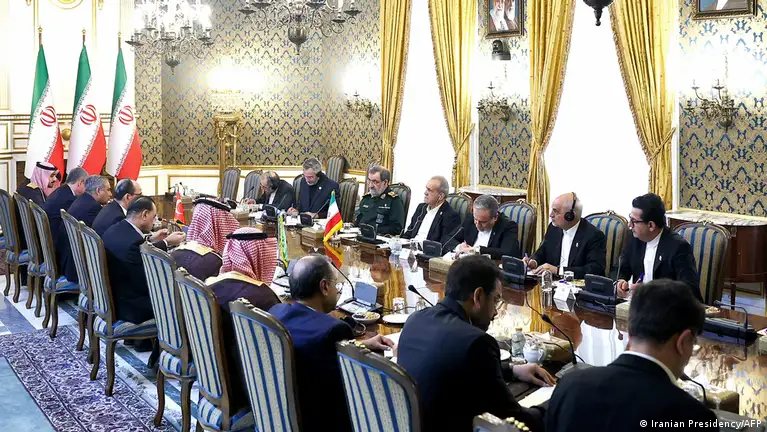
Meanwhile, regional diplomacy has moved directly to Tehran. As DW reports on the meeting of representatives of the “Mecca” defense pact, Pakistan’s army chief Asim Munir, Saudi Defense Minister Khalid bin Salman and Turkish intelligence chief Ibrahim Kalin visited Iran on Monday. They met with President Masoud Pezeshkian and other Iranian officials. The Saudi side said the visit was intended to open channels for negotiations and “prevent a return to military escalation.”
According to Reuters, the discussions covered a possible regional non-aggression network, US-Iran contacts, the situation in the Strait of Hormuz, the US naval blockade and Houthi attacks on Saudi Arabia. A Pakistani official said Munir had presented a settlement proposal that could offer concessions to both Washington and Tehran, with the three visiting countries and Qatar potentially acting as mediators. No specific agreements were announced, however. Mohsen Rezaei described the meeting’s atmosphere as “very positive” and said a “new atmosphere” was emerging in the region. This points to a desire to keep political dialogue going, but does not amount to a breakthrough.
The meeting served two purposes. On the one hand, Saudi Arabia, Pakistan and Turkey are trying to prevent the war from spreading and protect their own interests. On the other, the presence of three senior representatives at once showed that the countries were acting as a coordinated bloc. The “Mecca” pact provides for mutual defense: an attack on one participant is treated as an attack on all. The visit can therefore be read both as a mediation effort and as a reminder to Tehran of the potential consequences of further escalation.
This dual purpose is particularly important for Riyadh. Saudi Arabia faces threats and attacks linked to the Houthis, who are associated with Iran, but a full-scale war with Tehran could endanger its infrastructure and economic projects. According to political scientist Babak Dorbeiki, the kingdom’s preferred option is a diplomatic settlement, since both the current instability and a major war would come at a high cost. Pakistan is also interested in mediation: it maintains relations with both Washington and Tehran, and an open conflict would distract it from its own security concerns, including tensions with India. Turkey, a NATO member, is acting cautiously: sending its intelligence chief rather than its foreign or defense minister does not suggest a promise of direct military support to either side.
Tehran, for its part, presents the meeting as confirmation that Iran is not isolated and remains part of regional diplomacy. Iranian presidential adviser Ali Asghar Shafiei rejected the interpretation of the visit as an ultimatum and stressed that negotiations can take place alongside preparations for possible hostilities. This is the characteristic logic of the crisis: diplomacy does not necessarily replace military deterrence; the parties use it while remaining prepared for a forceful scenario.
The main regional point of contention is not just Iran’s nuclear program, which Washington reportedly wants to put on the table from the outset. Saudi Arabia is concerned about Houthi attacks, while Tehran has offered no public guarantees that it can or will stop them. DW notes that Iran may view its influence over the Houthis as a bargaining chip in exchange for a reduction in US military pressure and broader steps toward ending the war. But for now, this is an analytical assessment, not a confirmed proposal from Tehran.
The military threat remains significant. According to Al Jazeera, Trump urged US allies in the Persian Gulf to prepare for a possible short but intense campaign after the US midterm elections on November 3. He mentioned the possibility of “another little ‘Epic Fury’”—the name given to the operation against Iran that began in February. Tehran, in turn, has warned that it would respond more forcefully to new US-Israeli strikes, including possible attacks on oil facilities, undersea cables, data centers and artificial intelligence infrastructure in Gulf countries. An adviser to the speaker of Iran’s parliament described this approach as a “zero red lines” strategy—that is, a threat not to limit the response in advance. This statement should be understood as a deterrent signal, not evidence that a decision has already been made to attack the listed targets.
Experts quoted by Al Jazeera assess the likelihood of new strikes as high. Ali Vaez called the risk “dangerously high,” suggesting that the elections could weaken the political constraints on Trump. Marzieh Kouhi Esfahani believes that, given the current deadlock, movement toward war is more likely than movement toward lasting peace. Rouzbeh Parsi warns that the next exchange of strikes could be larger and more destructive, as both sides feel pressure to demonstrate resolve. These assessments are not predictions with guaranteed outcomes, but they reflect widespread concern: the diplomatic window may close faster than a substantive agreement can take shape.
Overall, events point not to a choice between “war” and “peace,” but to simultaneous movement in both directions. Vance’s letter, contacts in Tehran and the involvement of regional mediators create channels for negotiations; threats of strikes, military preparations and warnings of retaliatory attacks raise the cost of a miscalculation. For now, diplomacy appears to be more a way to buy time, test intentions and avert immediate escalation than evidence of agreement on the key issues.
Three indicators will be important in assessing what happens next: Iran’s official response to Vance’s letter, Washington’s willingness to discuss terms that go beyond simply proposing a meeting, and the emergence of concrete regional guarantees on Iran’s nuclear program, Gulf security and Houthi activity. So far, there are no such signs. The current diplomatic activity is encouraging, then, but it does not remove the risk: unless the parties move from exchanging signals to verifiable commitments, diplomatic contacts may prove to be only a pause before another confrontation.
Separately, Yahoo Tech’s article about the possible discovery of the dwarf planet 2026 ED138 is unrelated to the Middle East crisis, but reports on a different development: the expanding reach of scientific observation. The candidate was detected in data from the Vera C. Rubin Observatory and, according to preliminary estimates, lies about 46 times farther from the Sun than Earth; its diameter may be between 600 and 1,500 kilometers. These figures are still approximate, and its status as a dwarf planet has not been confirmed: its size must be determined more precisely, and scientists must establish whether its gravity is strong enough to make it nearly spherical. As researcher Matthew Holman emphasizes, that remains to be proven. More details are available in Yahoo Tech’s article on 2026 ED138. This article has no connection to the two political reports; its broader takeaway is not about war or diplomacy, but that repeated observations of the sky with new telescopes may reveal objects that earlier searches missed.