In all three pieces — about the daring rescue operation of a downed American pilot over Iran, about the death of a man wielding a sword in Boston during police intervention, and about the unexpected postponement of a UFC title fight — a common theme emerges: how modern structures of power (the state, intelligence services, police, sporting organizations) act in moments of acute crisis, balancing between demonstrations of might and encounters with human vulnerability, chance, and chaos.
In NBC’s report on the rescue of the second crew member of an F‑15E over Iran NBC News we see a classic narrative of military bravery, technological superiority, and political image. The two-seat F-15E Strike Eagle, one of the symbols of American “precision power,” was shot down over Iranian territory — an event that seemed, for a long time, not supposed to happen given Washington’s repeated claim of “full control” over Iranian airspace. The very phrase that the plane’s downing “busted the notion of total control” in the skies over Iran sharply exposes the limits of power: even with air dominance, even with technological and numerical advantage, war remains an environment where absolute invulnerability does not exist.
The article suggests that rescuing the second crew member — the so-called “backseater,” responsible for weapons systems — became one of the most hazardous search-and-rescue operations in modern U.S. history. President Donald Trump, in correspondence with NBC, calls it an “Easter miracle” and uses the most solemn rhetoric: “one of the boldest search-and-rescue operations in U.S. history,” “no American was killed or wounded,” “overwhelming air superiority.” On this level the text shows how political leadership seeks to stitch a military operation into a heroic, almost cinematic narrative: from “miracle” to a demonstration of “Air Dominance.”
But alongside that, the same piece unfolds another storyline — about the shadowy, far less spectacular side of modern warfare: intelligence, information operations, and disinformation. A senior administration official, referring to CIA actions, speaks of a “deception campaign” inside Iran: the agency spread a false signal that the American pilot had already been found and was being evacuated by land, intended to disorient Iranian forces. The image the source uses is telling: “a needle in a haystack, but in our case — a brave American soul in a mountain cleft, invisible to anyone except the CIA’s capabilities.” Behind the rhetoric and metaphors lies an important shift: the success of an operation is determined not only by the physical presence of aircraft and special forces, but by a complex play of the opponent’s perceptions, information noise, and management of uncertainty.
That leads to a counterpart in Iran’s reaction. According to Iranian agencies Fars and IRNA, during the American rescue operation two Black Hawk helicopters and a C-130 transport were destroyed and the rescue attempt “failed.” From their perspective, it’s another story: not a U.S. triumph but failure and losses. In this mirrored narrative each side emphasizes its own success and the other’s weakness. But the fact that an F‑15E was downed by a modern air-defense system of the Islamic Revolutionary Guard Corps, as the affiliated source Nour News asserts, already demonstrates that even “air superiority” is subject to erosion when an adversary builds up and modernizes its defenses.
The episode with the A‑10 Thunderbolt, which NBC reports was hit by Iranian fire but managed to reach Kuwaiti airspace before the pilot ejected, speaks to the same point. The plane was lost, the pilot saved. This is another example of how the military machine, even while maintaining high effectiveness in rescuing its personnel, cannot guarantee complete protection from being struck. Technological might and organizational capacity work to preserve personnel, but equipment and space remain mortal and fragile.
Move now to Boston, Hemenway Street, where the scale and type of power — police and emergency services rather than combat aviation — seem entirely different. Yet the Huntington News story is essentially about the same thing: how, in a crisis, an organization of force tries to control chaos while confronting human vulnerability — both its own and the public’s. Police respond to a call about a “mental health crisis”; the individual believes people around him are armed and that he is in danger. This portrait fits the symptomatology of acute psychosis or a severe perceptual disorder, where a threat is experienced as utterly real even if objectively it is not.
Police Commissioner Michael Cox emphasizes that the suspect was likely in a mental health crisis rather than, say, acting as part of a criminal group. Yet the person arms himself with a sword and attacks police and EMS personnel. The image of a sword in modern urban drama appears almost anachronistic, which is why it is so jarring: it’s not a pistol but “cold” weaponry, close‑quarters physical violence that requires proximity. Officers use both a Taser and lethal force to “stop” the attacker; he dies in hospital. Several police and medical personnel suffer, according to Cox, “non-life-threatening” injuries.
Here, as in the Iran story, we confront a dual logic. On one hand, officials — Commissioner Cox and District Attorney Kevin Hayden — try to stress that law enforcement acted in an extremely difficult, “chaotic” situation and did “everything possible” to handle a person clearly in mental distress. Interagency cooperation is emphasized: police, EMS, mental health services. On the other hand, the final outcome is that a person is dead and a homicide investigation and the DA’s office are involved. Again the same paradox revealed in the Iranian skies: institutions meant to control threats actually operate under severe shortages of time, information, and de-escalation tools.
Under these circumstances the question of proportionality of force becomes central. In the Iranian case Trump speaks of dozens of combat aircraft with “lethal ordnance” scrambled to search for two pilots, highlighting the demonstrative aspect of the operation: to show the adversary the scale of readiness and ability to respond. In Boston proportionality is expressed differently: the escalation from attempting to resolve a mental health crisis to deploying lethal force against a person with a sword. In both instances the system, demonstrating the capacity to act decisively, inevitably raises the question: where is the line between necessary protection and excessive or thoughtless escalation?
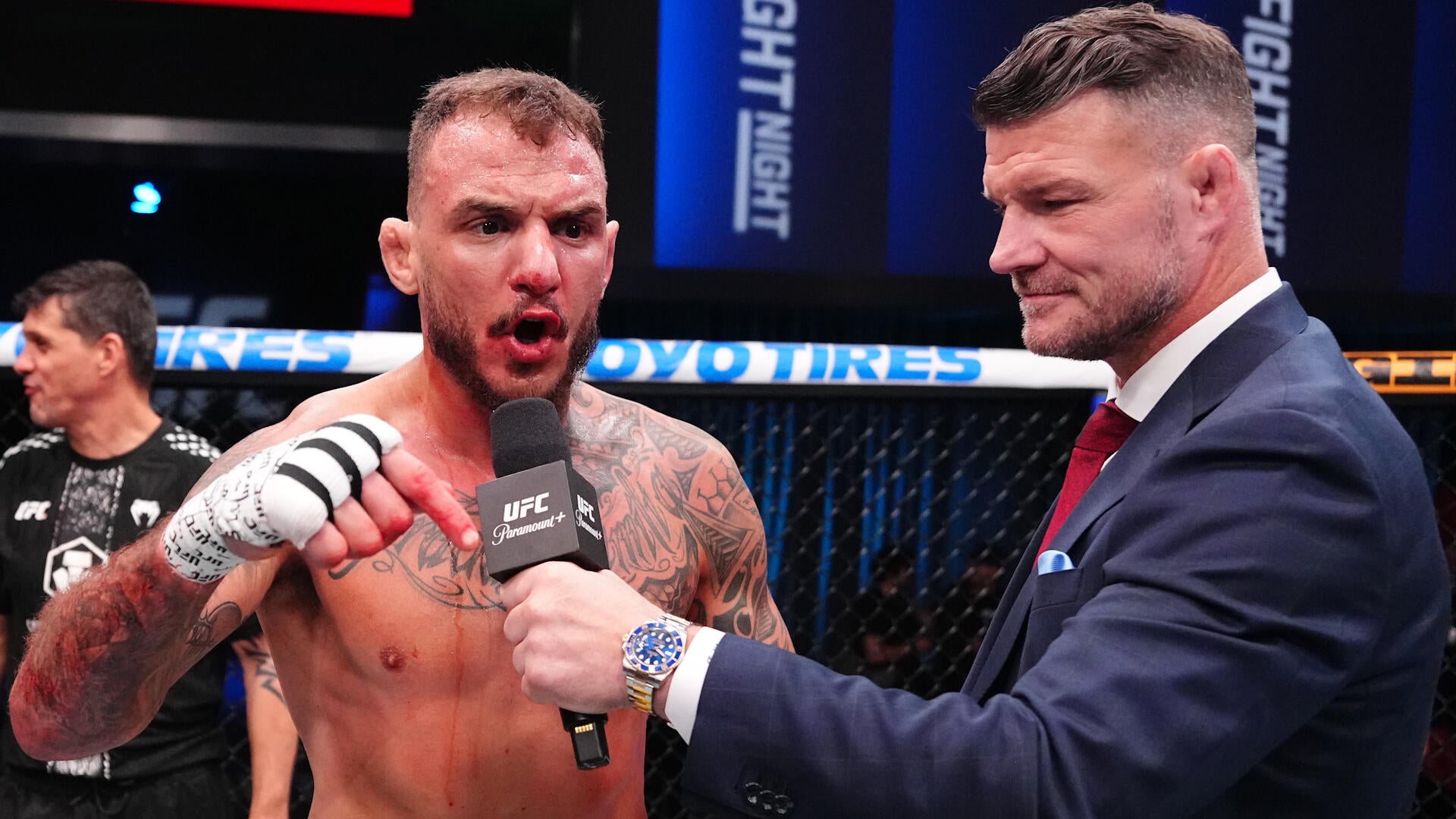
The last, at first glance peripheral piece from CBS Sports — a brief notice about the postponement of the UFC flyweight title fight and a discussion of “what’s next for Moicano in the lightweight division” — closes the motif in the field of professional sport. UFC is institutionalized violence brought into an arena and strictly regulated: weight classes, rules, medical tests, licensing systems. A postponed title fight is a reminder that even in a carefully constructed system where risk seems controlled, chance and unpredictable factors remain. It could be an injury, a training problem, a failed drug test, a visa issue — the public doesn’t know the details, but the wording “what’s next for Moicano” shows how a fighter’s career depends on organizational decisions and unexpected schedule disruptions.
Mixed martial arts are often described as the “pure” form of conflict: two athletes, one set of rules, one outcome. But beneath that sporting layer lies the same foundation: the management of violence, an attempt to package risk and aggression within formalized boundaries. When a fight is postponed, it reminds us that control is incomplete: plans collapse, career strategies shift, and an athlete’s physical and psychological preparation for a specific date is put into doubt. In this sense UFC is a micro-model of how society tries to civilize force while remaining subject to unforeseen contingencies.
Bringing these three narratives together, common trends and consequences are clear. First, power in the 21st century is less about “hard” measures — the caliber of guns and number of aircraft — and more about the ability to manage information, perception, and time. The CIA in Iran, deceiving the adversary; Boston police leadership rapidly shaping a narrative about a “mental crisis” and “heroic officer actions”; the UFC publicity machine instantly refocusing viewers on “what’s next” — these are all manifestations of the same logic: the real struggle is over how the story of power will be told.
Second, the enhancement of technical and organizational capabilities almost automatically raises societal expectations. When a president speaks of “overwhelming air superiority,” any loss of an aircraft is felt as a blow to the myth of invulnerability. When city authorities repeatedly assure students and residents that “there is no threat to campus,” each new outbreak of nearby violence is felt more acutely. When the UFC sells the image of “unstoppable fighters” and a “career ladder to a title,” any bout cancellation highlights the fragility of the human body and an athlete’s reliance on outside decisions.
Third, in all three cases it becomes evident that human vulnerability — physical, mental, and psychological — is the primary factor that both triggers crises and gives them drama. The pilot trapped in a mountain cleft in Iran; the person in Boston consumed by fear and convinced that “people with guns” surround him; the UFC fighter whose career can change months or years because of one postponed bout — all are at the intersection of large systems of power and personal bodily and mental limits. Systems almost always frame these situations in terms of their effectiveness, not in terms of human consequences.
Finally, a key consequence is the question of trust. Iran and the U.S. publish diametrically opposite versions of the same operation’s outcome; Boston residents will await the investigation’s results, comparing the official account of a “chaotic scene” with witness statements and possible video; UFC fans speculate about what really caused the title fight postponement and how it will affect the bracket. In each case institutions of power not only act, they compete to be recognized as the credible source of truth about what happened.
It is precisely at this juncture — between power and trust, between might and vulnerability — that today’s main dramas unfold, whether in the mountain ranges of Iran, the halls of a Boston building on Hemenway Street, or inside the UFC octagon. The systems meant to control risk and violence do not eliminate them — they only change their form, pace, and visibility, foregrounding the ability not only to wield force but to honestly acknowledge its limits.