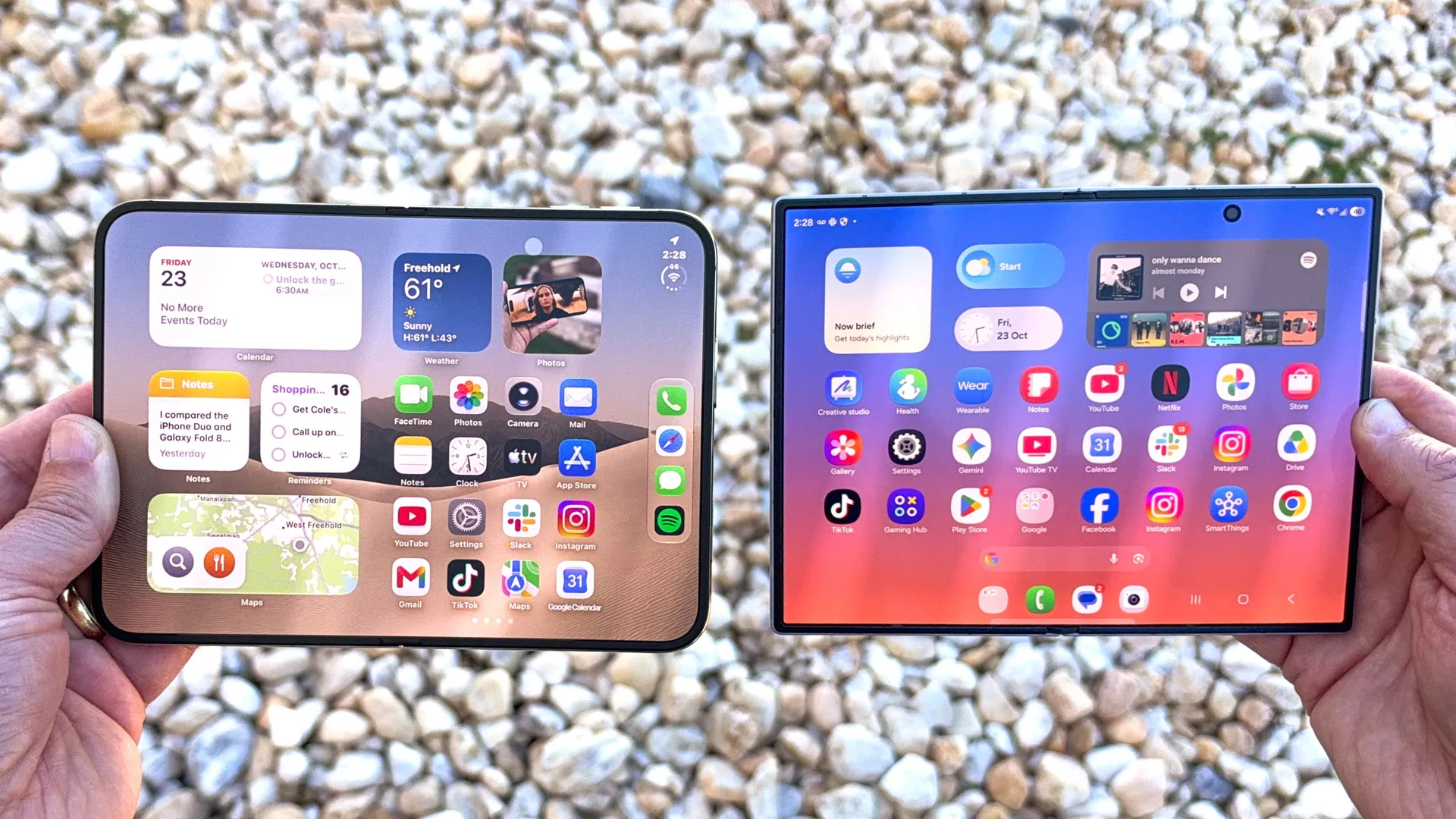
Three articles reveal different sides of the same story: Apple has entered the foldable smartphone market with a device that can rival Samsung in performance, cameras, and battery life, yet has also sparked debate over its display, weight, and software limitations. This contrast matters beyond a comparison of two phones: it shows that in a mature category where Samsung has been building experience for nearly a decade, an impressive debut alone does not guarantee superiority. Amid the heated discussion around Apple’s new device, the company is also changing more mundane processes—for example, how it checks returned products—in an effort to guard against fraud while making customer service less awkward.
In its comparison of the iPhone Duo and Galaxy Z Fold 8, Apple comes across as a strong newcomer, but not an undisputed leader. According to the publication’s tests, the Duo significantly outperforms Samsung in general computing performance: it scored 4,007 in the single-core Geekbench 7 test and 11,363 in the multi-core test, compared with 2,978 and 9,811 for the Fold 8. Apple also holds an advantage in the graphics test. Battery life proved another strong point for the Duo, lasting 13 hours and 20 minutes versus 10 hours and 6 minutes in the reported test. The authors say its camera more often renders scenes naturally and produces sharper photos in low light.
But the numbers do not add up to a clear-cut victory. Samsung edged ahead in the AI processing test, and its foldable is lighter and thinner: 201 grams and 4.5 mm when unfolded, compared with 254 grams and 5.2 mm for the iPhone Duo. What’s more, Samsung offers more advanced multitasking, with up to three apps on a split screen, floating windows, and DeX mode, which turns the phone into something like a desktop computer. The Duo supports Apple Pencil and offers several ways to use the screen when partially folded, but its interface is less flexible for now. In other words, Apple makes a compelling case as a maker of fast, long-lasting phones, while Samsung retains an edge in developing the foldable form factor as a work tool.
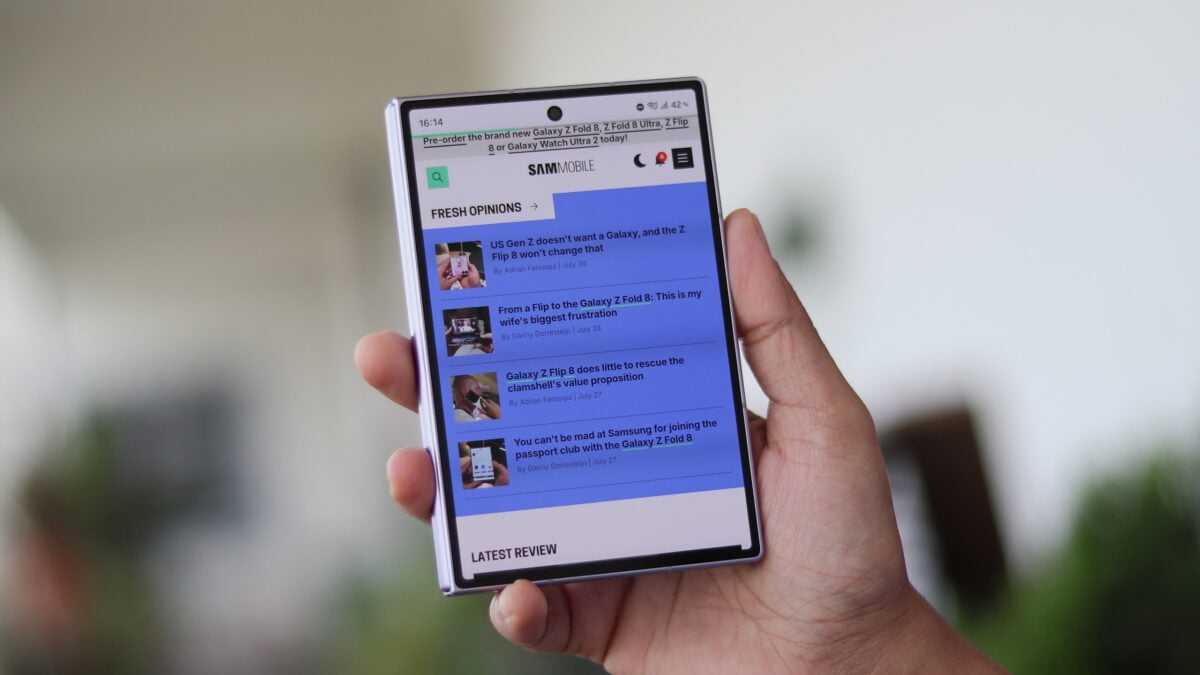
The difference is most striking in the display. Apple equipped the Duo with Nano Texture, a microscopic surface treatment intended to diffuse incoming light and reduce glare. The idea is clear: make the foldable screen easier to read in bright light and make the crease less noticeable. But a SamMobile article describes user complaints and comparisons in which the Galaxy Z Fold 8’s screen looks more contrasty and sharper. According to the article, Nano Texture sometimes diffuses too much light, making the image look blurry and washed out; the coating is also harder to keep clean. This is not a comprehensive assessment of the display, nor proof that the coating is equally inconvenient for everyone, but it does point to a real trade-off: reducing reflections may come at the expense of perceived sharpness and color saturation.
This is where Apple’s ambition runs up against Samsung’s experience. Apple wanted not merely to launch a foldable iPhone, but to show that its long wait to enter the market had been justified by a distinctive solution. But a new technology is not always an advantage in everyday use. According to Tom’s Guide, Samsung’s main display is brighter, and its anti-reflective coating better preserves the impression of a vivid image. The Duo, meanwhile, offers better dust and water protection, with an IP68 rating compared with the Fold 8’s IP48. Both models have 7.6-inch displays, but differ in their form, weight, and approach to using a large screen in software.
The contest extends beyond the devices themselves. SamMobile notes that the Samsung Mobile U.S. account seized on the social media discussion of Nano Texture, replying to a screen comparison with the quip: “Thanks for shedding some light on this.” It’s an example of how technical features become a marketing tool: a competitor’s weakness can quickly become part of a brand’s public image. But remarks like these are no substitute for independent testing, and SamMobile’s barbed tone should be read with its interest in comparisons with Samsung in mind.
There is also a practical indicator of Apple’s position: according to Tom’s Guide, demand for the iPhone Duo was so high that it sold out at carriers and retailers, while the Galaxy Z Fold 8 remained available and was discounted in some places. Strong demand reflects the power of the brand and interest in the first foldable iPhone, but it does not, by itself, answer the question of which product is better. Scarcity can reinforce a sense of exclusivity while also inconveniencing buyers who have to wait for stock.
Against this backdrop, Gizmodo’s article about returns highlights a less visible but related aspect of Apple’s strategy: managing trust and risk around expensive electronics. According to Gizmodo, Apple Stores may soon begin using devices that can check an iPhone inside its sealed box. In the past, employees often opened the packaging before processing a return because the company feared that a customer might have removed the device or its components and resealed the box. An in-store check could let staff put the product back on the shelf without sending it for additional inspection—and spare the customer an experience that feels like being publicly suspected of fraud.
Like Nano Texture, this system illustrates a characteristic Apple challenge: making a process both controlled and unobtrusive for the customer. In one case, the company is trying to verify the contents of a box without opening it; in the other, to reduce glare and the visibility of the crease with a specially treated screen surface. Both ideas aim to improve the user experience, but their value depends on how well they work. Gizmodo explicitly notes that the new check will be useful only if it does not mistakenly flag a returned phone. Likewise, an anti-glare coating’s benefits are questionable if they come at the cost of lower contrast.
Ultimately, the broader story in these articles is not simply the rivalry between Apple and Samsung, but a test of how far companies can go in trying to rethink the user experience. Apple excels in performance, battery life, cameras, and demand for its new device, but Samsung remains more convincing in terms of lightness, multitasking, and—according to the cited assessments—the image quality of the inner display. The choice depends on what buyers value: those who prioritize Apple’s ecosystem, speed, and battery may prefer the Duo; those who value a more compact design, Android’s flexibility, and mature large-screen features may find the Fold 8 more appealing. The broader takeaway is that foldable devices are about more than simply bending a screen: what matters is how well the manufacturer brings together the design, coating, software, and everyday customer service.