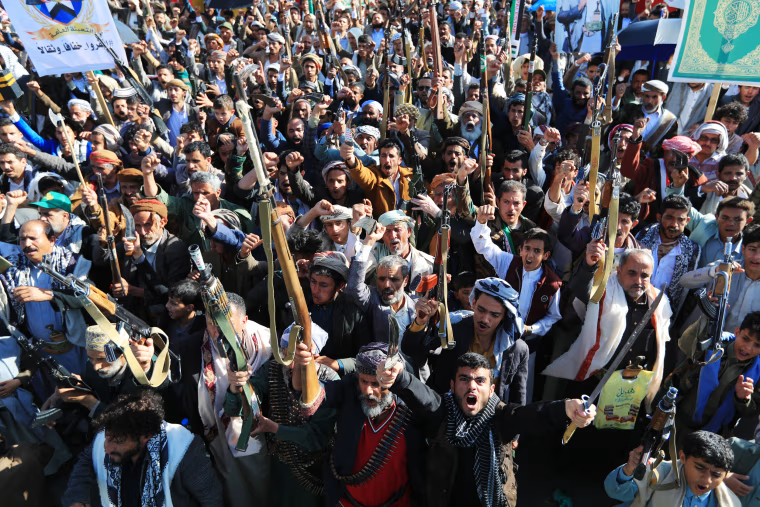
Saudi Arabia faces a paradox: the country possesses one of the world’s most expensive and technologically advanced military arsenals, yet it cannot reliably protect its cities, airports, and oil infrastructure from attacks by a significantly weaker opponent. The latest escalation around Yemen shows that the conflict increasingly resembles something other than a conventional war between a state and an insurgent movement. It has become a war of attrition, in which cheap drones and missiles allow the Houthis to inflict politically and economically painful blows, while Saudi airstrikes risk expanding the conflict without addressing its root causes.
As reported by The Washington Post, the attacks are occurring at a particularly sensitive moment for Riyadh. Saudi leaders are seeking to present the country as a safe center for investment and international business. In recent weeks, JPMorgan Chase CEO Jamie Dimon and BlackRock CEO Larry Fink made highly publicized appearances at major investment conferences in the capital. These events were intended to highlight the kingdom’s economic potential, but strikes on an airport and threats against oil facilities undermine precisely the image of stability Saudi Arabia is trying to project to the world.
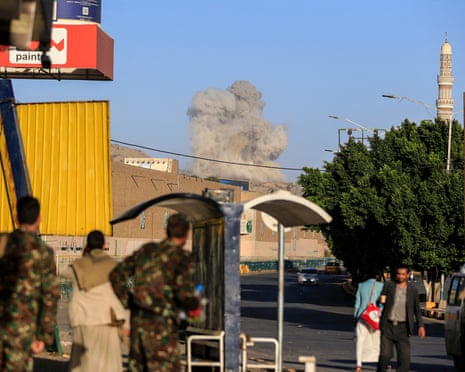
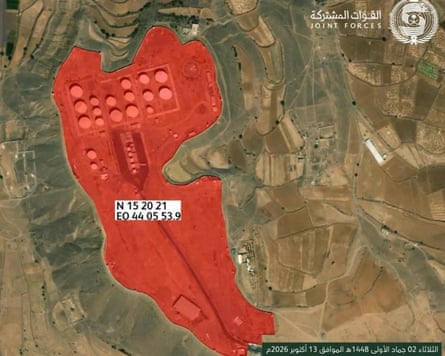
According to The Guardian, Saudi Arabia carried out a series of strikes on oil storage facilities near Sana’a, as well as on Houthi targets at the port of Ras Isa and in northern Yemen. In response, the Houthis said employees and civilians near Saudi Aramco facilities in Riyadh should leave, calling the sites “legitimate targets.” Later, the Saudi-led coalition said it had intercepted a missile heading toward Dhahran, where Aramco’s headquarters is located. Missile debris fell in a residential area, while the building was evacuated, according to Reuters sources.
This sequence of strikes and threats shows that energy infrastructure has become the central battleground. Saudi Arabia’s economy depends on oil exports, and the Houthis do not need to physically destroy major fields or refineries. It is enough to temporarily shut down an airport, disrupt logistics, force companies to evacuate personnel, or increase fear of future attacks. Even limited damage can lead to higher insurance costs, delivery delays, and investor doubts about the kingdom’s reliability.
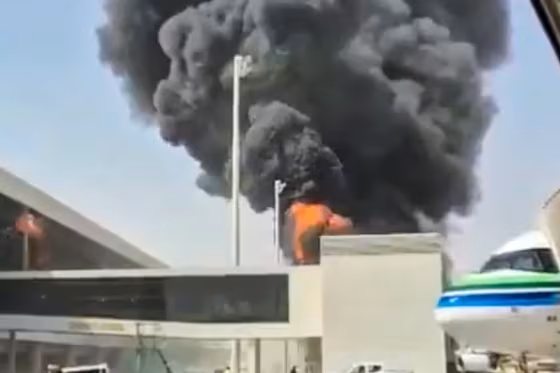
The strike on King Khalid International Airport in Riyadh was particularly significant. According to The Guardian, the attack killed 13 people and injured around 300, after which the airport was closed at least until Saturday. NBC News reported at least 14 deaths in the latest attacks, as well as saying that schoolchildren and company employees were forced to remain at home. The Houthis are therefore affecting not only military targets but also the daily lives of civilians, turning security into a source of public pressure.
Riyadh’s main problem is not a lack of weapons, but the limitations inherent in air-defense doctrine itself. Saudi Arabia is among the largest buyers of American weapons: from 2021 to 2025, it accounted for about 12% of U.S. arms exports. Its arsenal includes F-15 fighter jets, Patriot systems, advanced radars, and other equipment. The kingdom’s military budget for 2026 amounted to $83 billion, and it previously signed a $9 billion agreement with the United States for the delivery of 730 Patriot interceptor missiles.
Nevertheless, as NBC News notes, Saudi Arabia must defend an enormous territory—roughly three times the size of Texas—with a more than 800-mile border with Yemen. Oil facilities, military bases, airports, and cities are scattered across sparsely populated desert regions. No system can guarantee the interception of every drone or missile, especially when an adversary uses dozens or hundreds of targets simultaneously.
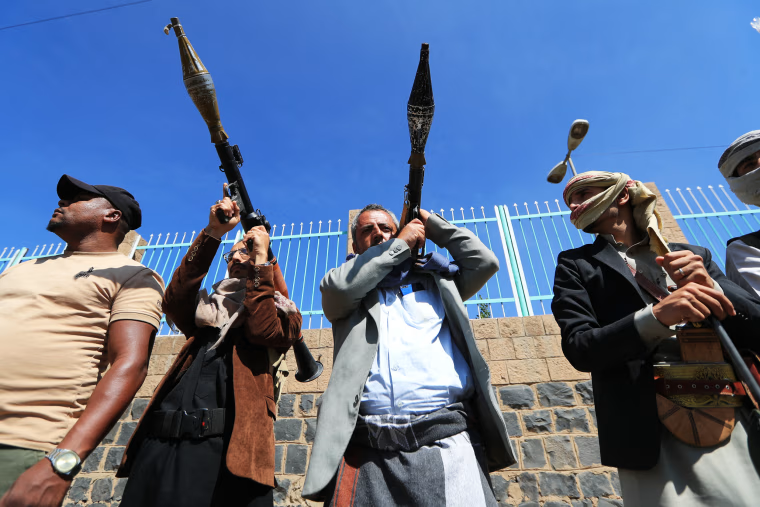
This is where the Houthis’ key advantage— asymmetric warfare—becomes clear. The term refers to a strategy in which the weaker side does not attempt to defeat a stronger opponent in direct combat, but instead exploits its vulnerabilities. Saudi Arabia spends millions of dollars on each defense system and on costly interceptor missiles. The Houthis, by contrast, need relatively inexpensive drones and missiles that only have to break through occasionally. If an attack forces Riyadh to spend far more on defense than the attacking side spends preparing the strike, the balance gradually shifts in the Houthis’ favor.
The Yemeni group is also adapting its tactics. Bar’aa Shiban, an expert at the Royal United Services Institute, warned that the Houthis have learned to launch “drones that fly lower, are smaller in size, and are harder to detect.” This is particularly important for air defenses: a small, low-flying drone can blend into the terrain and appear on radar only at the last moment. Even if most targets are destroyed, a few drones that get through can cause disproportionately large damage.
Geography also works in the Houthis’ favor. They operate from neighboring Yemen, while their targets are located inside a vast country. Saudi aircraft retain near-total dominance of Yemen’s airspace, but that does not mean Riyadh controls the consequences of the war. The kingdom can launch powerful strikes against warehouses and oil facilities, but it cannot completely stop the flow of inexpensive missiles and drones across its long border. This creates a classic defensive problem: the attacker needs to find only one breach, while the defender must be prepared for an attack everywhere.
Saudi Arabia’s retaliatory operation therefore has a mixed effect. On the one hand, strikes against oil storage facilities and command centers are intended to deprive the Houthis of resources and demonstrate that attacks will carry a price. On the other hand, the destruction of energy infrastructure increases the risk of a humanitarian crisis and further regional escalation. If the Houthis are indeed continuing their advance in southern Yemen, including toward the city of Taiz, the conflict could shift from an exchange of long-range strikes to a large-scale ground offensive.
Taiz has both strategic and humanitarian significance. According to The Guardian, the Houthis have approached the outskirts of the city and are shelling residential areas. Medical workers warn of shortages of medicines for intensive-care patients. Government forces are sending reinforcements to areas around Lahij, but the anti-Houthi coalition inside Yemen remains divided.
This fragmentation is another reason Saudi Arabia’s military superiority has not translated into political victory. Riyadh supports the internationally recognized government, but its allies pursue different goals. The Southern Transitional Council, for example, is fighting the Houthis while also seeking the separation of southern Yemen from the northern part of the country. Its leader, Aidarus al-Zoubaidi, called for mobilization to defend the south while reaffirming his intention to hold a referendum on South Yemeni independence in the future.
This creates a difficult dilemma for Saudi Arabia. The Southern Transitional Council may prove a more effective military force against the Houthis than the government of President Rashad al-Alimi. But legitimizing the council and allowing al-Zoubaidi to return to the country could destroy Yemen’s fragile political balance and lead to its breakup. By supporting separatists, Riyadh could strengthen its short-term defenses while simultaneously creating another long-term conflict.
The American factor adds to the uncertainty. President Donald Trump said the Houthis were “behaving very badly” and linked their actions to an attempt to influence the upcoming U.S. midterm elections, but he did not announce new American strikes. According to NBC News, Washington is considering joining the Saudi attacks. But direct U.S. intervention could have limited military effectiveness while strengthening the Houthis’ argument that the conflict is a struggle against American-Saudi pressure.
This points to a broader political question: what exactly does Riyadh want to achieve—a victory over the Houthis or an end to the war? If the goal is the group’s complete defeat, Saudi Arabia will have to continue an expensive campaign without any guarantee that the strikes will stop the attacks. If peace is the priority, large-scale bombing of Houthi infrastructure may only push negotiations further away. The parties are already demonstrating a willingness to strike energy facilities, which usually signals a shift toward mutual punishment rather than a search for compromise.
The situation has consequences far beyond Saudi Arabia and Yemen. The Houthis have previously seized important areas near the Bab el-Mandeb Strait, a critical route for transporting oil and other cargo through the southern Red Sea. Any sustained disruption to shipping raises transportation costs, lengthens delivery times, and creates additional risks for global energy markets. At the same time, the threat to Saudi Aramco has symbolic significance: the company is not only the kingdom’s largest national business but also a key source of revenue for the Saudi state.
The main conclusion from all three reports is that modern technology does not eliminate the political and geographic limitations of war. Saudi Arabia may possess advanced aircraft, radar, and missile-defense systems, but it cannot turn its vast territory into an impenetrable shield. The Houthis, by contrast, cannot match the kingdom’s resources, but they can use relatively inexpensive weapons to undermine confidence, disrupt the economy, and pressure society.
The current escalation also shows that military power does not guarantee strategic control. Saudi strikes may destroy individual warehouses, command posts, and oil facilities, but they do not eliminate the causes of the conflict: the struggle for power in Yemen, regional rivalry with Iran, the division between the country’s north and south, and the absence of a unified anti-Houthi camp. As long as these causes remain, every new setback for the Houthis may simply force them to shift toward more covert and less expensive forms of attack.
The consequences for Riyadh are especially serious. The war now threatens not only the border but also the kingdom’s ambitious economic modernization project, associated with the Vision 2030 program. Investment conferences and international deals require a demonstration of predictability. A closed airport, the evacuation of Aramco’s headquarters, and the need to ask allies for additional interceptors create the opposite impression.
Saudi Arabia’s most important crossroads therefore lies not in choosing the next target for an airstrike, but in defining the limits of a military approach. Continuing the war may temporarily reduce the intensity of individual attacks, but it cannot guarantee security. Negotiations, by contrast, may look like a concession to the Houthis, yet they could reduce the threat to cities, energy infrastructure, and investment. As the sides trade strikes against oil-related facilities, the conflict is following its most dangerous trajectory: the cost of war is rising for everyone, while the path to a political settlement is becoming increasingly narrow.