In the material presented, the focus is not so much on the war itself as on its consequences for the regional order: the Persian Gulf states are forced to rebuild relations with Iran, the United States, and even Israel—not based on trust, but on the need to reduce risks. The most meaningful and unifying thread here is the pragmatization of foreign policy in a crisis. It is this, above all, that helps explain why the six countries of the Gulf Cooperation Council perceive the U.S.-Iran understanding as a welcome opportunity for de-escalation—not as a reason to move closer to Tehran. Against this broader backdrop, the other reports look like reminders that international and domestic security today are both simultaneously fragile: from devastating earthquakes in Venezuela to a local crash that blocked a highway in North Carolina.
The main Al Jazeera piece shows that the Gulf countries have long lived in a mode of forced balancing. The Gulf Cooperation Council, or GCC, was created in 1981 as a collective response to fear of the expansion of Iran’s new regime after the 1979 revolution. Yet the current dynamic is paradoxical: Israel and the United States’ attempt to isolate Iran and its network of regional allies has not strengthened the region’s resilience; instead, it has pushed some of the Arab monarchies toward more cautious—and in some cases closer—engagement with Tehran. As researcher Fara al-Kawassmi notes directly, the ongoing conflict has “forced the Gulf states to seek more pragmatic relations with Tehran,” meaning dialogue that is needed not for trust, but to contain escalation.
This important distinction matters: de-escalation is not the same as reconciliation. The article repeatedly emphasizes that the six GCC countries welcomed the memorandum of understanding between Iran and the United States signed last week because it could stop the war—not because they have begun to see Iran as a reliable partner. In other words, for Riyadh, Abu Dhabi, Doha, Kuwait, Manama, and Muscat, the priority remains not strategic rapprochement with Iran, but minimizing threats: drone strikes, missile attacks, pressure on shipping, and the use of proxy groups. British expert Rob Geist Pinfold puts it especially clearly: for the Gulf capitals, “the nuclear program is a problem for tomorrow,” while “the problem of today is Iran’s use of drones and proxies to destabilize and undermine sovereignty.” This logic explains why the Washington-Tehran agreement is of interest to the region primarily as a mechanism to limit immediate threats, not as a diplomatic victory in a narrow nuclear issue.
From this follows another key line: the current negotiations give the Gulf countries more influence than in 2015, when the nuclear JCPOA was reached. According to Mehran Haghirian, the Gulf states “are at the very center of the negotiations.” This is especially visible through Qatar’s role as mediator and through the fact that security issues were built into the content of the memorandum. The author points to Articles 5 and 6 of the agreement, where topics that directly concern the region appear in practice: the fate of the Strait of Hormuz, possible shipping fees, and the idea of a regional investment fund for Iran. Here, too, the logic of a new regional policy becomes clear: the Gulf countries do not just want to watch the talks; they want to be co-authors of the rules by which their own neighborhood with Iran will live.
The Strait of Hormuz is an especially sensitive issue. It is one of the world’s most important maritime routes through which a significant share of global oil and gas passes. If Iran tries to establish unilateral control there or introduce its own fees, that would become a direct challenge to the GCC. That is why Haghirian rightly warns that “there can be no new Hormuz authority on the part of Iran that does not include other GCC countries.” In this context, disputes over who would finance a potential Iranian reconstruction fund look less like a bookkeeping detail and more like a question of political weight and symbolic recognition. Statements by J.D. Vance about possible funding by Gulf states, followed by Marco Rubio’s subsequent clarification that regional allies would not be asked to make such a contribution, show how sensitive this storyline is for the Arab monarchies. Even Qatar’s prime minister describing the $300 billion figure as “aspirational”—more wishful than realistic—demonstrates that, for now, the matter is not about ready-made obligations, but about bargaining and political signals.
Another important thread in the material is the absence of a unified position within the GCC itself. It is not a monolithic bloc, but a group of states with different historical experiences and different degrees of concern regarding Iran. Oman, Qatar, and Kuwait traditionally viewed the JCPOA much more favorably, while Saudi Arabia, the UAE, and Bahrain were more skeptical, even though they publicly supported the agreement. After the U.S. left the JCPOA in 2018, some of these countries began to see Washington as a new hardline ally and believed they had “found a partner in DC,” as Haghirian puts it. This led to a period of “maximum pressure era,” when sanctions, threats, and displays of force became the dominant model. But, as is often the case in international politics, pressure generated not only escalation, but also a reassessment of one’s own risks. The attacks on Saudi Arabia’s Abqaiq-Khurais oil facilities and on ships off Fujairah in 2019 were not just Iran’s response to the pressure campaign; they also proved how vulnerable the Gulf states remain to asymmetric instruments of influence. After that, a visible course correction began: the restoration of UAE-Iran ties in 2022, and then the Saudi-Iranian agreement mediated by China in 2023.
In today’s war, this logic has accelerated. Israel, according to the article, used the conflict to try to strengthen its own presence in the region, including through reports about deploying an Iron Dome battery in the UAE. But for the Gulf states, and for Israel and Iran alike, these are sources of instability rather than clear partners. Pinfold emphasizes that first Israel started the war with a destabilizing act, then Iran responded by attacking the Gulf states—creating a chain reaction of mutual threat escalation. At the same time, the key political takeaway is that even after direct strikes on their territory and infrastructure, the states maintain patience and choose a negotiating line. Qatar, for example, continued mediating between the U.S. and Iran even after it itself was targeted by drone and missile attacks. Haghirian notes that “the fact that all six were attacked” is already a level of decision-making at which it becomes extremely difficult for states not to respond with force. But that is precisely where the new pragmatism emerged: instead of symmetric retaliation, they preferred to speak on their own behalf at the negotiating table and seek to have their interests formalized through diplomacy. His final formulation is accurate: “This war has indeed triggered a full reshaping of the entire region.”
Looking more broadly, this material shows how regional elites are moving from ideology-driven policy to risk-management policy. The Gulf countries no longer have illusions that Iran as a security factor can be fully eliminated, and at the same time they do not consider it possible to rely solely on American power pressure. Hence the emphasis on multilateral channels, on intermediaries such as Qatar, on partial understandings, and on a format in which their interests are built into the text of agreements. This does not mean trust in Tehran; it means recognizing that proximity is unavoidable, and therefore must be managed.
That is why the key conclusions from the first report are as follows: today’s de-escalation in the Persian Gulf is not “peace” in the classic sense; it is more like temporary conflict management; the GCC countries are not seeking friendship with Iran, but reducing vulnerability; the Strait of Hormuz remains the central node of geo-economic pressure; and the GCC’s internal diversity makes regional diplomacy flexible but also complex. In practical terms, this could lead to a more active role for Qatar and Oman as mediators, cautious rapprochement by individual monarchies with Tehran, and attempts by the U.S. to prevent allies from feeling that Iran has achieved a strategic victory.
The second and third materials stand apart thematically, but they also remind us of another important reality: the world of news is always made up of multiple layers of vulnerability. CGTN’s report on powerful earthquakes in Venezuela—where, according to acting president Delcy Rodríguez, at least 164 people died and 971 were injured—shows how quickly a natural disaster turns into a national-scale crisis. Two shocks measuring 7.2 and 7.5 in magnitude, followed by dozens of aftershocks, forced authorities to declare a state of emergency and launch large-scale rescue operations. What matters here is not only the fact of destruction, but also that events like these test the resilience of a state no less than military conflicts do: the ability to respond quickly, coordinate assistance, and minimize losses becomes a question of political legitimacy and public trust.
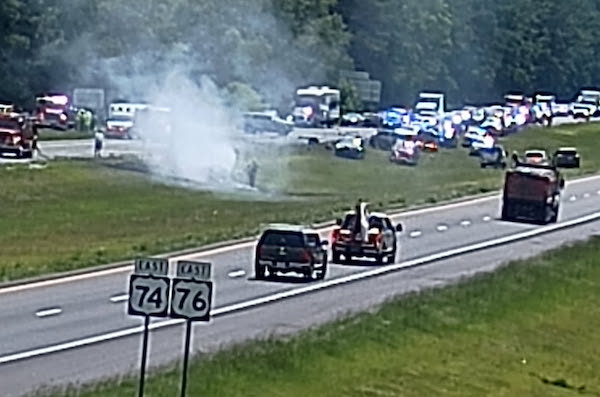
The third story from Columbus County News—about a serious crash involving a deputy sheriff on U.S. 74 near Hallsboro—may seem local at first glance, but it also fits into the overall picture of everyday fragility. One person was seriously injured, a car that caught fire ended up in the median, and the westbound lanes of the highway were closed. Such news rarely becomes part of big geopolitics, but it illustrates how infrastructure and transportation safety are essential to everyday life—and how quickly a local incident can paralyze traffic and the work of services. In this sense, all three materials, despite differences in scale, say the same thing: resilience is always the result of crisis management—whether it is war, an earthquake, or an accident.
Some difficult-to-understand concepts are also worth clarifying here. The GCC, or the Gulf Cooperation Council, is a regional bloc of six monarchies: Saudi Arabia, the UAE, Qatar, Kuwait, Bahrain, and Oman. JCPOA stands for the Joint Comprehensive Plan of Action—meaning the 2015 nuclear deal between Iran and the world powers that limited Tehran’s nuclear program in exchange for easing sanctions. “Maximum pressure” is a strategy based on sanctions and tough political and economic coercion. Proxy groups are armed or political allies of a state that act indirectly and allow it to exert influence in the region without direct official involvement. The Strait of Hormuz is a narrow and strategically critical maritime corridor between the Persian and the Gulf of Oman. “De-escalation” means reducing the level of tension and the risk of direct confrontation, but it does not necessarily eliminate the root causes of the conflict.
If everything is reduced to one conclusion, the materials show a shift from the politics of symbolic camps to the politics of forced interdependence. The Gulf countries can no longer afford full confrontation with Iran, nor blind faith in U.S. protection, nor unconditional rapprochement with Israel. Therefore, they choose the most realistic path—though not the most comfortable one: to talk with everyone, avoid direct confrontation, and, where possible, build their own security into any future deals. That shift—from ideology to cautious calculation—is what defines the region’s new political landscape.