Three articles show how personal loyalty, security threats and technological competition are becoming part of a single political narrative in contemporary America. In each case, authorities or actors linked to them seek to portray a complex and ambiguous situation as a struggle for control—over elections, an aircraft or artificial intelligence. At the same time, key decisions are accompanied by a lack of certainty: voters do not know whether Angela Paxton supports her husband, investigators have not yet established the motives behind the attack on board the aircraft, and the Trump administration has not explained exactly what powers the new AI development body will have.
A common theme in these stories is the effort to mobilize society around a threat while demonstrating that the state is capable of containing it. However, the articles also highlight the gap between political rhetoric and verified facts.
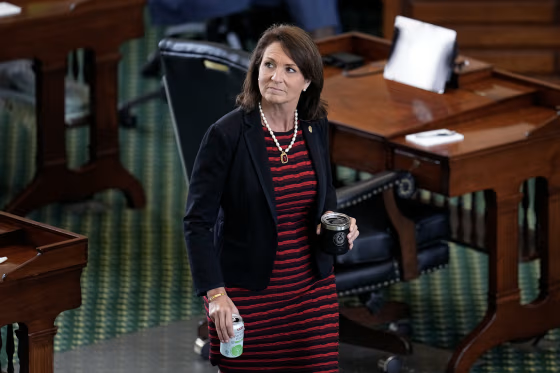
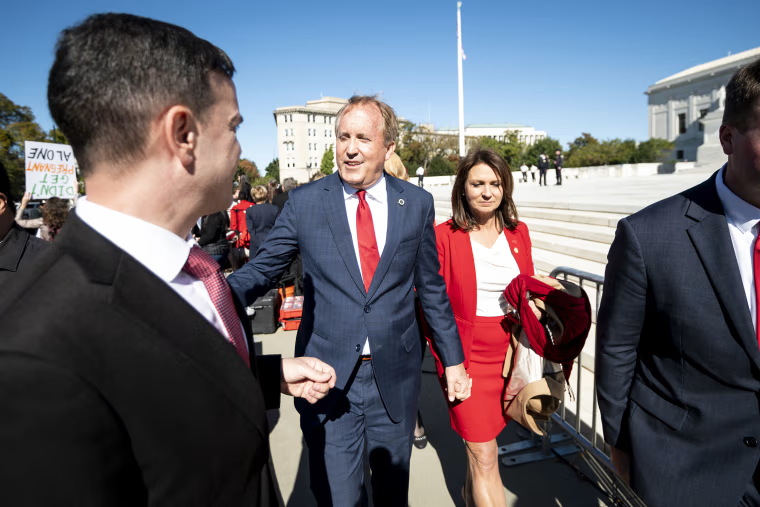
In the NBC News article about the Texas Senate race, it is especially clear how party solidarity is being used to overcome an individual candidate’s reputational crisis. State Senator Angela Paxton urged voters to support the entire Republican ticket but deliberately did not name her husband, Ken Paxton, who is running for a Senate seat. Her formulation—“it’s less about individual players and more about making sure the whole team crosses the finish line”—shifts the conversation from the candidate’s personality to collective party responsibility.
This is particularly revealing given the couple’s family conflict. Angela Paxton filed for divorce, citing “biblical grounds,” while her husband’s political career has been accompanied by allegations of abuse of office and bribery. In 2023, the Republican-controlled Texas House impeached him, but the state Senate acquitted him. Allegations of marital infidelity, which Ken Paxton denied, were also discussed during the proceedings.
Angela Paxton’s campaign ad is therefore built on deliberate ambiguity. She refers to “the elephant in the room”—a problem everyone can see but avoids discussing directly. At the same time, it remains unclear whether she personally intends to vote for her husband. This strategy allows her to avoid breaking with the Republican Party while also avoiding clear public responsibility for supporting a specific candidate.
The conflict between party loyalty and personal reputation has become the central issue in the race. Paxton’s daughter, Mattie Hayworth, by contrast, appeared directly in her father’s campaign ad with her husband and children. She portrayed him as a defender of families and a fighter against rising prices, while associating his opponent, James Talarico, with “liberal politicians.” Family appearances here serve not only an electoral but also a reputational function: they are intended to show the candidate as someone who retains the support of those closest to him despite the scandals.
However, polling indicates that this strategy has not yet guaranteed success. According to an NBC5 Dallas/Telemundo poll, Talarico had 46% support, compared with 43% for Paxton; another 8% of voters remained undecided. The gap was formally within the margin of error, but the very fact that the race is competitive matters in Texas—a state where Republicans have not lost a statewide election since 1994 and Democrats have not held a U.S. Senate seat since 1988.
Donald Trump’s support gives the campaign national significance. The president endorsed Paxton in the Republican primary over Senator John Cornyn, while his super PAC, MAGA Inc., invested millions of dollars in the race. Trump has repeatedly said that Paxton “has to win.” This turns the election into more than a contest for a Senate seat: it is also a test of Trump’s influence over the Republican electorate and party apparatus.
The second article—an NBC News report on the attack aboard a Flydubai flight—transfers the same question of control into the realm of physical security. According to preliminary information, the co-pilot attacked the captain with a fire axe and attempted to gain access to the aircraft’s controls while the plane was flying from Dubai to Tel Aviv. There were 174 passengers on board, most of them Israeli citizens. A disaster was averted after crew members and passengers intervened and subdued the attacker.
U.S. officials and Shalom Ben-Hanan, a former Israeli security official, said the suspect probably acted alone. Ben-Hanan described the incident as an example of “lone-wolf terrorism” inspired by material found online. The term “lone wolf” refers to an attacker acting independently, without a proven direct connection to a terrorist organization or state. However, this preliminary classification does not mean the investigation is complete.
Emirati authorities emphasized that they were still determining the suspect’s “full circumstances, motives and connections.” Israeli Prime Minister Benjamin Netanyahu had previously suggested that the attacker might have been directed by someone else. Donald Trump, meanwhile, speculated about possible Iranian involvement and threatened further strikes against Iran if such a connection were confirmed. But according to a U.S. official familiar with the investigation, no indications had been found that Iran directed or participated in the attack.
This is where the danger of premature political conclusions is particularly apparent. Until the investigation establishes the final motive and whether accomplices were involved, public statements about a possible foreign connection could quickly turn an isolated incident into an international crisis. The facts cited in the article currently point more toward an individual act than an operation by a state or organization, but a final assessment is not yet possible.
Captain Smith Macchhar played a significant role in preventing a catastrophe. He said he was seriously injured and could feel the aircraft descending, but managed to open the cockpit door, allowing passengers and crew to intervene. “I acted for my own life, but at the same time I understood that I couldn’t let them all die,” he said. The quote highlights the human dimension of the incident: safety was restored not only through procedures but also through the decisions of individuals facing extreme risk.
The third article, an ABC7 News report on the creation of the “Super Intelligence Force”, examines control at the strategic and technological level. Trump announced the creation of a federal working body intended to coordinate the government’s efforts in artificial intelligence. The president said the United States must maintain its lead in “superintelligence,” arguing that the technology could prove more significant than the Industrial Revolution and the emergence of the internet.
For now, the announcement remains primarily a political signal rather than a fully developed program. The administration has not said what specific powers the body will have, what rules it will be able to impose or how oversight of private companies will be carried out. The announced participants include Director of National Intelligence Jay Clayton, Federal Trade Commission Chairman Andrew Ferguson, Under Secretary of Defense for Research and Engineering Emil Michael, and Office of Personnel Management Director Scott Kupor.
The administration’s approach is built around the idea of technological primacy. Clayton said that “the risk of not being first is very high,” because falling behind could increase both known and unknown threats from adversaries. In this logic, AI development becomes not only an economic project but also an element of national security. The stronger American companies and the government are in this field, the better equipped they will be, in the administration’s view, to confront rivals and manage potential risks.
Yet this logic contains an inherent tension. The faster the technology develops, the greater the potential benefits—but also the greater the likelihood of mistakes, abuse and the uncontrolled spread of dangerous systems. The article notes that some technology executives support federal regulation. The White House, however, has so far emphasized coordination and industry self-regulation. Trump previously said that he had reached an agreement with six companies that had supposedly adopted a kind of “constitution” of internal-control standards.
“Self-regulation” refers to a situation in which companies develop their own safety rules and restrictions for their products, while the government participates in dialogue and establishes broad parameters. The advantage of this approach is flexibility and faster decision-making. Its drawback is a conflict of interest: companies benefit commercially from the rapid deployment of technologies while also being expected to limit the risks that could slow their growth.
Across all three stories, political rhetoric seeks to reduce a complex situation to an easily understood framework. In Texas, voters are asked to choose a “team” rather than discuss a controversial candidate. In the investigation into the aircraft attack, attention is focused on whether the attacker was acting alone or was part of an external network. In the field of AI, a national goal is offered—“win the race”—even though the content and rules of that race have not yet been fully defined.
The key trend is the expanding meaning of national security. It includes not only defense and terrorism but also political power, the information environment, technological leadership and the state’s ability to coordinate private actors. In this context, the Texas election becomes a question of the durability of a political coalition, the aircraft attack a test of crisis-response mechanisms, and artificial intelligence a long-term contest for economic and geopolitical influence.
A second important conclusion is the growing role of uncertainty. In each article, final answers are absent. It is unknown whether Angela Paxton personally supports her husband; the investigation has not established the co-pilot’s definitive motives; and the powers and operating mechanisms of the new AI body remain unclear. Nevertheless, political actors are already using these situations to mobilize supporters and shape public interpretations of events.
This creates a risk that analysis will be replaced by signals. Dramatic statements can attract attention and reinforce the image of a decisive leader, but they may get ahead of the evidence. In an election campaign, such a strategy can conceal a candidate’s reputational problems. In security matters, it can lead to accusations without sufficient evidence. In technology policy, it can replace concrete regulation with a slogan about global leadership.
The overall picture therefore presents American politics as a struggle not only over decision-making but also over who has the right to define how society should understand a threat. One actor portrays a party scandal as a test of team discipline, another presents an attack as a possible element of an international conspiracy, and another depicts AI development as a race in which delay is more dangerous than insufficient regulation. In every case, the decisive factor is the balance between the speed of response and the quality of fact-checking.
The main consequence of this approach is the further personalization of politics. Ken Paxton’s reputation, Trump’s statements, the pilot’s actions and the decisions of technology executives are treated as factors capable of changing the fate of entire institutions. But the articles also serve as a reminder that the resilience of a system depends not only on individual leaders. It is determined by the transparency of investigations, the clarity of official powers, the independence of oversight and the willingness to acknowledge uncertainty until conclusive evidence emerges.