Three reports describe events that are formally unrelated: the removal of U.S. bombers from a British base because of a possible terrorist threat, a fatal crash near Salinas, and a U.S. strike on a vessel the military believes was involved in drug trafficking. Yet they share a broader theme—the making of decisions under conditions of incomplete information and the question of how convincingly authorities justify actions capable of causing deaths or serious consequences.
In each case, official institutions disclose only part of what happened. The Pentagon has not revealed details of the threat to RAF Fairford, police are still establishing the circumstances of the crash, and the U.S. military claims that the destroyed boat was linked to drug smuggling without publishing evidence that drugs were on board. As a result, the central issue in these reports is not only the danger itself, but also the limits of public trust in official explanations.
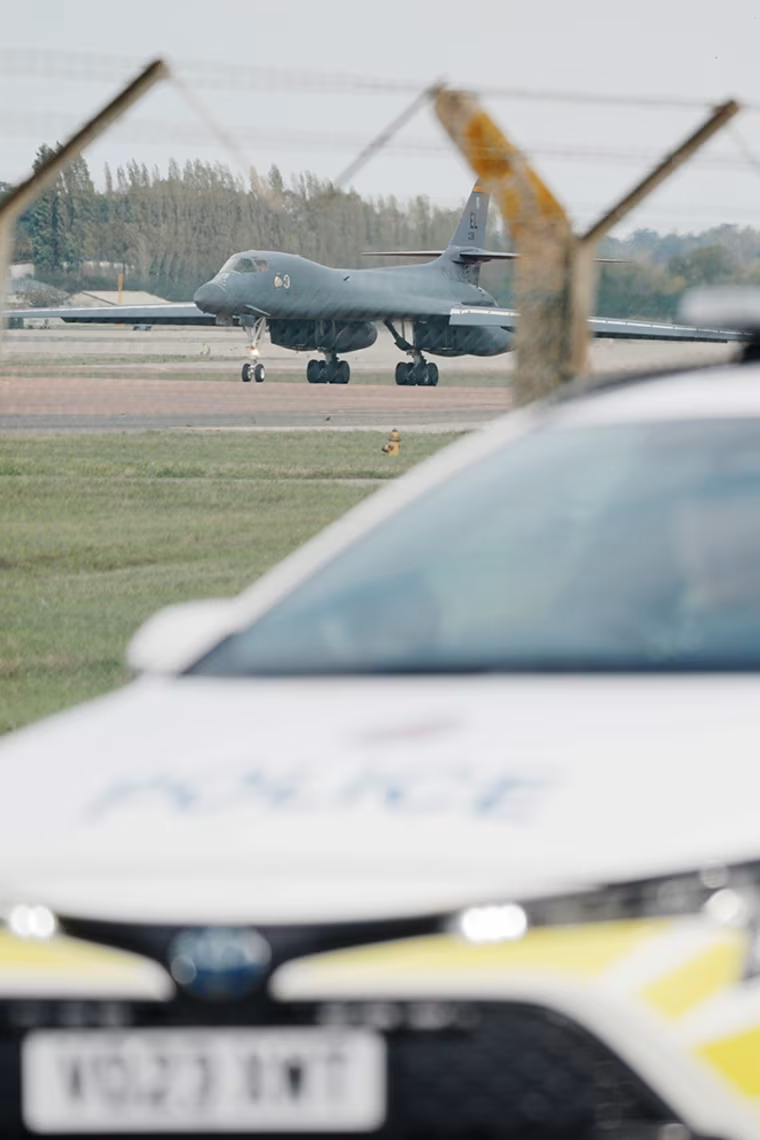
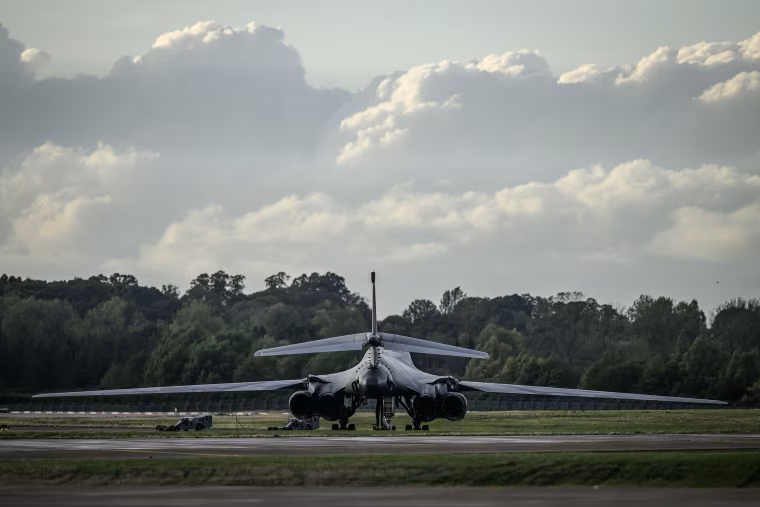
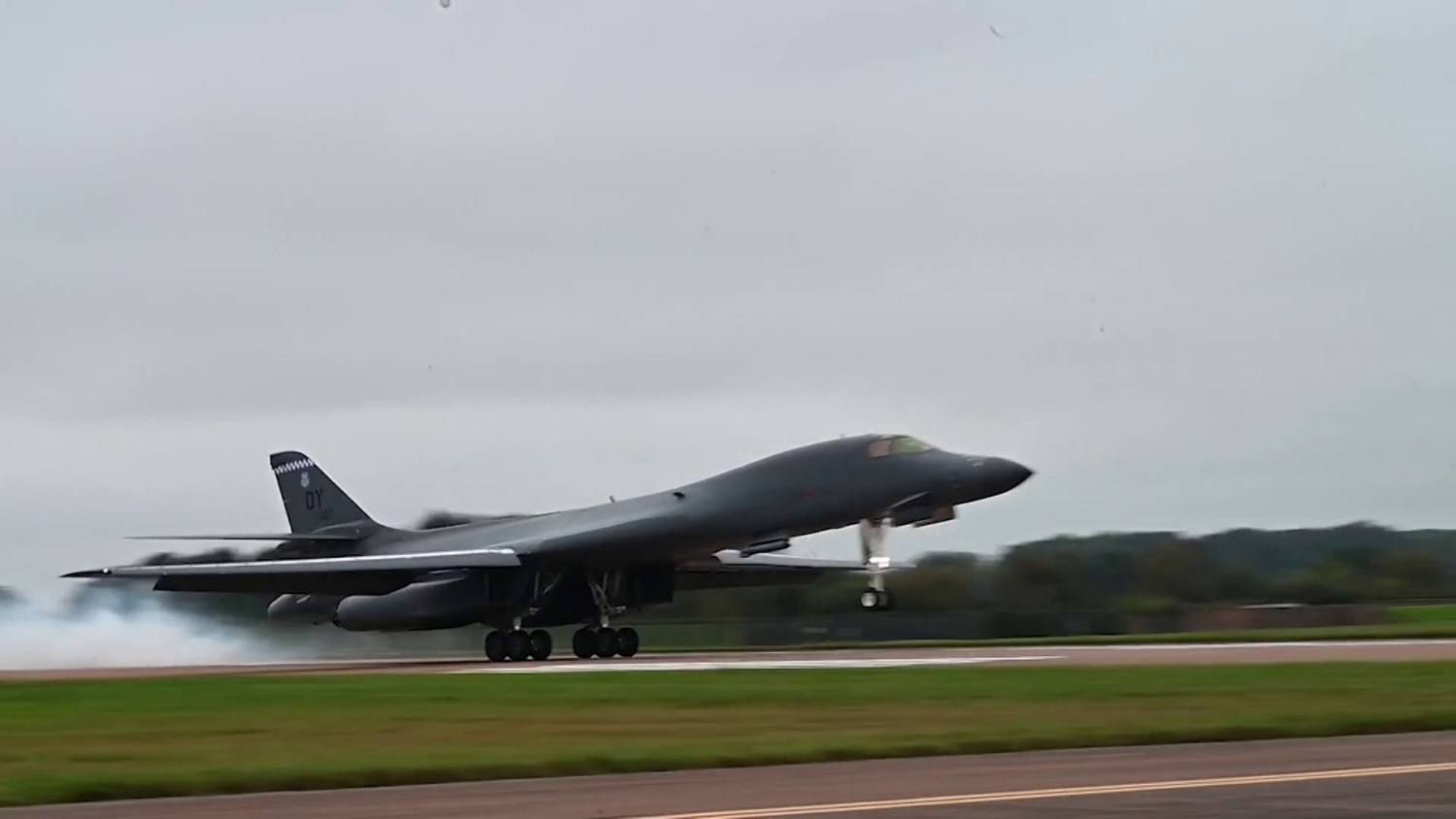
An NBC News report says that the U.S. Air Force urgently returned all bombers stationed at RAF Fairford in the United Kingdom to bases in the United States. At least 12 aircraft were involved, including planes that had only recently arrived as part of a scheduled rotation. Fairford is a U.S. military base in the United Kingdom used to station and service strategic aircraft, including B-1, B-2 and B-52 bombers.
A U.S. Department of Defense spokesperson emphasized that “all U.S. bombers deployed to RAF Fairford were relocated to their permanent bases in the United States.” The Pentagon described the decision as part of an existing body of intelligence, rather than a response to a new or changing threat. The comment both confirms the seriousness of the situation and leaves unanswered the key question: what exactly prompted the military to abandon its presence at the base at that particular moment?
Significantly, the U.S. side explained the withdrawal not as an end to readiness, but as a change in where that readiness would be maintained. The statement said that bomber crews and personnel “remain ready to provide precise global strike capabilities,” including by conducting operations from the continental United States. In other words, officials are seeking to present the relocation as a controlled adjustment rather than a retreat in the face of a threat. Yet the urgent removal of recently arrived aircraft demonstrates that even a symbolically important military presence can be rapidly reconsidered when risks become unacceptable.
The second report—KSBW—shifts attention from national security to the everyday vulnerability of civilians. A black Nissan and a white Honda SUV collided head-on on Abbott Street near Salinas, California. According to the California Highway Patrol, at least three people were killed; each vehicle was carrying at least three occupants. Six ambulances arrived at Natividad Medical Center, the nearest trauma center, while medical staff were initially warned that as many as 10 injured people might be brought in.
This report differs from the other two primarily in the nature of the information it contains. There are no geopolitical statements or public justifications for the use of force; the account is developing as information becomes available, and the circumstances of the crash are still being investigated. The phrase “this is a developing story” underscores the provisional nature of the initial picture. The number of fatalities may be revised, as may information about the injured, the causes of the collision and the possible responsibility of the drivers.
Nevertheless, the crash illustrates the same mechanism of decision-making under uncertainty. Emergency services must act before the full scale of the incident is known: closing the road, dispatching ambulances and preparing the hospital to receive a large number of patients. Unlike military statements, this response is directly focused on saving lives, but it too is based on a preliminary risk assessment and incomplete information.
The third report, published by ABC News, concerns not the prevention of a suspected threat but its destruction. The U.S. military said it attacked a boat in the Caribbean Sea that it believed was connected to drug trafficking. Four people were killed. According to the U.S. Southern Command, the vessel was traveling along known smuggling routes and was a high-speed boat, known as a go-fast vessel.
However, the report notes that the military provided no evidence that drugs were actually on board. A video posted on the social media platform X shows an explosion destroying the moving vessel, but by itself it does not confirm the nature of the cargo or the identities of those killed. This is a crucial distinction: visual evidence that a target was struck is not proof that the attack was lawful or that the object was correctly identified.
According to ABC News, since September 2025, after the start of Donald Trump’s administration campaign against those the authorities call “narco-terrorists,” at least 235 people have been killed in 70 strikes on boats. The president said that the United States is in an “armed conflict” with Latin American drug cartels and presented the military attacks as a necessary intensification of the fight against drug supplies and fatal overdoses in the United States. At the same time, the report says, the administration has provided little evidence supporting its claims that smugglers were eliminated.
The term “narco-terrorists” has not only a descriptive but also a political and legal meaning. It combines the fight against drugs with the fight against terrorism, potentially moving alleged criminals from the sphere of law enforcement into the sphere of military action. Under the conventional criminal justice model, suspects are arrested, questioned and tried; military logic permits the destruction of a target as a means of neutralizing a threat. The use of the term therefore changes how the public perceives the operation and raises the evidentiary standard: the more serious the declared status of the adversary, the more convincing the supporting evidence must be.
Taken together, the three reports show different levels of government response to danger. In the United Kingdom, authorities chose to reduce the risk by removing expensive and strategically significant assets. In California, emergency services mobilized to minimize the consequences of a catastrophe that had already occurred. In the Caribbean, the U.S. military used lethal force based on its own assessment that the vessel was connected to criminal activity.
The key trend is the expanding role of preliminary information in decision-making. In the RAF Fairford case, reports of a threat were enough to change the deployment plan for the bombers. In the maritime strike, the boat’s presumed connection to a smuggling network became grounds for an attack, even though no public evidence was presented. In the crash, preliminary information is used differently—not to punish or destroy, but to prepare the rescue system for the worst-case scenario.
This creates different costs for mistakes. If the military withdraws aircraft from a base prematurely, the consequences may include reduced operational convenience, financial costs and reputational damage. If rescuers misjudge the scale of a traffic accident, people may fail to receive the necessary assistance in time. If the military mistakenly identifies a boat as a drug-smuggling vessel, the result is the deaths of people with no possibility of subsequent judicial proceedings. Decisions based on unverified information therefore face the strictest requirements—especially in the last case.
Another common theme is limited transparency. The British Ministry of Defence declined to comment on the removal of the U.S. bombers. The Pentagon referred to existing threat information but did not disclose its contents. The U.S. Southern Command reported the outcome of the strike but presented no evidence confirming that drugs were on the vessel. In the crash case, the lack of information is explained by the ongoing investigation, while in military matters secrecy may be part of security policy. But the effect on the public is similar: audiences are asked to accept the official version without the ability to verify it independently.
The reports also demonstrate how language shapes attitudes toward events. The Pentagon speaks of “global readiness” and “precise strikes,” shifting attention from the threat to the military’s professional ability to act. The Trump administration uses the phrase “armed conflict” and the term “narco-terrorists,” giving the campaign the character of a war. In the crash report, by contrast, neutral facts predominate: the location, the vehicles, the number of fatalities, and the work of the hospital and highway patrol. These differences in vocabulary reflect different institutional objectives: the military seeks to justify a strategy, while a journalistic report on a crash seeks to document a developing situation.
The main conclusion is that modern crisis decisions are increasingly made not after all the facts have been established, but on the basis of an assessment of the likelihood of a threat. Such a model is unavoidable in intelligence, emergency response and efforts to combat criminal networks, where delay can also cost lives. But it requires proportionality, independent oversight and the subsequent publication of evidence. Without these safeguards, preventive measures may appear to be reasonable risk management, while lethal operations may look like actions shielded from scrutiny by the very status of national security.
Together, the three sources emphasize that security is not only the state’s ability to respond quickly, but also its ability to explain why that particular response was necessary. The removal of the bombers demonstrates caution in the face of a potential threat, the crash near Salinas highlights the importance of rapid coordination, and the strike on the boat illustrates the danger that arises when a use-of-force decision rests on claims the public cannot verify. The balance between speed, effectiveness and evidentiary support determines whether the fight against threats will be seen as responsible policy or as arbitrary use of force.