On the summit of the Empire State Building, several storylines converged in the space of a single day: a brazen breach at one of the world’s most recognizable skyscrapers, a public demonstration carrying an anti-establishment message, an unexpected engagement at nearly 500 meters, and an immediate police response. The story, reported by CBS News, NBC News and briefly by CNN, reads at once like a city incident, a performance, and an extremely risky act. But if you look past the flashy image, the story raises a far more interesting question: why does a symbolic act on a skyscraper instantly become a national news item, and how can the same scene be read both as a romantic gesture, a breach of security, and a kind of self-presentation in the age of social media?
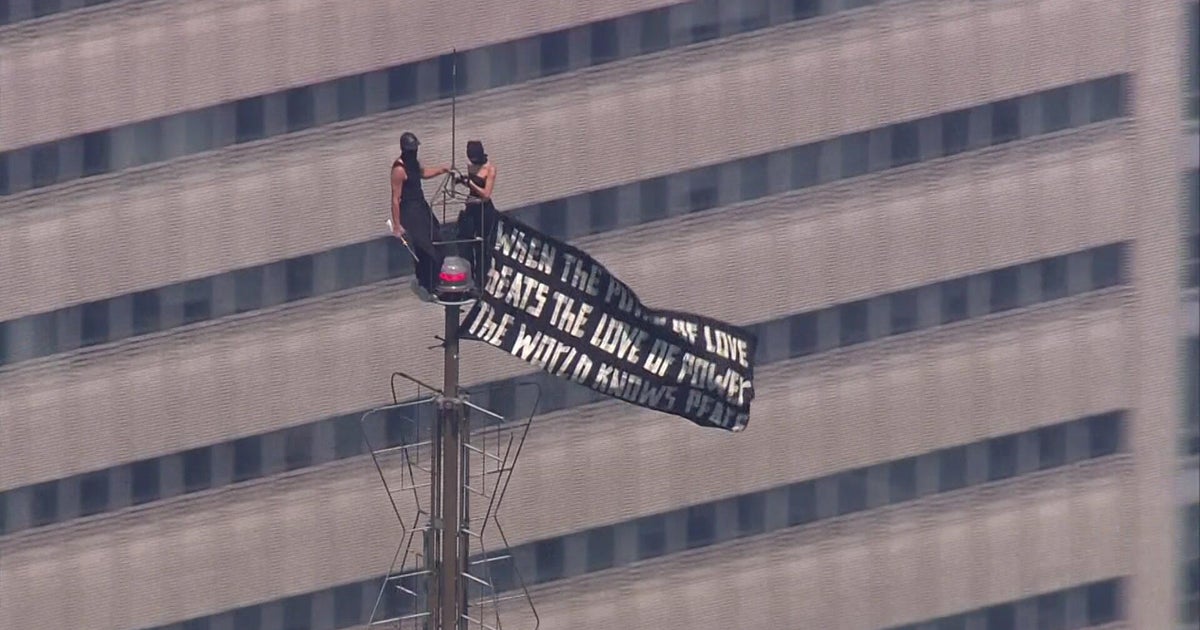
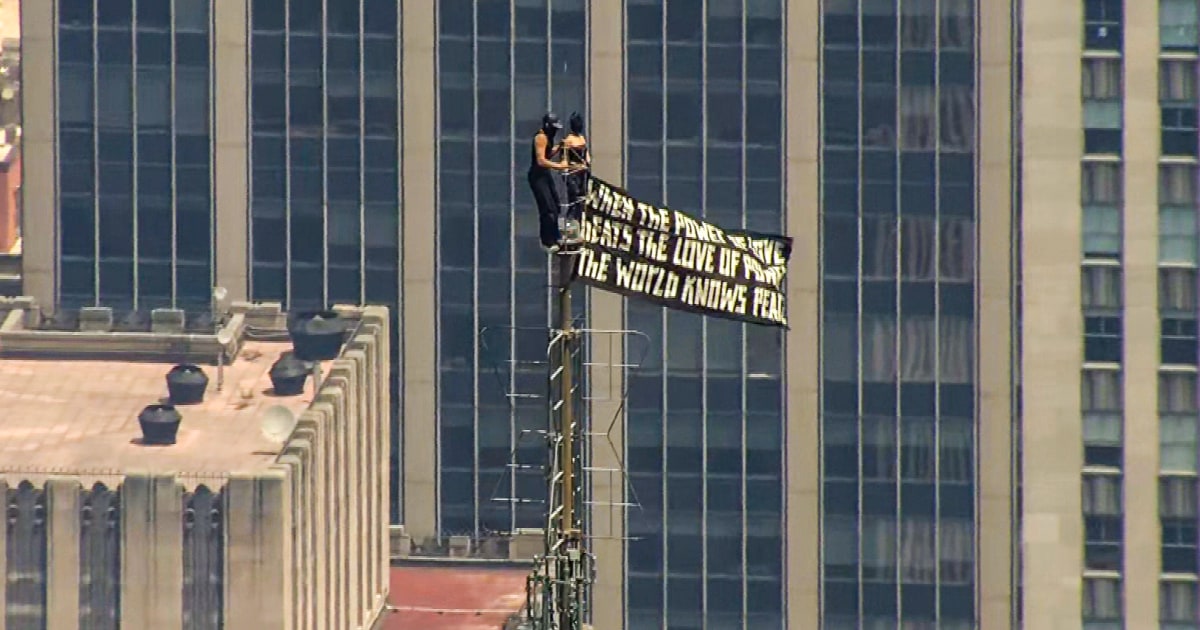
According to CBS and NBC, two people—Ivan Kuznetsov, 32, and Angelina Nikolaou, 33—climbed to the very top of the Empire State Building without permission, unfurled a black banner with white text: “When the power of love beats the love of power the world knows peace” (“Когда сила любви побеждает любовь к власти, мир узнаёт мир”), and then, from the lower platform, the man stood on one knee and, apparently, proposed. They hugged and kissed, after which they were detained. NBC reports that they were taken into custody after coming down to the street, while CBS уточняет that police are considering possible charges, including trespass and reckless endangerment—that is, illegal entry and creating a dangerous situation. The building itself said the incident was “resolved” through “constructive and useful coordination” with the NYPD and that “at the time there was no danger to tenants, visitors, and guests of the observation deck.”
It is exactly the mix of romance and danger that makes the episode so noticeable. On one hand, it has an almost cinematic scene: two people in masks, a banner, the top of one of the world’s most recognizable skyscrapers, a police helicopter, and the crowd looking up from below. On the other hand, this was not tourist-style acrobatics or an authorized stunt, but entry into a secured area via a hatch on the 103rd floor, as CBS reports. For most observers, this is where the line between a striking gesture and a wrongdoing is drawn: on the level of image it looks like “a scene from a movie,” but on the level of infrastructure it is an intrusion into an operating facility—one with electrical systems, radio frequencies, technical stairways, weather risks, and limited access.
Notably, both reports stress that at the very top was not just a decorative spire, but an active transmission tower. A former engineer for CBS News New York, John Cleary, put it directly: “There’s a lot of danger up there... It’s something that we’re trained to do. We go to classes for this ... it’s not like you climb rocks. This is a live transmission tower.” This is an important remark because it shifts the discussion from “bravery” to professional risk. For non-specialists, the height alone is already frightening, but here radiofrequency emissions, electrical infrastructure, heat, and wind are added. So externally it may look like an extreme sport, but in essence it is not a sport—it is unauthorized access to a technically dangerous environment.
At the same time, the story is not only about a violation. The fact that the banner carried a message about love defeating power, followed by an engagement, turns the episode into an attempt to create a public symbolic gesture. Here you can clearly see how modern public life is built through vivid, easy-to-read images: a slogan, a towering height, a kneeling gesture, a kiss, a social-media post. CBS says they were posting from the very top point, while NBC notes that the events were filmed by random witnesses and an NBC New York helicopter. In other words, the event was meant not only for the immediate experience but also for sharing as images. In that sense, the Empire State Building incident is a quintessential product of the era in which a private act increasingly gets projected all at once as a media story.
Still, the symbolic element of the chosen phrase is ambiguous. The slogan “power of love” versus “love of power” sounds like a universal pacifist thesis, but against the backdrop of an illegal climb it carries a double meaning. In substance, it speaks about peace, compassion, and prioritizing human relationships over authority and domination. In practice, the people behind the gesture demonstrate their own power over the public’s attention, over the city’s vertical landscape, and over the very media space. The result is a paradox: an anti-hierarchical message is expressed through a highly hierarchical act—the seizure of the very top of the megacity’s symbol. This doesn’t necessarily negate the sincerity of the motivation, but it makes the message more complicated than it may appear at first glance.
Another layer of the story is how it relates to the Empire State Building itself as a cultural object. The tower has long lived in two dimensions: as an operating commercial and technical complex, and as a mythologized symbol of New York. That is why any out-of-the-ordinary action on it is read more broadly than just a local incident. CBS reminded readers that the building has been “conquered” before, including with permission—such as when Jared Leto did it in 2023; NBC and CBS also point to “King Kong” as an element of the city’s mythology. Against that backdrop, even an unlawful climb is instantly placed into a cultural framework—not only “what happened,” but also “what it means for the image of the city.”
There is also a more down-to-earth, but important, context. NBC writes that the incident occurred amid the heat in New York and the surge of visitors ahead of weekend and holiday events. CBS also notes the temperature was 89 degrees at the time of the incident, with light wind at the top. This helps explain why police and the building’s administration reacted quickly: in conditions of heat, large crowds, and an active tourist flow, any unauthorized activity at height increases risks. Especially considering that normal visitors were at the observation deck below, and, according to CBS, one of the witnesses even initially thought the people who went up were “authorized.” That impression is understandable: the building’s architecture creates an illusion of order and control that is suddenly disrupted.
If you translate the key terms into simple language, trespass means illegal entry onto someone else’s property or into a restricted area, and reckless endangerment is behavior that creates a real risk to others, even if no direct harm ultimately occurred. In this case, it isn’t necessarily about assault or causing damage, but about actions that could have led to a dangerous situation for the participants themselves, building staff, tourists, and responding services. Another term is transmission tower—this is not just a “spire” for beauty, but an engineering structure where equipment is installed for radio and television broadcasting.
The main takeaway from this story is that a modern city symbol increasingly becomes a battleground for attention. The Empire State Building is no longer just a high-rise—it is an ekran, a stage, and an object of collective imagination. That is why people are willing to risk themselves in order to be part of its image. But the more striking the gesture becomes, the higher the cost of making a mistake: behind the beautiful shot lies real height, technical infrastructure, and legal consequences. That is why the building’s administration was so eager to stress that there was no danger for visitors, and why police moved quickly to take control of the situation. For the building’s brand, it is important to preserve both the sense of grandeur and the illusion of safety; for the police, to show that even city symbols remain under supervision; and for the participants themselves, to turn risk into a story about love and freedom.
In the end, this episode is less about two people on top of the building than about how our attention works. We read into it at once a romantic gesture, a politically tinged slogan, a boundary-crossing, a social-media spectacle, and an illustration of how cities live under constant pressure from symbols. And perhaps that is exactly why the news spread so quickly: the Empire State Building remains a place where a private act can instantly become a public event.