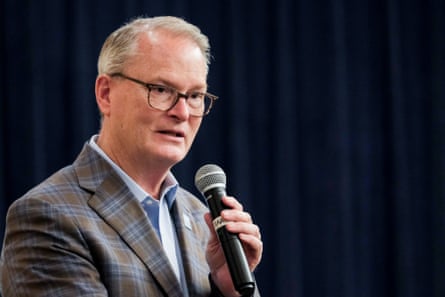
The Senate race in Kansas is evolving from a predictable Republican contest into an unexpectedly competitive campaign in which party affiliation is no longer the only factor at issue. Trust in the candidates, the cost of living and voter fatigue with political aggression have also moved to the forefront. Democrat Adam Hamilton, pastor of the largest Methodist congregation in the United States, is trying to attract independent voters and moderate Republicans by presenting himself not as a party activist but as a defender of the state’s interests. Donald Trump’s response has been personal attacks and accusations that the president’s critics have called false and manipulative.
The main line of conflict runs between two political styles. Hamilton is building his campaign around accessibility, the ability to listen and a willingness to cooperate across party lines. Trump, by contrast, is trying to portray him as a symbol of a radical Democratic Party hostile to Christianity, traditional values and security. This contrast may determine the election’s outcome: Republicans are counting on mobilizing the conservative base, while Hamilton is trying to turn voters’ frustration with economic problems and political polarization into support for Democrats.
According to The Guardian, the intrigue surrounding the election is unusual for Kansas. Donald Trump won the state by a 16-point margin just two years ago, and no Democrat has been elected to the Senate from Kansas since 1932. Nevertheless, some polls suggest that Hamilton could achieve a historic victory over incumbent Republican Senator Roger Marshall.
His strategy is based on addressing problems that do not fit neatly into the traditional “red” and “blue” state framework. Hamilton talks about housing costs, health insurance, the position of farmers, the job market for young people and water shortages in rural areas. At meetings with voters, he tells stories about people he has met during the campaign: a woman forced to give up her health insurance because of high premiums and a farmer worried about the future of young agricultural producers.
His vivid account of the characters in The Wizard of Oz is particularly telling. Dorothy and her companions needed courage, a brain and a heart, and Washington, Hamilton says, needs all three qualities as well. This is not merely a local cultural reference, but an attempt to articulate an alternative to politics based on conflict: the country needs not only toughness and party discipline, but also reason, courage and compassion.
Hamilton deliberately calls himself an “independent Democrat.” He promises to represent Republicans, Democrats and independents, saying: “I will not answer to a party or to any one person in Washington. I answer to you.” This approach is aimed at voters who may not be ready to switch camps for ideological reasons but are disappointed by the way current officeholders respond to everyday problems.
In this respect, Hamilton has an important advantage: the ability to engage personally with his audience. As The Guardian notes, he moves freely among event attendees, shakes hands, takes photographs and listens to questions. Young voters are particularly receptive to his promise to “turn down the temperature” of political conflict. Student Brennen Ross said that this quality is precisely what appeals to many young Kansans concerned about housing, jobs and access to water.
However, the economic agenda exists alongside cultural issues. For some Democrats, women’s rights and access to abortion are important, while the Republican campaign is seeking to focus on religion, immigration and transgender issues. This is where Trump entered the campaign.
At a rally supporting Marshall, the president called Hamilton a man who “openly mocks Jesus” and portrayed Democrats as anti-Christian extremists. As The Washington Post reports, Trump also compared Democrats to “jihadists” and radicals whom he accused of causing destructive protests in France. The rhetoric was aimed less at discussing the candidates’ specific platforms than at creating an emotional sense of threat among voters.
An MS NOW report cites other accusations by Trump: that Hamilton supports “flooding Kansas with unvetted refugees,” uses church money to fund “anti-religious transgender activity” and mocks Jesus. Host Joe Scarborough sharply rejected the claims: “Everything you just said there was a lie.” He referred to a fact-check by the Kansas City Star, according to which Hamilton does not support open borders and has said that “dangerous criminals do not belong here.”
Hamilton’s position on transgender issues is also more complicated than Trump presented it. In an interview with ABC News, the pastor said he believes there are two sexes, while also criticizing the president for turning a small and vulnerable group into a tool of electoral politics. In his view, transgender people are subjected to bullying and harassment, and the president has made them a political target.
This detail is important because it illustrates a mechanism of modern political communication: a candidate’s moderate or nuanced position is reduced to the most accusatory formulation possible. To Trump, Hamilton is not a local candidate with a specific platform, but a convenient symbol of a supposed cultural threat. For Hamilton, by contrast, the task is to bring the discussion back to governing the state and quality-of-life issues.
Scarborough’s criticism also touches on the religious dimension of the campaign. He called the attack on the pastor of the country’s largest Methodist church “deeply offensive,” saying that Hamilton preaches the Christian Gospel. The host contrasted Hamilton’s preaching with Trump’s behavior, arguing that the president routinely “lies about people,” attacks them personally and spreads false information.
It is important to recognize that this is not an independent account of events, but a political assessment by an MS NOW host. Its significance lies not in definitively establishing the truth of every episode, but in showing how the conflict is perceived by liberal media: as a clash between religious ministry and the political exploitation of religion. At the same time, Trump’s statements should also be viewed in the context of electoral mobilization, rather than as a neutral presentation of facts.
The Republicans’ second vulnerability is connected to Roger Marshall himself. Hamilton points to reports that Marshall filed lawsuits against hundreds of patients over unpaid bills, after which dozens of people were arrested. For a candidate seeking to position himself as a defender of ordinary residents, such a story could be especially damaging. Hamilton also accuses the senator of being insufficiently accessible: according to Hamilton, Marshall held his last open town hall roughly 600 days ago and left after facing pointed questions. Marshall explains the end of such meetings by saying they had become “unproductive and dangerous.”
The dispute reflects a broader problem in representative politics: voters are interested not only in the decisions a senator makes, but also in whether he is willing to engage in direct dialogue with citizens. At meetings in Topeka, residents said they valued Hamilton’s ability to listen, although some wanted more specific answers from him. For many, this itself is becoming a political quality—not a ready-made set of ideological formulas, but evidence of attention and openness to criticism.
The changes among young and independent voters are particularly noticeable. Students and young professionals cite housing costs, uncertainty in the job market, women’s rights and access to medical care. They do not necessarily consider themselves Democrats, but are willing to vote across party lines if they view a candidate as more responsible and open. Democrat Jacinta Bergkamp said that, in her impression, Kansans are tired of what is happening and are increasingly ready to demand accountability from their representatives.
The portrayal of Kansas as a completely “red” state is also proving inadequate. One campaign participant said: “Kansas is not red or blue… It’s much more liberal than people outside the state think.” This does not mean an automatic shift toward Democrats. Rather, it points to the presence of a significant moderate and independent electorate that may reject both conservative party rigidity and overly broad Democratic slogans.
Hamilton’s main strategic risk is that the national agenda could crowd out his local message. The more Trump talks about religion, immigration and transgender issues, the harder it becomes for the candidate to keep voters’ attention on prices, housing, farming and health care. But aggressive attacks could also backfire on Republicans if voters see them as an unfair attempt to frighten the state and impose a national political war on it.
For Marshall, Trump’s support is both an asset and a burden. The president can mobilize the Republican base and tie the election to the national struggle against Democrats. However, if the campaign becomes too dependent on Trump’s attacks, Marshall risks appearing not as an independent senator but as a representative of the White House. Hamilton has already made this point in a joking appeal to his opponent: “You weren’t hired to be the White House press secretary. You were hired to fight for your people.”
The key conclusion is that the Kansas election is becoming a test not only of the party balance but also of the limits of national political polarization. Hamilton is trying to turn his religious authority and preaching skills into the image of an attentive, independent, community-oriented politician. Trump is seeking to destroy that image by defining his rival through cultural conflicts and accusations of anti-Christianity. The outcome will depend on what proves stronger: Kansas’s traditional party loyalty or growing irritation over the cost of living, politicians’ inaccessibility and the constant escalation of conflict.
In this context, the term “independent Democrat” does not mean a nonpartisan candidate, but a Democrat who emphasizes his autonomy from party leadership and willingness to work with Republicans. “Independent voters” are citizens who are not registered as committed supporters of one party; they often determine the outcome of competitive elections. “Red” and “blue” states are shorthand for states where Republicans or Democrats, respectively, usually dominate, but Kansas in this campaign is described as more politically mixed—or “purple”—than commonly assumed. Finally, a “culture war” is a struggle over religion, immigration, abortion, gender identity and other issues that provoke strong emotional reactions and are often used to mobilize voters.
Thus, the race in Kansas shows how local problems can collide with the national political machine. Hamilton talks about people struggling to pay for housing, insurance and farm expenses; Trump shifts the dispute toward religious and cultural identity. The question for voters is whether they will allow national polarization to determine their choice or prefer a candidate who promises to “fight like hell for the people of Kansas” while preserving the ability to speak with both parties.