Three reports describe events of vastly different scales: a botched execution in Tennessee, a water-main break in Boston, and a school celebration in Iowa. Yet they share a common theme: the dependence of public life on the reliability of systems, procedures, and the decisions of the people who manage them. In one case, a failure led to severe medical consequences and called the practice of carrying out death sentences into question. In another, it disrupted traffic but did not affect the water supply. In the third, bad weather changed the format of an event without undermining its purpose. Together, these stories show that a system’s resilience is determined not by the absence of problems, but by its ability to respond to them promptly, ensure safety, and explain its actions to the public.
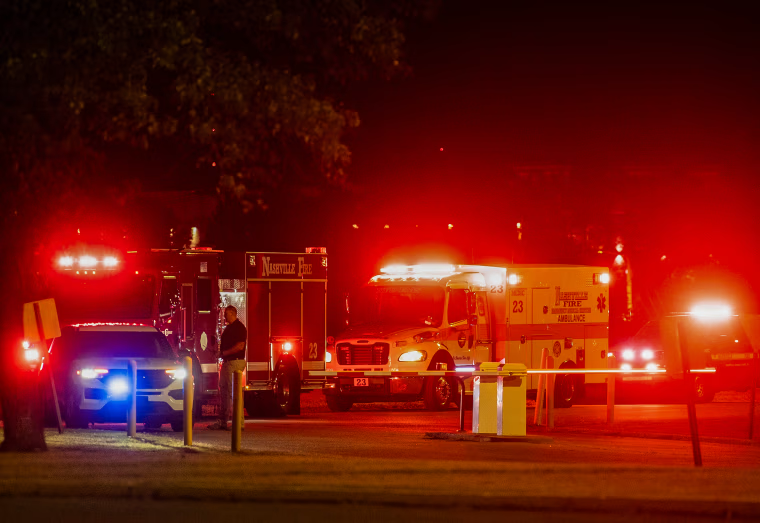
The most serious report is NBC News’ story on the condition of Christa Pike, who survived a failed execution attempt in Tennessee. According to her attorneys, Pike was in critical condition, unconscious, intubated, and connected to a ventilator. The cause was reportedly the effects of pentobarbital and serious injuries to both arms.
Pentobarbital is a barbiturate, meaning a drug that suppresses activity in the central nervous system. When used in a lethal injection, it is supposed to cause profound unconsciousness and respiratory depression. But if the drug enters the surrounding tissue rather than the vein itself, the situation can become extremely painful and unpredictable. Doctors believe this may have happened to Pike. She said she felt as though her arm were “exploding,” while an NBC medical expert explained that pentobarbital injected outside a vein can cause severe pain while also resulting in the administration of a dose insufficient to cause death.
This produced the most disturbing paradox of the incident: the drug was apparently strong enough to suppress breathing, but not effective enough to cause death. At the same time, pentobarbital has no rapid antidote; the body must process the substance on its own. The key question in assessing Pike’s prognosis therefore became how long her brain may have been deprived of oxygen.
Her attorneys say the process lasted more than two hours and involved chaos and intense pain. In an emergency motion, they asked that all materials related to the execution attempt be preserved and accused the Department of Correction of “indifference to the basic medical needs” of the prisoner and of disregarding its own protocols. The alleged violations included the use of defective or improperly prepared needles, incorrect insertion of the needles, and the absence of emergency medical oxygen in the room. According to NBC News, oxygen had to be brought in from elsewhere.
This raises a particularly important question about the limits of state responsibility. Even if the death penalty is legal, government agencies are required to carry it out in accordance with established procedures and to provide medical assistance when the process does not go as planned. Criminologist Deborah Denno framed the issue this way: “The goal is to kill someone, but to do it in a reasonable way, without pain and suffering.” The wording itself reveals the inherent contradiction of capital punishment: the state seeks to impose an irreversible penalty while simultaneously being required to observe standards of humane treatment.
The dispute over whether the state system had a duty to provide Pike with immediate life-saving care has become especially sharp. According to her attorneys, even after an ambulance was called, state representatives maintained that the Department of Correction was not obligated to provide such assistance. That claim could become a central element of future litigation, because it concerns not only a technical error but also the fundamental way the state treats a person under its control.
At the same time, the report does not ignore the seriousness of the crime for which Pike was convicted. In 1995, she was found guilty of murdering Colleen Slemmer. According to Knoxville police, Pike and two other teenagers tortured, beat, and fatally wounded the victim. Pike was 18 at the time of the crime; she was 50 when the execution attempt took place. This adds another important dimension to the story: decades spent on death row did not eliminate the need to follow legal and medical standards when carrying out the sentence.
At another level, the same question of infrastructure reliability appears in WCVB’s report on a water-main break in Boston’s financial district. A 16-inch water main burst overnight Friday near Purchase and Summer streets. Water flooded the streets, prompting the closure of Purchase Street between Congress and Summer streets. The southbound Interstate 93 exit to South Station and the Massachusetts Turnpike was also closed.
Unlike the Pike case, this failure did not pose an immediate threat to life or disrupt the area’s water supply. However, it showed how quickly a malfunction in underground infrastructure can affect urban mobility and the operation of a business district. The report emphasizes that the cause of the rupture has not yet been determined. This concise wording is important: at the initial stage, authorities focus primarily on limiting the consequences—closing roads, assessing the damage, and checking the condition of the networks. The explanation of the cause comes later, after a technical investigation.
The third report—a KCII story on the crowning of a homecoming king and queen—shows a gentler form of adaptation to unforeseen circumstances. At Mid-Prairie High School in Iowa, Tommy Miller was chosen as homecoming king and Samantha Wunderlich as queen. The parade scheduled before the ceremony was canceled because of bad weather, but the main events were moved to the Tim Grady Gymnasium. The program included dodgeball competitions, performances by the dance team and school band, and the introduction of student-athletes.
In this case, the system functioned resiliently: rather than canceling the entire celebration, organizers changed its format. The event’s purpose—to bring the school community together and mark the beginning of the season—was preserved. The report also mentions the upcoming football game against Central Lee and ways to listen to its radio broadcast, illustrating the continuity of school life even after one part of the program was canceled.
Comparing the three reports reveals the difference between a simple disruption and a systemic failure. In Boston, the problem was localized: the rupture caused flooding and road closures but, according to the available information, did not interrupt the water supply. In Iowa, an external circumstance—weather—changed the plan, but organizers quickly found a safe alternative. In Tennessee, the alleged errors affected a medical procedure on which a person’s life depended and raised questions about staff training, available equipment, and the authorities’ willingness to provide assistance.
What all three stories share is the need for transparent communication. In Boston, authorities reported which streets were closed and said the cause of the accident was under investigation. In Iowa, organizers explained why the parade was canceled and announced the new location for the events. In Pike’s case, by contrast, the public information remains disputed: her attorneys say the Department of Correction has “answers it needs to provide to the public.” The greater the potential harm, the more important it becomes not only to fix the problem but also to explain in detail why it occurred.
The main conclusion is that institutions are tested precisely when the standard scenario fails. For utility services, this means quickly securing the danger zone and investigating the cause. For organizers of public events, it means moving the program to a safe location. For the correctional system, it means having functioning equipment, trained personnel, a medical plan for complications, and an unequivocal readiness to save a life if a lethal procedure does not end immediately.
These reports also show the difference between a technical error and institutional responsibility. A burst pipe, by itself, does not prove that utility services acted improperly. Canceling a parade because of the weather does not mean the organizers failed. But if Pike’s attorneys’ claims are confirmed, the case may involve a combination of violations: a defective medical procedure, a lack of necessary equipment, inadequate preparation, and a delayed response. In that event, the consequences would extend far beyond the individual case and call into question the reliability of the entire system for carrying out death sentences.
Thus, the three events are connected not by their subject matter but by the logic of risk management. Where a system anticipates alternatives and operates transparently, a breakdown remains contained. Where procedures are insufficiently considered or responsibility is diffused, a technical problem can become a humanitarian and legal crisis. That is why Pike’s story matters not only as an account of a specific botched execution, but also as a test of whether the state is capable of taking responsibility for the consequences of its own decisions.