Three reports describe different events: a shooting involving an immigration officer in Texas, a road closure following a crash in Indiana, and California’s preparations for a strong “El Niño.” Yet they share a common theme: how government agencies respond to sudden threats and try to limit the consequences of crises. In each case, the issues involve public safety, access to reliable information, and the distribution of responsibility among federal, regional, and local authorities.
The most serious story concerns the shooting in Austin. According to NBC News, an officer with U.S. Immigration and Customs Enforcement (ICE) shot 28-year-old Venezuelan citizen Wilber Rafael Garces Perez, who, according to his attorney, was making a food delivery. The man suffered a torso wound and was in “serious but stable condition.” The Department of Homeland Security later said that he was in federal custody and awaiting deportation.
The circumstances of the incident remain under investigation, and the published accounts differ significantly. Attorney Kate Lincoln-Goldfinch said Garces Perez was an asylum seeker who entered the United States under a parole program. A DHS spokesperson, by contrast, said the man entered the country illegally during the Joe Biden administration and had a final removal order. These descriptions matter for more than legal reasons: they shape public perceptions of what happened and show how politicized information about immigration cases can become.
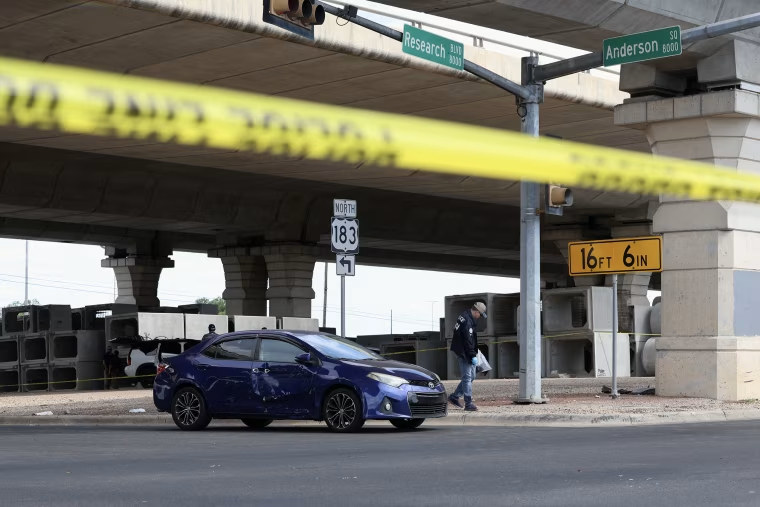
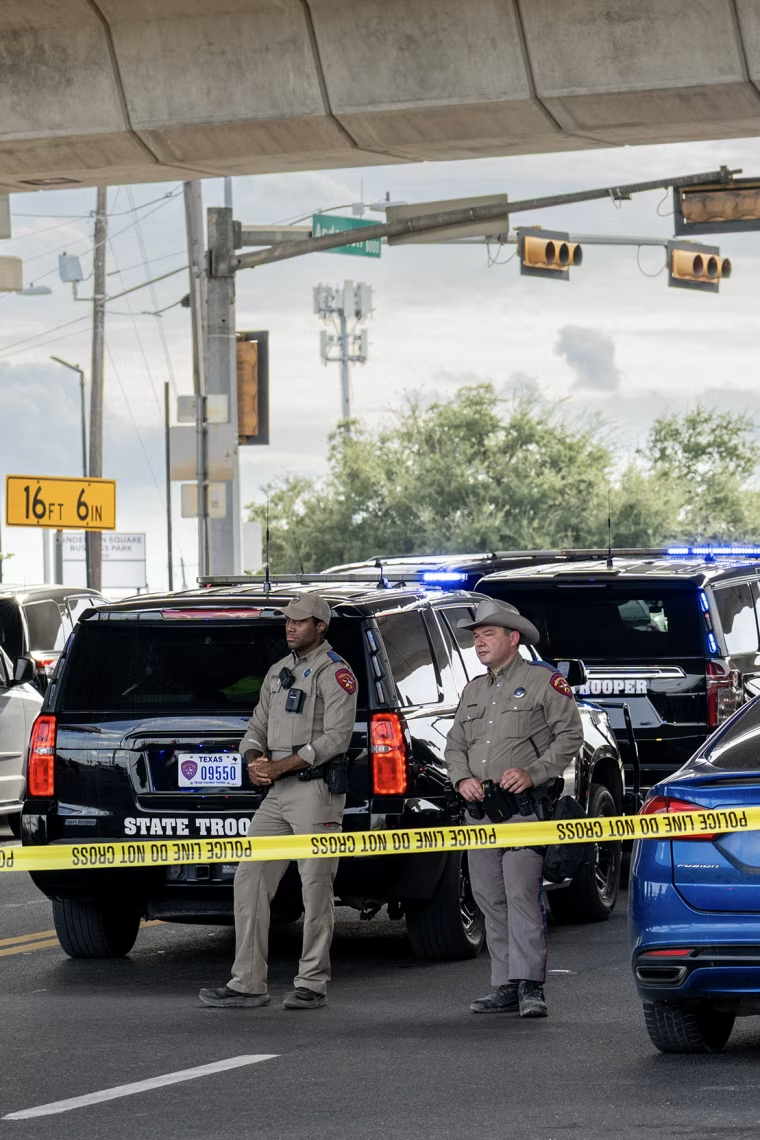
Video reviewed by NBC News shows a vehicle pursuit followed by gunfire. The recording captures the screeching of tires and at least three shots. It also shows a person getting out of a dark SUV and approaching a blue Toyota Corolla sedan. Texas state police arrived only after the shooting. A department spokesperson said the responding officers helped provide medical assistance to the driver. The fact that the key episode occurred before local police arrived makes an independent reconstruction of events more difficult and increases the importance of the federal investigation, which is expected to be conducted by Homeland Security Investigations with assistance from the FBI.
The treatment of the victim’s relatives raised additional questions. According to the attorney, Garces Perez’s wife came to the hospital but was removed from the premises along with her lawyer and treated as if they were trespassing. The attorney also said the family was initially told that the patient was not in the hospital. These claims have not yet been fully independently verified, but they point to a broader problem: when an injured person is also a detained migrant, medical care, the family’s access to information, and respect for procedural rights can become entangled with the interests of law-enforcement agencies.
The second report—a brief notice from InkFreeNews—concerns the closure of the westbound lanes of U.S. 30 near County Road 150W in Warsaw, Indiana, because of a crash. Unlike the Austin case, it contains almost no details: police merely warned that traffic would be restricted for an extended period. But this brevity reflects another function of crisis communication—to immediately warn drivers about an obstruction. Even a minimal notice provides practical information: where the problem occurred and why delays should be expected. At the same time, the lack of information about injuries, the cause of the crash, and when traffic might resume illustrates the limits of early alerts: the first priority is road safety, not a complete explanation of events.
The third report—an official statement by California Governor Gavin Newsom published on the state’s California.gov portal—demonstrates not a response to an incident that has already occurred, but preventive risk management. Authorities declared a state of emergency to prepare for a potentially very strong “El Niño.” This is a natural climate cycle in which surface waters in the eastern tropical Pacific become warmer than usual. The warming alters atmospheric circulation and can shift the paths of storms.
For California, this means a heightened risk of heavy rain, flooding, landslides, mudflows, coastal flooding, large waves, power disruptions, and road closures. The statement emphasizes that climate change may intensify natural processes. According to research cited in the document and published in the journal Science, modern El Niño events are more than 36% stronger than those before the industrial era, and the trend has accelerated over the past 40 years.
Declaring a state of emergency is intended to simplify the mobilization of resources and procurement. The state plans to pre-position sandbags, pumps, and equipment for road closures, snow removal, and flood response. The National Guard may be called upon for search-and-rescue, engineering, and logistical operations. Environmental and natural-resources agencies will be able to expedite approvals for projects related to protection from floods, landslides, and mudflows.
Of particular importance is the shift from general climate anxiety to specific measures for residents. Authorities recommend assessing flood risks in advance, cleaning storm drains and gutters, signing up for emergency alerts, and preparing an action plan in case of evacuation, a power outage, or blocked roads. At the same time, the official notice explicitly clarifies that El Niño does not guarantee a rainy winter and cannot precisely predict an individual storm. It only increases the likelihood of hazardous weather conditions. This is an important distinction between a risk forecast and an exact prediction of an event.
Taken together, the reports show three levels of response. In Austin, the government is investigating a use-of-force incident that has already occurred while confronting conflicting accounts and questions about agency transparency. In Indiana, local police promptly reported a traffic restriction without yet having—or publishing—a complete picture of the crash. In California, authorities are trying to act in advance, turning a climate forecast into administrative decisions and infrastructure preparations.
The main conclusion is that effective crisis management depends not only on available resources but also on the quality of communication. In the shooting case, the lack of consistent information and the conflict between the authorities’ statement and the attorney’s account undermine trust. In the crash case, a brief notice is useful for immediate safety but will need to be supplemented as more information becomes available. In the El Niño case, authorities are trying to explain both the threat and the limits of forecasting in advance, in order to avoid both panic and an underestimation of risk.
There is also an important difference in the nature of the dangers themselves. A use-of-force incident requires an investigation, a legal assessment of the use of a weapon, and protection of the victim’s rights. A crash requires rapid traffic management and assistance to those involved. A climate threat requires long-term planning, interagency coordination, and preparation for a series of possible events rather than a single incident.
The term “state of emergency” in the California context does not mean that a disaster has already occurred across the state. It is a legal mechanism that allows resources to be directed more quickly, contracts to be awarded, and agencies’ actions to be coordinated. Similarly, “federal custody” in the Garces Perez case means that the person is under the control of federal authorities, but it does not by itself establish whether every stage of the detention or use of force was lawful. Those questions must be determined through investigations and judicial proceedings.
The key trend running through all three sources is the expanding role of government in managing uncertainty. Authorities must make decisions before complete information is available while explaining to the public what is known, what remains unverified, and what actions are being taken. This is especially important in an era when law-enforcement operations, road incidents, and climate threats quickly become matters of public attention.
The reports also demonstrate unequal access to information. Official agencies have resources and control over procedures, but independent journalists, attorneys, and witnesses may reveal details that would otherwise remain unknown. A reliable assessment of a crisis therefore requires comparing official statements with video footage, testimony, medical records, and the eventual results of investigations. For now, it is too early to draw final conclusions about the Austin incident; the Indiana crash report remains preliminary; and California’s warning is a preventive measure whose effectiveness will become clear only as the weather situation develops.