After thirteen years of waiting, the release of Grand Theft Auto VI became more than just a video game launch. It turned into an event that reached far beyond the entertainment industry, touching some unexpected areas—from army life to sports-club marketing strategies and the hiring policies of American employers. At first glance, these stories seem unrelated: Rockstar admitting that even a studio with almost unlimited resources has its limits; a Georgia army battalion using the game as a tool to retain personnel; and an NBA game transformed into a “Vice City”-themed promotional event. Together, they paint a picture of a mass-culture product reaching such a scale that it begins to shape the behavior of institutions, not just entertain individual consumers.
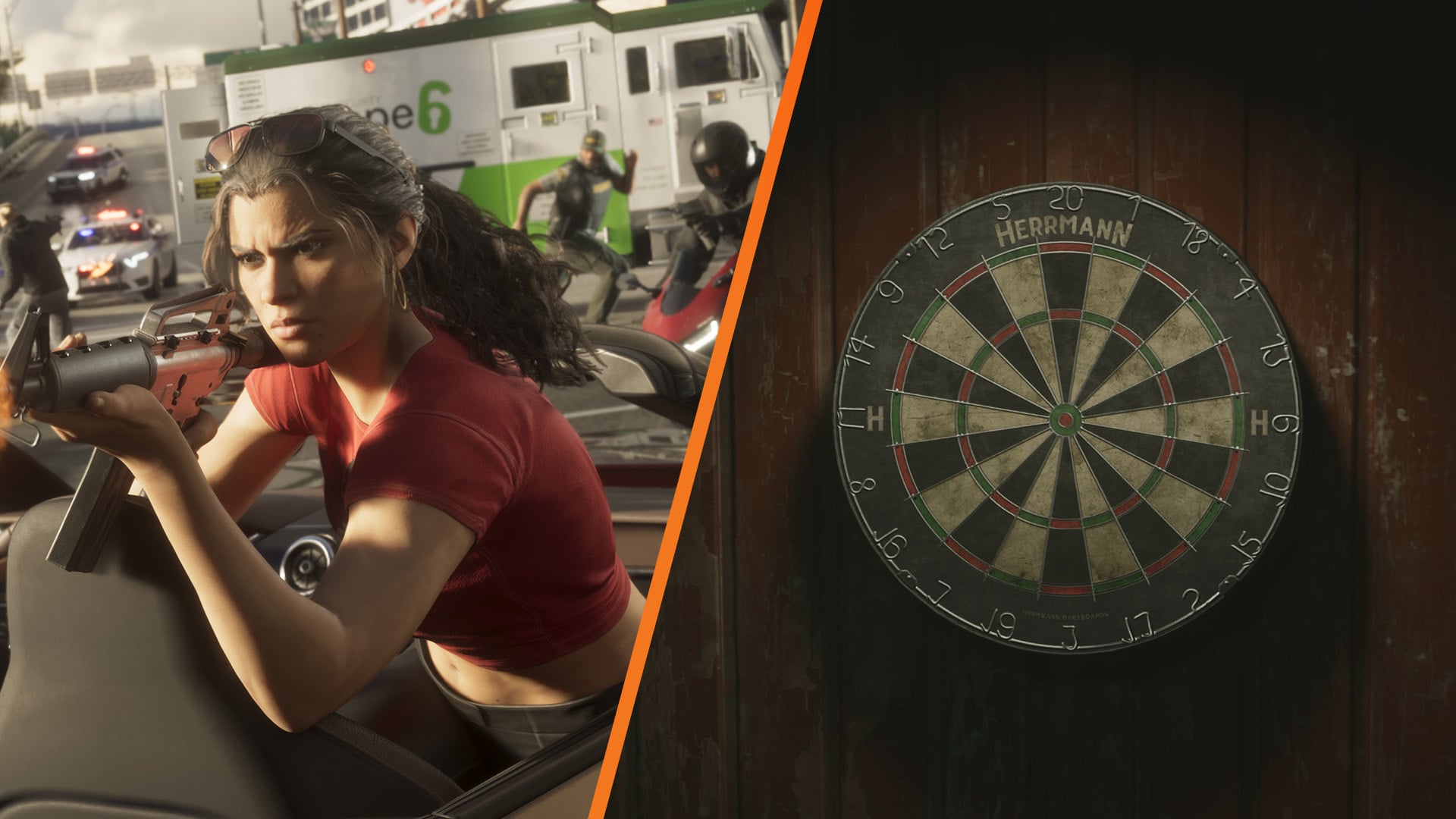
It is worth starting with Rockstar’s own position, since it sets the tone for everything else. In an interview with Video Games Chronicle, GTA 6 producer and Rockstar North co-head Rob Nelson explained why darts and bowling—minigames that became something of a hallmark of earlier entries in the series—didn’t make it into the game. His candid phrasing is striking: “Darts is a tricky one. Even we… you hear that they have unlimited money or unlimited time, but even we don’t, and sometimes you just have to admit that we won’t be able to do it to the standard we think is necessary.” In effect, the head of a studio often seen as having bottomless budgets is publicly acknowledging that its resources are limited—and that admission matters more than any marketing claim.
According to Nelson, the approach to selecting minigames goes back to Red Dead Redemption 2: “We’ve made it so that minigames are now activities.” The distinction is fundamental. A minigame can be an abstraction, a series of button presses, whereas an activity has to feel like “an extension of the mechanics” of the main game. Billiards in GTA 6, Nelson says, has “real physics” and is “a game in its own right.” Weightlifting is designed so that “you’re not just pressing a button; it simulates what lifting weights is like.” Basketball, meanwhile, is an example of a compromise the studio found acceptable: you can’t play full matches, but “you can run around and shoot smoothly, and it feels cohesive.” It is telling that even chess in Red Dead Redemption 2 proved challenging for the studio, despite the importance of Dutch’s chessboard to the story. Nelson’s conclusion sounds almost like a production credo: “It’s better not to do it at all than to do it and have it turn out not good enough.”
This approach helps explain how the release itself has been received. VGC’s review calls GTA 6 “the game of the generation” and “a modern masterpiece,” noting that “minor performance issues do not detract from the brilliance of an absolutely essential experience.” In other words, the absence of darts isn’t seen as a shortcoming; it fits an overall strategy of selective perfection, where less is better if it’s done flawlessly.
Yet the most telling consequences of the release have emerged beyond the game world. The Washington Post reports that a U.S. Army battalion stationed in Georgia offered service members who reenlisted within a certain timeframe a four-day weekend to play “the most anticipated video game of the century.” What makes this noteworthy is how casually the military has folded a pop-culture release into its personnel-retention incentives: the game is treated as a perk on par with financial bonuses or extra leave.
The sports industry responded on an even larger scale. Yahoo Sports describes in detail how the Miami Heat turned their home game against the Milwaukee Bucks—already a significant matchup, as it was Giannis Antetokounmpo’s first meeting with his former team since being traded—into a themed “Vice City Night.” Kaseya Center was decorated for the occasion, music from the game played throughout the arena, and concessions featured food inspired by fictional fast-food chains from the franchise. Fans lined up in pouring rain more than four hours before tip-off. According to ESPN reporter Cameron Wolfe, all the Heat x GTA Vice City merchandise sold out within ninety minutes of going on sale, after which the stores closed. The Heat won the game 137–130, with Antetokounmpo posting 27 points, 14 rebounds, and 9 assists.
One point of terminology is worth clarifying, as it may not be obvious. Vice City is a fictional city in the franchise, not an exact copy of Miami, but it was inspired by the city; the game’s state of Leonida, in turn, is inspired by Florida. This familiar connection allowed the team to build its marketing around the release not as a random partnership, but as something that fit its city’s culture.
Finally, there is the economic context that ties all these stories together. An estimated 16 million copies of the game were preordered, and experts predict that U.S. businesses could lose more than a billion dollars in productivity as employees stay home—the very “sick days” many are expected to take for the release. This is where the broader pattern becomes clear: the game Rockstar deliberately kept limited in certain mechanics for the sake of quality is generating effects no studio can control. The military uses it as a personnel-retention tool, sports teams as a marketing opportunity, workers as a reason to call in sick, and analysts as a factor in projected macroeconomic losses.
The key conclusion to draw from these reports is that GTA 6 has ceased to be a product in the traditional sense. It functions as an infrastructure of cultural time: an event around which institutions of vastly different kinds synchronize. At the same time, Rockstar is showing a rare degree of discipline in the industry—the willingness to sacrifice expected features if they don’t meet its internal standard. The irony is that this restraint, rather than an unrestrained expansion of content, has strengthened the game’s reputation as a “masterpiece of the generation.” The trend to watch is whether this model will prove sustainable: if releases on this scale continue to reshape the schedules of army battalions and basketball arenas, the entertainment industry will become one of the central reference points of public life, with all the consequences that entails—including economic losses and ethical questions about whether it is appropriate to use a game as an incentive to extend a military contract.