The three pieces focus on entirely different events—a major archaeological discovery in Germany, U.S.-Italian diplomatic relations, and discussion of the New England Patriots’ NFL victory. Yet they share one theme: how an individual decision or action can change the scale of a situation and prompt a reassessment of facts that were already known. In one case, a metal detector’s signal leads to the discovery of Germany’s largest hoard of Roman coins from the era of Hadrian; in another, Giorgia Meloni’s absence from the United Nations General Assembly becomes a symbol of deteriorating relations with Donald Trump; and in the third, the Patriots’ 20–3 victory is viewed not only as the result of a game, but also as a test of roster depth, team resilience, and its prospects for the season.
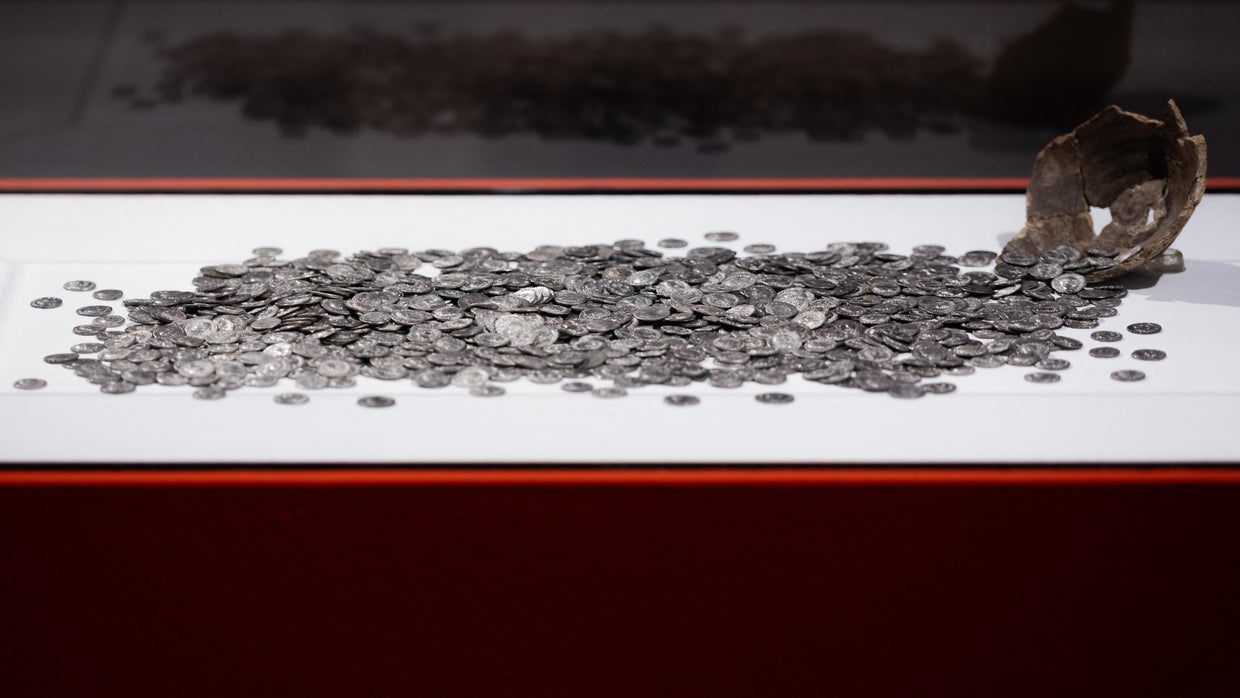
The CBS News article tells the story of a discovery made by amateur archaeologist Oliver Riedle near Wesseling, south of Cologne. He initially found several silver coins, but the metal detector continued to signal. Riedle realized that these were not isolated finds and contacted specialists. Subsequent excavations uncovered 934 Roman denarii weighing a total of 3.1 kilograms. According to the Rhineland archaeological service, this is the largest coin hoard from the reign of Emperor Hadrian ever found in Germany.
The discovery is important not only because of the number of coins, but also because it offers a glimpse into the economic and social history of the Roman province. Most of the denarii were minted under the Flavian dynasty, which ruled from A.D. 69 to 96. The oldest coin dates to 148 B.C., when Rome was still a republic rather than an empire. The hoard was most likely buried in the second quarter of the second century A.D., roughly during the reign of Hadrian.
The denarius was the principal silver coin of the Roman Republic and Empire. Its purchasing power changed over time, making it difficult to determine the hoard’s exact modern value. Archaeologists nevertheless offer an accessible comparison: an ordinary legionary earned about 300 denarii per year, although roughly half of that amount was deducted for food and equipment. To save the entire amount found in the hoard, a soldier would therefore have had to set aside all of his disposable income for approximately six years. This points to considerable wealth—not necessarily that of the upper class, but a sum that could have belonged to a soldier, merchant, official, or prosperous local resident.
The reason the money ended up in the ground is especially intriguing. As archaeologist Erich Claßen noted, banks did not exist in antiquity, so people often hid their savings. The owner may have died, left the region, or passed away without telling heirs about the hiding place. The hoard is therefore more than a collection of ancient objects. It records a specific human story—an attempt to preserve savings in unstable circumstances, after which knowledge of the hiding place was lost for nearly two thousand years.
The regional context also matters. The area around modern-day Cologne was under Roman control from approximately 39 B.C. to A.D. 459. The Romans established themselves there to control the Rhine frontier. Over time, the military post became Colonia Agrippina, the city that preceded modern Cologne. The coins therefore do not represent an isolated find far from the Roman world, but rather evidence of a developed frontier zone where the army, trade, and local population intersected.
Riedle’s story shows how important cooperation between amateurs and professional archaeologists can be. The metal detector merely identified an anomaly; systematic excavation and expert analysis gave the find its scientific value. This distinction is crucial: removing individual objects without recording their position deprives archaeologists of much of the information about their context. In this case, promptly contacting the authorities preserved not only the coins but also data about how the hoard was arranged.
The political article from Fox News examines another kind of public signal: diplomatic absence. Italian Prime Minister Giorgia Meloni did not attend the United Nations General Assembly, breaking a roughly 15-year tradition of Italian prime ministers taking part in the annual high-level debate. Officially, she attributed the decision to a crowded schedule: over three and a half weeks, Meloni had attended six summits and needed to deal with domestic matters.
Formally, this is a rational explanation, but the political context made her absence notable. Meloni and Trump had previously maintained relatively warm relations: she was the only European leader to attend his inauguration in 2025. Their relationship later became strained by public disagreements. Trump claimed that Meloni had supposedly “begged” him to take a photograph with her at the G7 summit. The Italian prime minister replied, “Neither I nor Italy ever beg.” Trump later posted a photograph of Meloni on social media with the caption “RESTRAINING ORDER REQUIRED,” providing another indication of personal tension.
Behind the rhetoric lie more serious issues. Meloni distanced herself from U.S. policy toward Iran and from American military operations in the Middle East. Trump criticized her for refusing to give the United States access to Italian runways, calling it a “major logistical inconvenience.” Italy nevertheless remains one of the United States’ most important military and strategic partners in Europe: nearly 13,000 American service members are stationed there, including in Vicenza, Aviano, Naples, and Sicily.
The situation shows that alliances consist not only of official agreements, but also of political expectations, personal trust, and a willingness to support specific decisions. Italian Foreign Minister Antonio Tajani emphasizes that transatlantic ties “go far beyond individual statements.” Yet individual statements can quickly change how relations are perceived by the public and political elites. Meloni’s absence from the General Assembly became a convenient symbol: it does not necessarily indicate a rupture, but it suggests a desire to avoid another direct confrontation and preserve room for maneuver.
In this sense, Italy’s position is dual. Rome reaffirms the importance of the United Nations and the transatlantic partnership, while at the same time declining to follow the American line unconditionally on Iran and other conflicts. This is a typical challenge for alliances: states can retain a shared strategic alignment without agreeing with every decision made by a partner. Personal closeness between leaders can facilitate cooperation, but public conflicts show how quickly it can become a source of instability.
The sports article from New England Patriots brings the same issue into another sphere: assessing a system’s resilience after a specific result. The Patriots Unfiltered program discusses the New England Patriots’ 20–3 victory over the Pittsburgh Steelers. The main focus is on the defense’s dominant performance: limiting DK Metcalf, generating pressure on the quarterback from the defensive line, and maintaining the team’s effectiveness despite injuries.
At the same time, the program’s hosts do not reduce the analysis to a simple celebration. In their assessment, the Patriots’ offense was inconsistent. The game contained clear positives, but problems remained that could emerge in subsequent contests. The victory is therefore viewed as a basis for cautious optimism, not as proof that the team has been completely transformed. One of the program’s key points is that fans should not become overly concerned about the offense’s shortcomings: the team can still develop, recover from injuries, and improve its coordination.
In American football, roster depth—the ability of reserve players to compensate for the loss of starters—is particularly important. That is why the discussion of injuries after the second week of the season has strategic significance. One game can reveal a team’s current form, but it does not necessarily determine the entire season. Just as an archaeologist cannot judge the Roman economy from a single coin, and a diplomat should not infer a complete break from one missed summit, a sports analyst assesses not only the score but also the team’s resilience in the face of future challenges.
The common conclusion of the three pieces is that an event’s significance is determined not only by its outward scale, but also by the processes it reveals. A continuing signal from a metal detector became evidence of the multilayered history of the Roman Empire. A single absence from an international forum became an indicator of accumulating tension between two allies. One convincing victory revealed a strong defense, an vulnerable offense, and the need to cope with injuries.
In every case, context is essential. The Roman hoard cannot be understood without the history of the Rhine military frontier and legionaries’ pay. The political conflict between Meloni and Trump cannot be assessed without considering the U.S. military presence in Italy, disagreements over Iran, and the role of personal diplomacy. The Patriots’ victory must be considered alongside the quality of the offense and the condition of the roster, rather than by the final score alone.
The key trend running through all the sources is the movement from an isolated fact to a broader interpretation. An archaeological discovery, a diplomatic decision, and a sporting result become significant only after their underlying causes and long-term consequences are analyzed. This approach helps prevent hasty conclusions. The hoard does not provide a complete picture of the Roman economy, Meloni’s absence does not prove the collapse of the U.S.-Italian alliance, and the Patriots’ victory does not guarantee a successful season.
Several terms are important for understanding the texts. The United Nations General Assembly is an annual meeting of representatives of member states at which general debates are held at the highest political level. A denarius is a Roman silver coin widely used for payments and trade. The Flavians were a dynasty of Roman emperors who ruled in the late first century A.D. “Roster depth” in the NFL refers to having enough strong reserve players to replace injured starters. “Pressure from the trenches” is a sports expression describing effective defensive-line play that prevents an opponent from organizing attacks.
Thus, the three articles address one fundamental idea: the resilience of any system is tested in moments of uncertainty. For the Roman owner of the money, such a moment apparently required hiding his savings. For Meloni, it meant choosing distance instead of another public meeting with Trump. For the Patriots, it meant proving that strong defense and team discipline could compensate for an inconsistent offense and injuries. It is the response to such circumstances—not a single dramatic episode—that reveals the true condition of a historical, political, or sporting system.