
Three stories concern entirely different events—a major archaeological discovery in Denmark, a White House conflict with journalists, and Iran’s conditions for ending its war with the United States. Yet they share a common theme: who has the right to control information, resources, and access to them. In each case, the struggle for control takes a different form—through government regulation of historical heritage, restrictions on press access, or the use of strategic sites and economic pressure in an international conflict.
The Danish discovery shows how an accidental private find can reshape our understanding of an entire region’s past. In the United States, the dispute over journalists’ credentials demonstrates how quickly political power can come into conflict with independent media and constitutional limits. In the Middle East, control over straits, oil, frozen assets, and negotiating conditions becomes an instrument of both warfare and diplomacy.
The Fox News article about the discovery in Denmark describes the largest known Viking Age silver hoard found in the country. A homeowner was preparing the site for a terrace and heard a “strange sound” roughly half an hour after beginning the work. At first, he thought he had hit old iron or wire, but after continuing to dig with his hands, he discovered jewelry, coins, and silver ingots.
The hoard had been hidden in a clay vessel and is believed to date from the 10th century. It includes around 700 objects and fragments: ingots, bracelets, coins, fragmented silver, and a small hammer of Thor. About 14 pounds of silver remained inside the vessel, while the other objects were scattered in the surrounding soil. Altogether, the find weighs more than 18 kilograms—about 40 pounds—and is nearly three times heavier than the previous record holder, the Thørslev hoard, which weighed approximately 14 pounds.
The significance of the discovery goes beyond its material value. According to Torben Sarauw, head of the cultural heritage department at the museums of North Jutland, one of the ingots bears a runic inscription that may have served as a protective formula. Other ingots are marked with Thor’s hammers and Christian crosses. This combination of pagan and Christian symbols is particularly important: it reflects a transitional period when Christianity was spreading across Scandinavia, while earlier religious beliefs continued to exist.
This is where the issue of control over meaning emerges. The owner of the hoard was probably extremely wealthy and held high social status. The large quantity of silver points not only to accumulated wealth, but also to access to trade networks, exchange, and possibly political power. Sarauw believes the find indicates that Himmerland played a more significant role in Denmark’s economic and political system during the Viking Age than previously thought.
Hoarded valuables were usually buried during times of instability to protect them. Archaeologists believe the owner may have died during a journey or military campaign and never returned. This is only a hypothesis, but it shows that silver was not merely wealth—it was also a means of survival in uncertain times. Under Danish law, the hoard belongs to the state, although the person who found it is entitled to a reward. Thus, a private discovery automatically becomes public property: the state assumes the right to interpret, preserve, and present historical heritage to society.
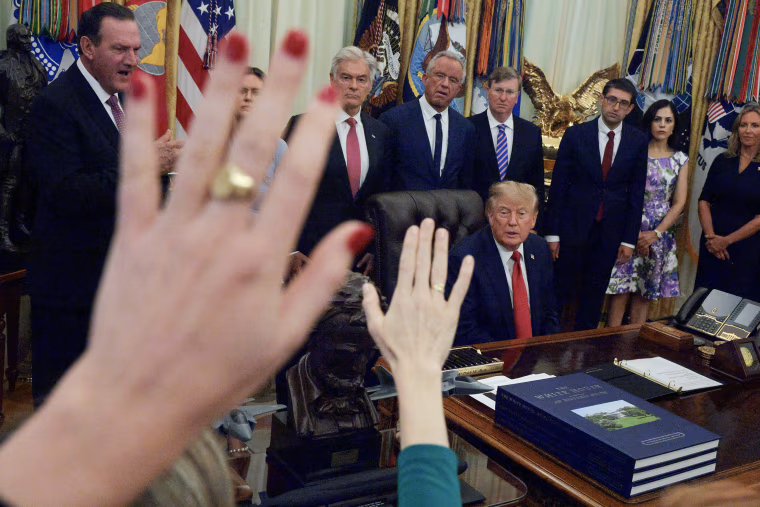
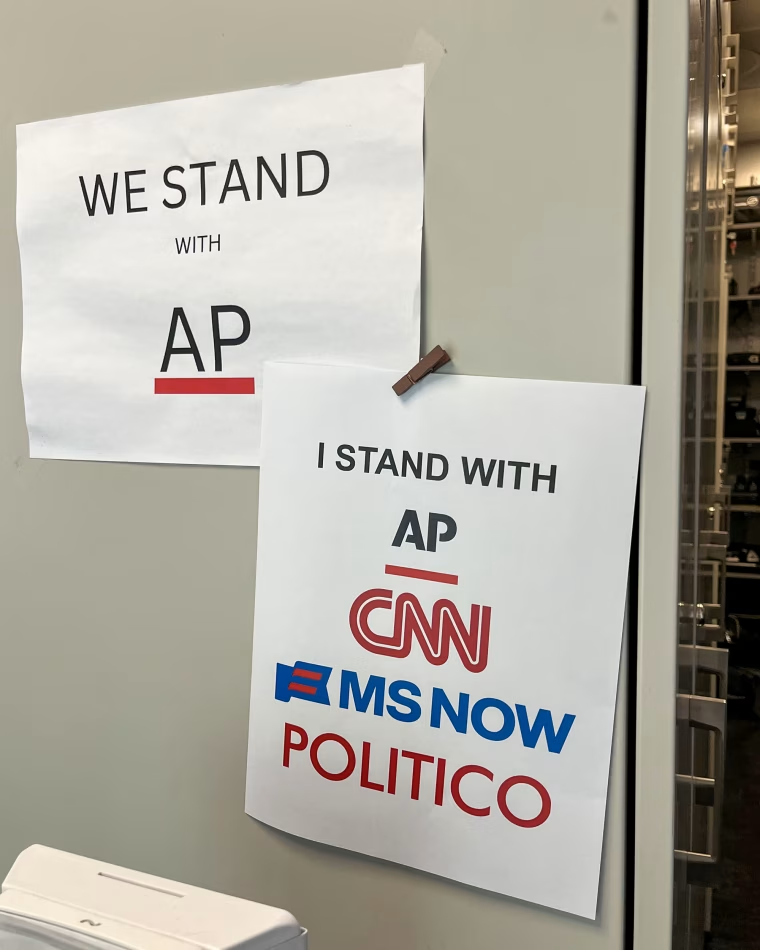
Modern politics, as described in the NBC News report on the White House’s conflict with the media, concerns the same problem of access, but this time not to artifacts, but to information. The White House barred journalists from MS NOW, CNN, and Politico from its premises and revoked their press credentials. The move came after President Donald Trump accused the organizations of continually spreading “fake news.”
Media representatives called the decision unlawful. CNN described the ban as an “illegal attack” on constitutional rights, while MS NOW said it was prepared to take “any steps necessary” to defend press freedom. The chair of the White House Correspondents’ Association demanded that journalists’ access be restored. Jameel Jaffer of Columbia University’s Knight First Amendment Institute told NBC News that the decision was “pretty clearly unconstitutional” and that a potential lawsuit would likely have a strong chance of success.
The practical significance of the conflict lies in the fact that the White House is not an ordinary private facility. It is a government institution, and its decisions affect all citizens. Journalists’ access to the presidential administration is therefore viewed not as a privilege granted to individual news organizations, but as a mechanism of public oversight. When journalists are removed from an official space, it is not only their physical presence that is restricted. Their ability to ask questions, verify officials’ statements, and observe decision-making is also narrowed.
The White House, however, argued that the media were “peddling lies” about the president and his administration, thereby harming democracy. The administration also said that the president sought to hold “fake news” accountable. But this logic creates a dangerous precedent: if the executive branch itself decides which news organizations are “credible,” it effectively gains the ability to shape an information environment convenient for itself.
It is particularly telling that several senior current and former White House officials told NBC News they had not known about the ban in advance. This points not only to a conflict with the press, but also to the concentration of decision-making around the president. CNN and MS NOW journalists continued working from the street across from the White House, symbolically emphasizing that denying access does not eliminate public interest or end coverage of the administration’s activities.
In Denmark, the state gains control over a physical object from the past on the basis of law. In the American case, the government attempted to control the channel through which society learns about the present. In both instances, the question is who has the right to establish the rules of access and on what grounds. The difference is that archaeological regulation is intended to preserve a shared heritage, while restricting journalists’ access can weaken democratic oversight.
In the Al Jazeera article on Iran’s conditions for ending its war with the United States, control takes on a military and geoeconomic scale. Iranian official Mohsen Rezaei said Tehran had conveyed its conditions for ending the war to Washington through Qatari mediators. They include a halt to fighting on all fronts, including Lebanon; the unfreezing of Iranian funds; an end to the naval blockade of Iranian ports; a US commitment not to interfere in Iran’s internal affairs; and an end to American strikes on Iranian territory.
The Strait of Hormuz remains the key instrument of pressure—a narrow maritime passage through which a significant share of the world’s energy supplies is transported. Iran has effectively closed it, while the United States is supporting a blockade of the country’s southern ports. Attacks on tankers, problems with routes through the Red Sea, and confrontation with the Houthis have pushed oil prices above $100 a barrel.
In this context, the Strait of Hormuz is not merely a geographic feature. It is a strategic lever capable of influencing the global economy. Any restriction on shipping increases insurance and transportation costs, creates the risk of supply disruptions, and pressures third countries to intervene with the parties to the conflict. Iran does not necessarily need to be capable of defeating the United States militarily; it is enough to retain the ability to raise the cost of continuing the war.
The new conditions largely repeat the provisions of a June memorandum of understanding. That agreement also called for an end to the war, respect for sovereignty, an end to the blockade, the unfreezing of Iranian funds, Iran’s renunciation of nuclear weapons development, the safe reopening of the Strait of Hormuz, an end to new sanctions, and a halt to additional US military buildup in the region. However, the previous agreement ran its course, and the parties returned to confrontation.
What changed most was not the substance of the demands, but the political environment and the way they were conveyed. Adele Abdel Ghafar of the Australian Strategic Policy Institute noted that after the memorandum failed, Iran publicly placed responsibility for future developments on Washington. This is a typical negotiating strategy in a deadlock: the parties preserve the possibility of diplomacy while simultaneously demonstrating their readiness to escalate.
According to experts, Iran cannot lift the American blockade on its own, but it possesses asymmetric capabilities—that is, means that allow the weaker side to inflict significant damage on its opponent and the global economy without direct military superiority. These include pressure on shipping, actions by allied groups, the threat of widening the conflict, and the use of the nuclear issue as a deterrent.
Tehran’s position on its nuclear program is also based on a dual signal. Rezaei said Iran had not yet withdrawn from the Treaty on the Non-Proliferation of Nuclear Weapons and continued to abide by the religious prohibition against creating nuclear weapons, but he simultaneously warned that the situation could change in the future. Such wording leaves room for diplomacy while raising the cost of sanctions, attacks, or referring Iran’s nuclear issue to the UN Security Council.
The United States has not yet officially responded to the new conditions. One expert suggested that Washington might not view them as a serious proposal and could interpret them as a demand for surrender. Other analysts noted that Iran’s decision to drop its earlier demand for military reparations might indicate a degree of flexibility. According to Al Jazeera, President Trump may be interested in reaching an agreement before the US midterm elections, but the gap between the parties’ positions remains too wide.
In all three stories, what matters is not only the object of the struggle, but also how control over it changes the public perception of reality. The silver hoard allows historians to reassess Himmerland: a region previously regarded by researchers as peripheral may have been a center of wealth and political influence. The ban on journalists changes the conditions under which citizens receive information about government actions. The closure of the Strait of Hormuz turns a local conflict into a driver of global inflation and energy instability.
The broader trend is that access is becoming a political resource. Access to an archaeological site is regulated by law and transferred to the state in order to preserve heritage. Access to the White House is restricted by the president in an attempt to punish critical media outlets. Access to a maritime route is used by Iran as a means of pressuring the United States and global markets. In every case, whoever controls access gains the ability to influence how events are interpreted and how other participants behave.
The consequences of such control, however, vary. Archaeological regulation can strengthen public knowledge if it is accompanied by scholarly research and the open publication of findings. Restricting journalists’ work, by contrast, risks undermining trust in government institutions, particularly when the criteria for exclusion are opaque. A military blockade may provide negotiating leverage, but it also increases the likelihood of miscalculation, accidental escalation, and humanitarian harm.
The key conclusion is that power is rarely limited to direct coercion. It is expressed through control over who is allowed to possess a historical object, who may stand close to government decision-making, and which routes remain open to global trade. The Danish hoard, the American conflict over the press, and Iran’s terms for peace reveal different forms of the same process: struggles over resources are accompanied by struggles over the right to define the rules, the facts, and the boundaries of acceptable behavior.
![Mohsen Rezaei outlined Iran’s conditions for returning to negotiations with the United States [screenshot/Al Jazeera]](https://www.aljazeera.com/wp-content/uploads/2026/09/Screenshot-2026-09-20-at-12.04.05-PM-1-1789895182.jpg?resize=770%2C513&quality=80)
