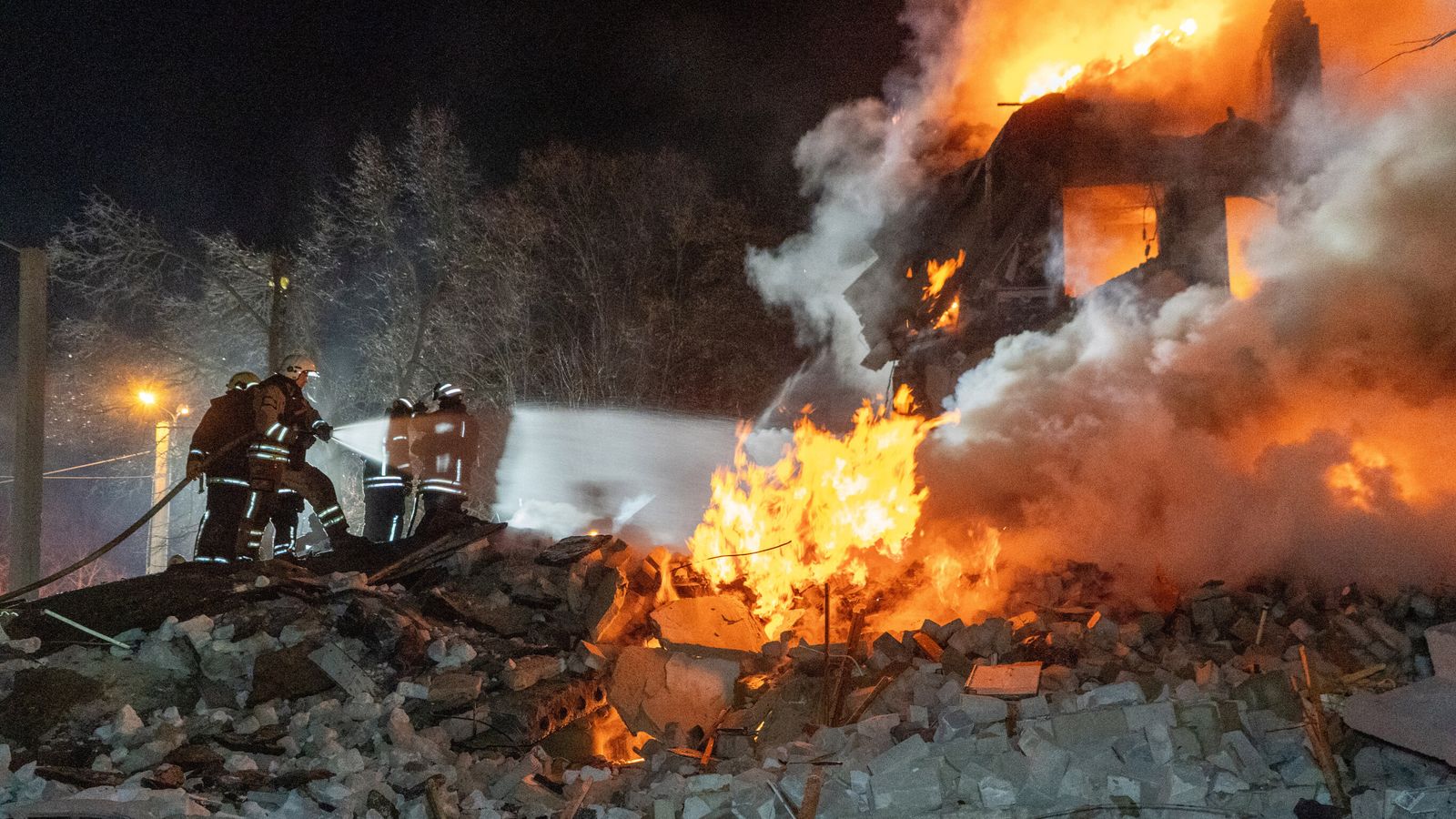
The stories underlying these news items at first glance seem unrelated: the disappearance of 84‑year‑old Nancy Guthrie in Arizona, the UN’s findings on the forcible deportation of Ukrainian children to Russia, Donald Trump’s remarks about a war with Iran and the resulting oil price fluctuations. Together they form a broader narrative about how fragile security is — personal, national, and global — and how information and power structures affect our ability to feel safe and understand what is happening.
At the center of the Nancy Guthrie case is a very concrete, everyday vulnerability: reliance on infrastructure and digital surveillance. At the center of the Ukrainian storyline is the total vulnerability of children to the machinery of war and state repression. And in the Iran case — the vulnerability of global markets and public perception to leaders’ rhetoric and the dynamics of armed conflict. All three stories show how security today is defined by a complex intertwining of technology, politics, institutions, and trust in them.
The Yahoo News piece on Nancy Guthrie’s case discusses the disappearance of the mother of TV host Savannah Guthrie and an investigation that has now entered its second month. Pima County police are probing a damaged telecommunications cabinet near her home and are checking for a possible link between that damage and an internet outage at the time Nancy disappeared. The outage disabled home surveillance systems in the neighborhood, effectively blinding what should have been a primary tool for protection and investigation.
Here the first important theme appears: personal security’s dependence on communications infrastructure and electronics. Home camera footage, networked devices, and internet services have long become part of the everyday “architecture of security.” When one element fails — in this case a utility box, a street communications cabinet — an entire layer of evidence and oversight collapses. That is why investigators are considering whether the damage was intentional. If it’s connected to Nancy’s disappearance, it’s no longer a random malfunction but a deliberate attempt to cut off the neighborhood’s digital “eyes.”
The family’s offer of a $1 million reward for information leading to her “recovery” (i.e., return alive or at least establishing her fate) highlights the second side of modern security: when state mechanisms do not produce quick results, families and communities try to compensate with money, media attention, and public pressure. Sheriff Chris Nanos, on Today, emphasized that they have “a lot of intelligence, a lot of leads,” but “now it’s time to just work,” meaning to move from gathering information to thoroughly processing it. That’s a typical investigative phrase, but here it is shaded by the fact that the missing person is the mother of a celebrity, and the case is under intense media scrutiny.
The link between media and security is critical. Savannah Guthrie’s return to the Today studio, her gratitude to colleagues and willingness to “return to the show when the time is right” are described as an important psychological step, as cohost Sheinelle Jones put it: “I don’t know what’s ahead of us, but this is a step.” Personal grief becomes a collective experience through television and the internet, and the media in this case serve not only as a source of information but as an emotional framework for viewers who consume news of violence and disappearances almost in real time.
If the Nancy Guthrie story shows vulnerability at the micro level — a specific house, a specific neighborhood, a specific family — the UN commission’s conclusions on Ukraine, described in the Sky News piece, move us to the macro level: state violence against children as a deliberate strategy of war. An independent international commission investigating events in Ukraine concluded that the forcible deportation of Ukrainian children to Russia and Belarus amounts to crimes against humanity.
“Crimes against humanity” is a legal category in international law applied to widespread or systematic attacks on civilians (killings, deportations, torture, etc.) carried out with the knowledge of or pursuant to state policy. The commission examined cases of 1,205 children and found that 80% of them have not returned to Ukraine. Ukrainian authorities estimate the total number of deported children at roughly 19,500. These figures matter because they show this is not about “random” episodes but a scheme the commission describes as “widespread and systematic.”
The report stresses that children are among the most vulnerable victims and that the consequences for their lives are “irreversible.” Forcible removal of children and their placement in so‑called “re-education” centers, which U.S. researchers have previously documented, means an attempt to alter their identity, language, and memory of the war. Essentially, this is an attack not only on people but on collective memory and the future of society: children raised under an imposed version of history become carriers of a different, legitimizing narrative of the aggression.
Emphasis on “re-education” is important: this is not merely placing children in camps or institutions but a system of ideological conditioning. The Sky News piece notes U.S. research indicating that children are being placed in Russian “re-education” camps where they are taught the Russian narrative about the war, identity, and the state. In human rights terms, this is forcible cultural assimilation, bringing the situation closer to historical practices of erasing indigenous identities or targeting politically unwanted groups.
Here the second cross-cutting motif appears: control over information and consciousness as a tool of security — or rather its destruction. In the Nancy Guthrie case, the loss of camera recordings due to an internet outage breaks the line of defense; in the Ukrainian children case, control over the informational environment in “re-education” camps breaks their personal identity. In both, the outcome is the same: a person is deprived of an anchor — an objective account of what happened that could protect their rights or at least record the crime.
The third story, about the war with Iran and the oil market, raises another level of vulnerability — the global. The New York Times post on Facebook reports that on day ten of the war with Iran, Donald Trump told CBS News the war was “very complete” and that the U.S. was “well ahead of schedule.” After that remark, oil prices, which had risen at the conflict’s outset, fell, and the stock market recovered morning losses.
The phrase “very complete” in this context shows how a leader’s language, even if militarily imprecise, directly affects market expectations. Trump then told Republican lawmakers that “the U.S. still has more to do” in the war — a more cautious, supplemental message aimed at a domestic audience. We see how the same war is described with different language depending on the target audience: investors must hear that the situation is under control to avoid panic; the political base must hear that the fight is not over and requires resolve.
This brings us to another important theme running through all three stories: the management of perceived security. In the Nancy Guthrie case this is a softer form — media support for the family, broadcasting the sheriff’s confidence that the investigation is “definitely closer” to a resolution despite no major breakthroughs. That reduces public anxiety and creates the sense that “someone is in control.”
In the Ukrainian case, information management takes the form of denial: Moscow rejects accusations of forcibly deporting children despite the commission’s systematized findings. This is a classic strategy of a state accused of war crimes: denial, minimization, alternative narratives (“we’re saving the children,” “they came voluntarily,” etc.). Here the state’s security — meaning its image and legitimacy — is set against the safety and rights of children.
In the Iran story, information management is almost a direct instrument of economic security: a single presidential interview creating a sense of “control” and “being ahead of schedule” changes oil price dynamics and stock indices. This shows that modern wars play out simultaneously on battlefields, in the media, and on markets, and there are no clear boundaries between these levels.
If we try to link all these stories into one logical thread, several key trends emerge.
First, security increasingly depends on complex, fragile systems: infrastructural (internet, power grids), institutional (law enforcement, international bodies, courts), and symbolic (media, national narratives). Damage to a small communications cabinet in Arizona can be a key factor in an unsolved missing person case. Decisions to deport children are taken at the state level but documented and interpreted by international commissions whose reports will have consequences for future trials and sanctions. One presidential interview about a war with Iran affects global oil markets that determine prices for billions of people.
Second, information control — from neighborhood cameras to wartime propaganda and presidential statements — is becoming a battlefield as important as physical violence. In the Nancy Guthrie case, an internet outage demolished a chain of possible leads. In Ukraine, the destruction of children’s lives is accompanied by “re-education” — an attempt to capture minds. In the Iran case, the information signal that the war is “very complete” is used to stabilize markets and demonstrate strength.
Third, amid these structural dynamics, the human factor — emotions, trust, fear — remains central. Nancy Guthrie’s family seeks to regain control through a $1 million reward and appeals to the public and the FBI; Savannah Guthrie shares her grief on national TV, and her colleagues and viewers become part of the story. In Ukraine, thousands of families live in limbo, unsure whether their children will return, and the UN stresses the “irreversible consequences” of such crimes for those children’s futures. In the U.S., investors who hear from the president that the war is “under control” change their behavior, and ordinary people absorb through the news how dangerous the outside world seems.
The paradox of the modern world is that despite vast technologies, institutions, and international structures, the sense of security is not stable. The story of a missing elderly woman shows that even in relatively well‑off environments security can be disrupted in hours, and regaining control becomes a long, painful process. The story of Ukrainian children demonstrates that at the level of states and wars the security of millions can be sacrificed to political aims, and international law, even when it documents crimes, does not guarantee immediate justice. The Iran war and oil price swings underscore that perceived security in the global economy is vulnerable to the words and gestures of a small number of people.
Taken together, these three narratives force a reconsideration of the familiar word “security.” It is now about more than police, armies, and borders; it is about the integrity of infrastructure, the reliability of information, the resilience of institutions, societies’ capacity to empathize and demand accountability. And about how ready we are to acknowledge that protecting the most vulnerable — the elderly, children, and civilians in conflict zones — should be a central criterion for evaluating policy and technology, not an afterthought in the pursuit of efficiency, influence, or economic growth.
That is why seemingly disparate stories — Nancy Guthrie’s disappearance in Arizona from the Yahoo piece, the UN commission’s findings on child deportations in the Sky News report, and the political‑economic effect of Donald Trump’s remarks about a war with Iran in The New York Times Facebook post — should be considered not in isolation but as parts of one larger conversation about the kind of security we live in and the kind we want to see.