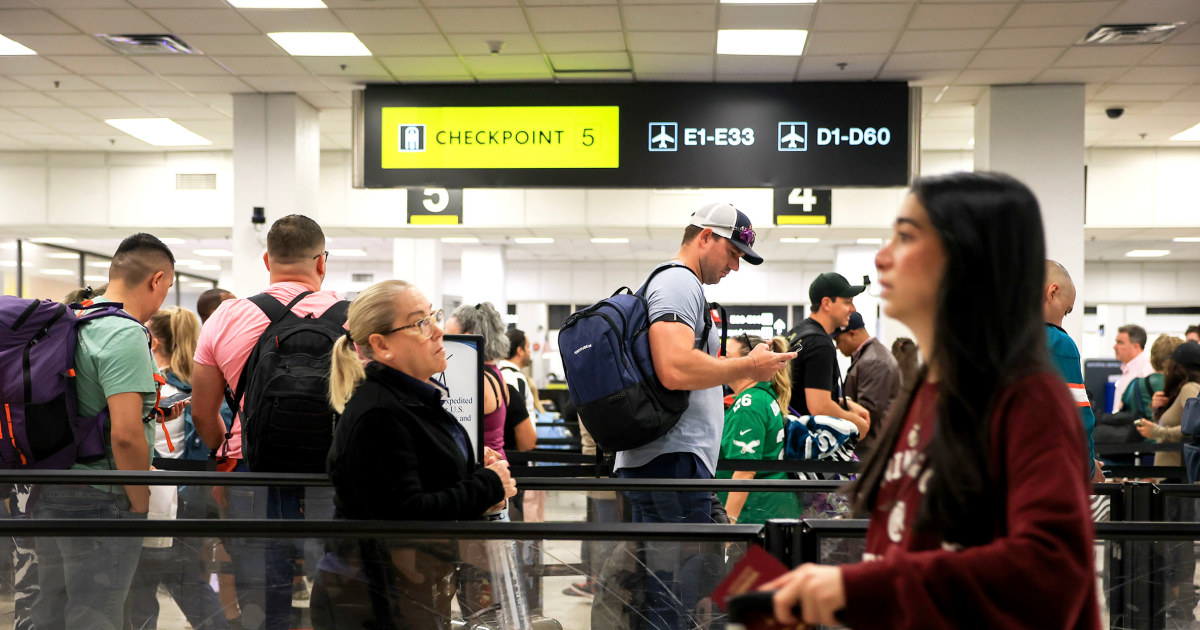
Across the news feed it looks like a collection of unrelated items: in one case the U.S. Department of Homeland Security, amid a last‑minute funding lapse, says it will not halt the expedited airport screening program; in another, a winter storm paralyzes roads in Pennsylvania and severs power lines; elsewhere the U.S. men's hockey team dramatically wins Olympic gold over Canada in overtime. But if you look not at “what happened” but at “how the system responds,” a single picture emerges: a country whose everyday life is held at the limits of resilience, where any stress — political, natural, or sporting — becomes a stress test for institutions, infrastructure, and public trust.
In the story about TSA PreCheck and Global Entry reported by NBC News, the key point is not so much the possible suspension of expedited screening as the reason: the cessation of funding for the Department of Homeland Security (DHS). In the American budgeting system there is a concept called a funding lapse — a literal interruption in funding, essentially a partial government shutdown — when Congress and the White House cannot agree on spending and some agencies are left without an approved budget. In this case, as NBC News emphasizes, DHS funding lapsed on February 14 amid a standoff between the White House and Senate Democrats over changes in the Department and the immigration agency ICE after two people were killed during a federal immigration operation in Minneapolis.
DHS’s response illustrates how prioritization kicks in during a crisis. The TSA PreCheck program — a fee‑based expedited screening service for “vetted” travelers — was initially slated to be suspended, as reported by The Washington Post and confirmed by DHS press secretary Tricia McLaughlin. Global Entry, managed by Customs and Border Protection (CBP) and allowing Americans to speed through arrival controls, faced a similar fate. But by Sunday a TSA spokesperson told NBC News that PreCheck would “remain operational,” although operations would be “adjusted depending on staffing limitations” and “evaluated on a case‑by‑case basis.” In other words, the system did not collapse but shifted into “we’re working, but on edge” mode.
Notably, the services that are being cut are symbolic: TSA’s statement says courtesy escorts — “honor escorts” for members of Congress and other VIPs — have been suspended. That’s largely a symbolic move, but it demonstrates a shift in focus: when resources are scarce the agency sheds image and protocol functions to preserve its core mission — “keeping the nation’s skies safe.” Something similar is signaled by Homeland Security Secretary Kristi Noem, who says the priority will be the “general traveling public,” and FEMA (the Federal Emergency Management Agency) will pause “non‑disaster‑related responses” during the funding lapse. And this comes as the East Coast braces for another powerful winter storm, a fact Noem herself notes in her statement.
Thus one and the same crisis — a political, budgetary one — is layered over an impending natural crisis, forcing the system to simultaneously maintain aviation security, prepare for the storm, and make up for a lack of money. NBC News stresses that FEMA, TSA, and Coast Guard employees continue to report to work even though they are not being paid: their duties are deemed critical. Formally, then, the government machinery is running, but it relies on the temporary sacrifice of people. At the same time ICE and CBP continue to receive pay from a previously approved $75 billion package — a consequence of last year’s tax‑and‑budget law under the Trump administration. The result is a fragmented reality: some components of the department are fully protected financially, others are working “on credit.”
This picture of federal infrastructure vulnerability is nearly mirrored in the regional mosaic shown in WGAL’s report on the winter storm in the Susquehanna Valley of Pennsylvania and the I‑81 crash in Cumberland County involving an overturned truck carrying frozen tuna. In the WGAL segment reporters are literally operating as a “command center”: anchors go on air at 4 a.m., the meteorologist and field reporters synchronously track road conditions, relay school closures, cancelled Amtrak runs, and disruptions to flights out of Harrisburg airport. Meteorologist Kristin Ferreira describes the snow as already “letting up” in many areas but remaining wet at temperatures “around freezing,” and she warns that the chief hazard is wind gusts up to 35–40 mph, capable of breaking trees and tearing down wires. That turns a classic snowstorm into a complex, combined threat for residents, utilities, and road crews.
Listening to the road reports, you hear how vulnerability unfolds in detail: parts of Interstate 81 are “snow‑covered and quite slick,” bridges and interchanges are glazed with ice, sections like those in Cumberland County show recorded crashes; on smaller roads “streets are still untreated,” Stop signs and speed limit signs are buried in clinging snow, further reducing safety. Reporter Morrissey Walsh even calls attention to nuances like unreadable road signs — things usually unnoticed that in extreme conditions become risk factors.
At the same time state agencies and municipal services are doing much the same as TSA and FEMA on the federal level: reallocating resources and trying to preserve what they deem critical. Governor Josh Shapiro signs a “declaration of emergency,” which, WGAL notes, gives the state emergency management agency greater flexibility in using funds and mobilizing crews. Utilities are battling multiple outages: in York County about 1,900 customers are without power, in Dauphin more than 800, in Cumberland over 300, with outages also reported in Lancaster, Lebanon, and Perry. Meanwhile transportation operators impose restrictions: Amtrak suspends the Keystone Service for a day (12 trains, six in each direction), several flights to/from Harrisburg airport are cancelled, and the Pennsylvania Department of Transportation urges those who can to stay off the roads.
Even the episode of the temporary shutdown of a Pennsylvania American Water intake in Cumberland County, described in the same WGAL report, fits this logic of tense equilibrium. An “oily sheen” was found in the Yellow Breeches near the company’s intake. American Water stopped the plant’s operation until the state Department of Environmental Protection confirmed test results were acceptable, after which service resumed. Formally the crisis was averted, but the very fact that a large private water company had to switch instantly from normal operations to emergency mode because of a local contamination underscores how dense and fragile the network of vital services has become.
Against that backdrop, The Athletic’s sports item, reposted by The New York Times on Facebook, about the U.S. men’s hockey team beating Canada 2–1 in overtime in the Olympic final feels like it belongs to another universe. It’s only the third Olympic hockey gold for the U.S. and the first since 1980 — an allusion to the legendary “Miracle on Ice,” when a U.S. collegiate team beat the USSR in Lake Placid. The report gives no match details, but the fact of an overtime victory, in a dramatic finish, invokes a familiar cultural image: under maximum pressure, the team holds its nerve, grinds out the opponent, and reclaims a historic title after decades.
Symbolically this narrative rhymes with the same resilience motifs shown in the DHS and storm stories. Overtime is by definition not normal time but extra time; victory is achieved where the game should have been over. The Athletic’s phrase, quoted by the NYT, stresses the temporal gap: “winning the gold medal for the third time and for the first time since 1980.” In other words the system (in this case the sporting one) after a long period of failures or stagnation rises again to the top, as if proving its capacity for renewal and mobilization at a critical moment.
Put these fragments together and you get a portrait of a country where resilience increasingly means not “reliability and margin” but “the ability to constantly balance on the edge.” A federal agency responsible for security and emergencies is forced to operate without guaranteed funding, its employees show up for shifts without pay. Regional authorities in Pennsylvania spend days holding roads, power grids, and water systems together under the blows of heavy wet snow and high winds. TV stations like WGAL become round‑the‑clock information hubs, telling residents which stretches are open, where power is out, which trains are cancelled. At the far end of the spectrum, in an Olympic hockey arena, a national team wins gold in extra time, reaffirming a long American narrative that “we play well when backed against the wall.”
Conceptually, it’s important to distinguish two types of resilience. The first is structural: having reserve funds, protected funding streams, modernized infrastructure, and rules such that a budget lapse, for example, does not threaten aviation security or FEMA operations. NBC News’s DHS coverage makes clear that structural resilience is fragmented: some parts of the department (ICE and CBP) are protected by last year’s budget decisions, while others — TSA, FEMA, the Coast Guard — are held hostage by the current political conflict. The second is adaptive: the ability to rapidly reallocate priorities, maintain key functions, and improvise during a crisis. Adaptive resilience dominates the WGAL storm reports: authorities, utilities, media, and residents adjust in real time to changing conditions.
In the short term adaptive resilience works: TSA keeps PreCheck running, albeit with caveats about “staffing limitations”; FEMA continues to respond to disasters despite unpaid labor; Pennsylvania weathers the snowstorm without total collapse, though thousands are temporarily without power, flights and trains are cancelled, and trucks full of frozen fish overturn on the interstate. In the long term relying solely on adaptation without shoring up structural foundations turns resilience into perpetual improvisation — something like endless overtime, where each subsequent effort comes at a higher cost.
Notably, information and trust in sources play special roles across all three stories — from DHS to the storm to Olympic hockey. NBC News explains in detail which programs are at risk, whom TSA officers will escort and whom they won’t, and who among DHS staff is being paid. WGAL’s reporting from 4 a.m. delivers granular data: specific stretches of I‑81 where a crash occurred; exact numbers of customers without power by county; lists of cancelled flights and trains; explanations of why heavy wet snow increases the danger of falling branches and downed lines. The NYT/The Athletic post, by contrast, strips away details and leaves only the fact of the victory and the historical frame “for the first time since 1980” — enough to trigger a collective cultural code. Information in each case is tailored to what audiences expect from it: practical directions, institutional transparency, or symbolic inspiration.
The overall trend emerging from these seemingly disparate sources is this: the United States no longer takes stability for granted. Every new crisis — budgetary, natural, infrastructural, or sporting — is perceived as another exam of the ability to “pull through in overtime.” Systemic flaws — political polarization, aging infrastructure, fragmented funding of critical services — keep accumulating. The hockey win sparks a powerful but brief surge of collective euphoria; meanwhile TSA officers report to work without guaranteed pay, and Pennsylvanians wake up in dark houses hoping that another round of wet snow won’t snap a few more power lines.
In such a reality the key question is no longer whether the system will withstand the next shock (so far it does), but whether lessons will be learned to turn this “perpetual overtime” into a more predictable, structurally protected normal — one where PreCheck does not depend on the next political bargaining, I‑81 does not become an obstacle course every storm, and symbolic Olympic victories do not substitute for a conversation about the price paid to keep the country’s everyday functioning going.