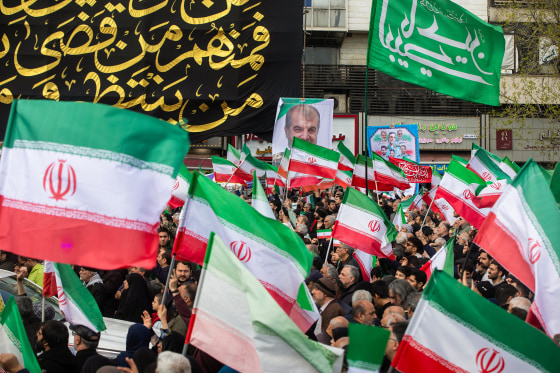
The stories in these pieces form a single alarming narrative: a U.S. war with Iran is ceasing to be "somewhere over there" and is increasingly turning into a confrontation between two countries in which not only the fate of a specific region is at stake, but also basic norms of international law, America’s image in the world, and the security of critical infrastructure. Against the backdrop of a two‑week ceasefire reported by CBS News about an agreement to halt hostilities between the U.S. and Iran for two weeks (CBS News), President Donald Trump’s rhetoric about the possible destruction of an "entire civilization" is echoing, strikes on bridges and power plants are being discussed, and simultaneously Iran is conducting an invisible cyberwar, infiltrating U.S. industrial systems, as warned by a joint U.S. intelligence report (NBC News). Against this background U.S. domestic politics is effectively splitting: some Republicans and a significant share of military officials and experts accuse the president of promoting ideas reminiscent of the darkest pages of the 20th century and warn of a direct risk of war crimes, as detailed by ABC News.
The common thread across all three pieces is the rapid erasure of boundaries between war and peace, between military and civilian infrastructure, between external and internal security. This is a story of how political rhetoric and cyberattacks on infrastructure become real threats to millions of people, while legal and moral limits that once seemed sacrosanct are openly under attack.
At the center of the narrative is the position and rhetoric of Donald Trump. On the eve of the two‑week ceasefire with Iran reported by CBS News, he threatened on social media that "an entire civilization will die tonight and never be restored" if Iran does not agree to a deal to open the strategically important Strait of Hormuz. This narrow waterway is a key channel for oil exports from the Persian Gulf; its blockage or control gives Iran leverage over the global economy and the West. As a lever of pressure, Trump explicitly talked about possible strikes on bridges and power plants in Iran—effectively targeting facilities critical to the daily lives of millions of civilians.
Here the main ethical and legal conflict emerges, running as a red thread through the reporting. Under international humanitarian law (the body of rules governing the conduct of war, including the Geneva Conventions), one of the core principles is the distinction between military and civilian objectives. Strikes on objects that are not military targets, or whose effects disproportionately harm civilians, can be considered war crimes. ABC News notes that experts are already warning that massive strikes on bridges and power plants that primarily serve civilians could potentially violate international law, and many Democrats explicitly call such actions war crimes.
Notably, this discourse has not remained on the sidelines: in the U.S. it has triggered a serious domestic political crisis. Several prominent Republicans—typically Trump allies—are publicly distancing themselves from him. Republican Senator Ron Johnson, in an interview on the "John Solomon Reports" podcast cited by ABC News, said he "hopes and prays" the president is merely "bluffing" and emphasized: "I don't want us to start blowing up civilian infrastructure… We are not at war with the Iranian people. We're trying to free them." Republican Congressman Nathan Morrow of Texas explicitly says he does not support the "destruction of an 'entire civilization'" and adds: "This is not who we are, and it is not consistent with the principles that have long guided America." Senator Lisa Murkowski calls Trump’s rhetoric "an affront to the ideals of our nation" that undermines the U.S.'s role as a "global beacon of freedom" and "directly endangers Americans both abroad and at home."
It is important to explain why such stark language about "civilization" and the destruction of infrastructure raises not only diplomatic but also legal and military alarm. The concept of a "war crime" includes, among other things, deliberate attacks against civilian populations and actions aimed at destroying groups of people as such. When the president of the world's most powerful military suggests "liquidating a civilization," that goes far beyond ordinary "tough rhetoric" and begins to resemble a threat of large‑scale violence against a group defined by nationality or culture. That is why a number of politicians and commentators cited by ABC News use terms like "mass murder" (Rep. Mike Quigley), "war crime" (Rep. Jason Crow), and even invoke the 25th Amendment to the U.S. Constitution, as former Republican Congresswoman Marjorie Taylor Greene does, suggesting the possibility of removing the president for inability to discharge his duties.
When asked about the legality of strikes on civilian infrastructure, Trump, according to ABC News, simply said: "No, no, I don't worry about that." This answer stands in stark contrast to statements by Defense Secretary Pete Hegseth, who, commenting on a prior incident in which children died after a strike near a school, emphasized: "We of course never target civilian objects."
On the Democratic flank the reaction is even harsher. Senate Democratic leader Chuck Schumer calls Trump "extremely sick" for the threat to destroy "an entire civilization" and says every Republican who refuses to vote against this "reckless war of choice" is responsible for the consequences. House Democratic leader Hakeem Jeffries urges Congress to "immediately stop this irresponsible war of choice in Iran before Donald Trump drags us into World War III" and implores Republicans to "put patriotic duty above partisan loyalty." A group of House Democratic leaders in a joint statement calls Trump "entirely unbalanced" and says his words "shock the conscience" and demand "decisive action from Congress." Mentioned in the reporting is the ongoing sixth week of war, strikes that killed more than 100 children at an Iranian elementary school, and calls to immediately "rein in" the president.
An additional, extremely important layer is the discussion of the legality of presidential orders and the duties of the military. ABC News recalls a video recorded a year ago by a group of Democrats—former military personnel and officers—in which they addressed U.S. service members and discussed the right and duty to refuse unlawful orders. Senator Elissa Slotkin emphasizes that if service members are asked to do something that contravenes the law and their training, it exposes them to criminal liability. Congressman and former special operations soldier Jason Crow reiterates that the military "must only follow lawful orders" and that calls to destroy a civilization are "the words of someone not entirely mentally sound" and "a war crime." Senator Mark Kelly, a former Navy pilot, says that in 25 years of service he has not met anyone so unfit for leadership as Donald Trump. Thus the conflict goes beyond politics and enters civil‑military relations and military ethics: the military are effectively being asked to prepare for a possible confrontation with their own commander‑in‑chief in the event of clearly unlawful orders.
Symbolically, at the very moment Trump publicly threatens Iran and is presented with a list of infrastructure targets, as NBC News reports, Iran is mounting its own campaign against U.S. critical infrastructure—already in cyberspace. In a joint advisory, the Cybersecurity and Infrastructure Security Agency (CISA), the FBI, the NSA, the Department of Energy, and U.S. Cyber Command warned that "Iranian‑affiliated APT actors" (APT—Advanced Persistent Threat—refers to well‑organized, persistent cyber groups often linked to state structures) are actively breaching industrial control systems in the United States.
This concerns Rockwell Automation systems and their Studio 5000 Logix Designer software package—a system used to manage industrial controllers that operate physical assets: pumps, turbines, conveyors, water treatment processes. According to NBC News, targets have included entities in government services, water and wastewater utilities, and the energy sector. "Operational disruptions and financial losses" have already been recorded, though the severity of incidents has not been publicly detailed. Notably, this is the first public advisory of this level about internal threats to critical infrastructure since the start of the U.S.–Iran conflict. Earlier, in 2023, the U.S. accused the Iran‑linked hacker group "CyberAv3nger," associated with the Islamic Revolutionary Guard Corps, of breaching at least 75 devices in U.S. water systems—then no significant damage was reported, but the current activity appears more targeted and larger in scope.
This mirroring—the U.S. considering strikes on Iran's energy and infrastructure while Iran attacks U.S. industrial systems—highlights a fundamental shift: civilian infrastructure is becoming a legitimate target on both sides, albeit by different means. In one case this might be physical destruction of power plants; in the other, remote manipulation of control systems that can also lead to factory shutdowns, blackouts, water outages, equipment damage, and even threats to human life (for example, if water treatment plants or hospital power systems fail). The joint advisory cited by NBC News recommends immediately disconnecting vulnerable Rockwell controllers from the internet—an admission that earlier mass connectivity of industrial systems under the banner of "Industry 4.0" has created new, poorly protected fronts of war.
To grasp the seriousness of the situation, it is useful to explain what industrial control systems (ICS) are. They are the digital "brains" of factories, power plants, treatment facilities, and other sites that, via programmable logic controllers (PLCs), manage physical processes: when to run a pump, which valve to open, what temperature to maintain. In peacetime, their compromise can cause production stoppages or financial loss. In wartime, they become a tool for "kinetic" impact: a wrong command can overheat a turbine, destroy equipment, or trigger an emergency. That is why attacks on such systems are regarded by many experts as a form of armed effect, even if no traditional weapons are used.
In this context, note another detail from the NBC News piece: sources say the Pentagon has already provided the president with a list of infrastructure targets serving both military and civilian populations in Iran—ostensibly to avoid qualifying strikes as war crimes. In other words, there is a search for a legal "gray zone" where an object can be labeled dual‑use and thus its destruction formally fit within permitted bounds. But the dual nature of such targets makes the consequences unpredictable for civilians: a power plant supplies not only a military site but also hospitals, homes, and drinking water pumps. Destroying a bridge disrupts logistics not only for the military but also for deliveries of food and medicine.
Thus the larger theme linking all three sources is the destruction of boundaries: between war and peace, legally permissible and morally unacceptable, military and civilian targets, foreign policy and domestic security. On one hand, Trump, according to CBS News, agreed to a two‑week ceasefire with Iran—a step that formally should reduce tensions. On the other, that pause looks less like a step toward peace than an operational breather amid escalating rhetoric and continuing cyberattacks. The two‑week truce is not accompanied by a change in tone: threats to destroy bridges, power plants, and an entire civilization were voiced literally on the eve of the pause.
According to ABC News, the American political system has not yet found a unified response. Some Republicans prefer silence: no member of Senate Republican leadership, Speaker of the House Mike Johnson, nor the chairs of relevant committees responded to requests for comment about Trump’s posts. Others, including Johnson, Moran, and Murkowski, have publicly stated that "this is not who we are." Democrats are demanding Congress be called back from recess early to discuss the war with Iran, but the House is not scheduled to vote until mid‑April. Outside Congress even conservative media figures like Tucker Carlson criticize the president: per ABC News, Carlson calls Trump’s Easter post on Iran "disgusting on every level" and "the most authentic" (i.e., the most revealing of his nature). Trump’s response—calling Carlson "a low IQ individual"—underscores that the confrontation transcends partisan lines and splits even the traditional conservative camp.
Key findings and trends emerging from these materials can be summarized in several directions. First—normalization of extreme rhetoric. The threat to destroy a "civilization" and the stated willingness to strike infrastructure that provides basic services to civilians is ceasing to be an unthinkable taboo and is becoming a subject of tactical debate. This is dangerous not only because it increases the risk of actual use of force, but also because it blurs moral benchmarks and creates a precedent: if one major democracy adopts such a broad interpretation of what is permissible, other authoritarian regimes gain a convenient pretext for their own actions.
Second—the growing importance of infrastructure as a theater of war. Classical war implied armies clashing on battlefields; modern war increasingly centers on control of infrastructure nodes: straits, power grids, water supplies, industrial control systems. Physical strikes on bridges and power plants and cyberattacks on Rockwell Studio 5000, described by NBC News, are two sides of the same coin. The vulnerability of civilian infrastructure becomes a key lever of pressure, and the lines between defense and offense in cyberspace are blurred.
Third—domestic institutional stress in the U.S. Appeals by politicians to the military reminding them of their duty to refuse unlawful orders, calls to invoke the 25th Amendment, demands to convene Congress immediately, splits within the Republican Party, and open confrontation between the president and media allies like Tucker Carlson, as reported by ABC News, are all signs of a system whose checks and balances are being tested. The question is not only what policy the U.S. will adopt toward Iran, but whether the American constitutional framework can withstand pressure from a president prepared to politically and rhetorically cross previously established red lines.
Fourth—mutual cyber‑escalation as both background and harbinger of broader conflict. Attacks by "Iranian‑affiliated APT actors" on American industry, warned about by CISA, the FBI, the NSA, the Department of Energy, and U.S. Cyber Command in the report cited by NBC News, show that war has long been waged on another, "invisible" level. These are not merely intelligence operations but attempts to cause real operational disruptions and losses. Combined with discussions of possible U.S. strikes on Iranian infrastructure, this creates a dangerous dynamic: each side can justify its actions as a response to the other's "hybrid aggression," while social and economic consequences for civilians grow regardless of whether a formal ceasefire exists.
In the end, even the two‑week truce reported by CBS News looks less like the start of de‑escalation and more like a short pause in a broader, deeper confrontation. As long as rhetoric remains at the level of threats to destroy "civilizations," domestic political crisis in the U.S. intensifies, and Iranian hackers continue to penetrate U.S. industrial systems, the main trend is clear: the world in which clear "red lines" existed between war and peace, military and civilian, external and internal is rapidly fading. In its place a dangerous landscape is emerging where every word from the leader of a nuclear power and every unprotected industrial device on the network can have consequences comparable to the use of weapons.