The materials presented share a common theme: the limits of endurance—the ability of a person or society to withstand prolonged physical, psychological and institutional pressure. In one case, the focus is on military sailors who spent almost a year at sea; in another, on a family and law-enforcement system confronted with a tragic crime; and in the third, on a 61-year-old woman who set a world record in the plank exercise. These stories differ greatly in scale and circumstances, but together they show that endurance always comes at a cost: it requires discipline, support, risk management and recovery.
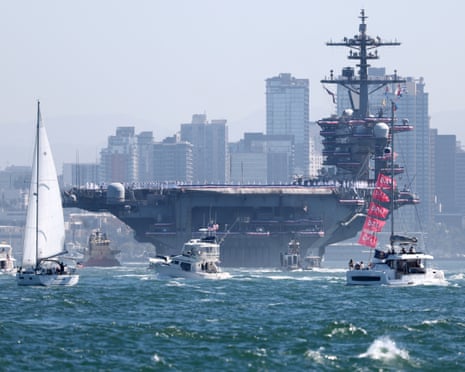
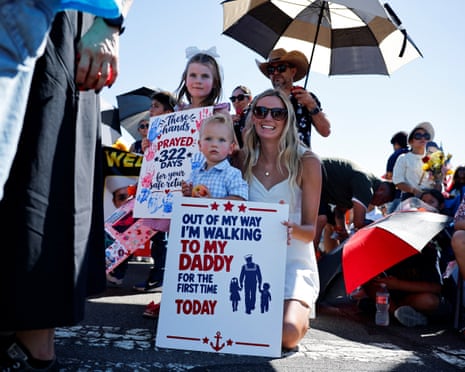
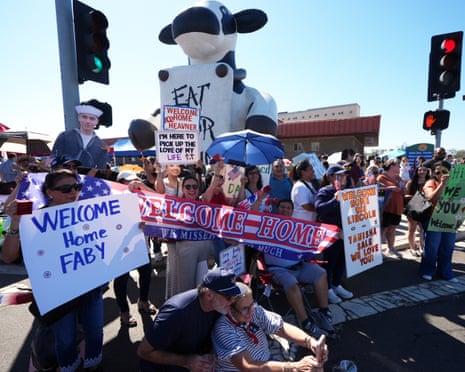
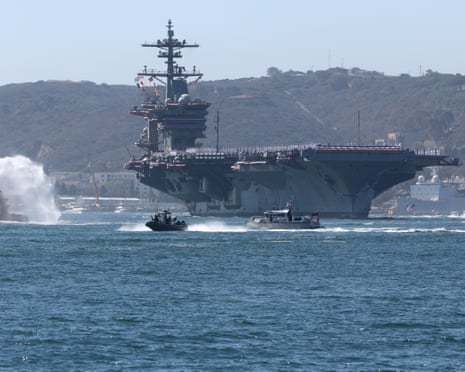
The return of the USS Abraham Lincoln aircraft carrier to San Diego was the main event covered by The Guardian. The ship completed a record-breaking mission after more than 320 days away from home and over 260 days without entering port. The deployment was extended twice because of the US war with Iran. For the military personnel, this meant prolonged strain; for their relatives, months of waiting and uncertainty. In photographs published by The Guardian, families greet the sailors with flowers and handmade signs. The emotional return scene highlights not only the celebration but also the scale of the ordeal they endured.
The contrast between public heroism and the hidden cost of prolonged service is particularly important. Acting Navy Secretary Hung Cao said that eight service members from the USS Lincoln and its accompanying strike group had attempted suicide. This transforms the discussion of the record-breaking mission from a story of professional resilience into a conversation about mental health, exhaustion and the limits of acceptable strain. Defense Secretary Pete Hegseth, by contrast, accused the media of spreading “insincere headlines” and “propaganda,” claiming that reports of low troop morale had been exaggerated. This creates an institutional problem: an organization may seek to preserve an image of strength, while the real consequences of prolonged stress require open acknowledgment and assistance.
The political context heightens this tension. Donald Trump said that the US would not strike Iran before the November 3 midterm elections, although it had previously been reported that the Pentagon was developing possible attack options. The president also attempted to explain his remarks that Iran could “destroy Los Angeles” or “San Diego.” He said he had not been discussing the desirability of an attack, but was comparing a temporary rise in gas prices with the potential threat posed by nuclear weapons and the bombing of American cities. This rhetoric again introduces the idea of cost: economic hardship and military risks are presented as an acceptable price for security. For service members and their families, however, the cost of such policies is measured not only in fuel prices or approval ratings, but also in time away from home, physical exhaustion and psychological trauma.
The article also shows how national resilience is intertwined with questions of trust and accountability. Federal Judge Timothy Kelly temporarily upheld the Trump administration’s ban on CNN, MS Now and Politico accessing the White House. The Justice Department argued that the outlets had spread “verifiable lies” and violated basic journalistic standards, while an attorney for the news organizations said the government had provided no evidence of harm to national security. He also noted the lack of prior notice and cited Trump’s own comments that the coverage had not been positive enough. Here, the resilience of democratic institutions is tested not by physical strain, but by their ability to withstand conflict among the executive branch, the press and the courts.
The same logic of systemic pressure can be seen in a report about administration figures’ ties to Bosnian Serb nationalists. As The Guardian reported, citing the Financial Times, Katie Wiles, the daughter of White House chief of staff Susie Wiles, works for a lobbying firm receiving $35,000 a month from the government of the Bosnian Serb entity. It was previously reported that former Trump campaign manager Chris LaCivita and deputy chief of staff James Blair are also paid consultants to the organization. The entity was created after ethnic cleansing during the 1990s war, while the 1995 massacre in Srebrenica took place there. The existence of such ties does not in itself prove any illegality, but it raises questions about conflicts of interest, reputational risks and the limits of lobbyists’ influence on foreign policy.
In another segment, The Guardian reports on new sanctions against 17 vessels belonging to Iran’s so-called “shadow fleet.” The term refers to a network of aging tankers used to circumvent sanctions and transport oil to foreign markets. Washington seeks to limit Iran’s ability to export raw materials, but such measures also increase economic pressure and may affect global energy prices. Thus, a state’s strategic endurance is built through sanctions, blockades and diplomatic pressure, but the consequences are distributed among governments, companies, service members and ordinary consumers.
A report by WCVB about Ryan Hanafin’s arrest in Vermont after the killing of his mother shows a very different scale of crisis—one that is familial and local. Police said that 49-year-old Andria Hanafin was found dead at a home in Reading, Massachusetts. Her husband called 911 after returning home; their 13-year-old son was inside the house. Police believe the woman was shot, and Ryan Hanafin’s firearms license had been suspended. After the suspect was arrested, authorities said there was no longer an immediate threat to the public.
This report particularly highlights how careful journalistic language must be. Police refer to the detained man as a suspect or a person of interest, not as a perpetrator. This distinction is important: an arrest means there are grounds for an investigation, but it does not replace a court ruling. The family must now endure the consequences of the mother’s death, the possible charging of one of the children and the attention of investigators. The references to the 13-year-old son, a daughter who was at school and numerous cat carriers provide a human context for the tragedy, while also reminding readers that the details of the criminal case have not yet been conclusively established.
The story of Donna Jean Wilde, published by Fox News, presents endurance in its most positive and individualized form. The 61-year-old Canadian and grandmother of 12 held a plank for five hours—from 3:03 p.m. to 8:03 p.m.—at the National Senior Games in Utah. She surpassed her own 2004 result of 4 hours, 30 minutes and 11 seconds by nearly half an hour. The new record is still awaiting verification and official recognition by Guinness World Records.
The plank is a static exercise in which a person supports themselves on their forearms and toes while keeping their body straight and avoiding contact with the floor with any other part of the body. To have a result recognized, the rules require the forearms and toes to remain continuously in contact with the surface while the torso stays straight. The feat therefore involves not only muscular strength, but also technical precision, self-control and the ability to tolerate prolonged discomfort.
Wilde described the first two hours as relatively quick, the next two as considerably harder and the final hour as the most difficult. During the last 30 minutes, she focused on breathing, staying calm and maintaining her form. Her experience shows that endurance is not the product of a single act of willpower, but of a strategy for managing exertion. She began practicing the plank after breaking her wrist because she could perform the exercise while wearing a cast, and later incorporated it into her daily life. Her advice—to keep practicing and use short periods of reading or working on the floor—reflects the principle of gradually building results.
At the same time, the sporting example cannot be mechanically transferred to military service or crisis situations. In Wilde’s case, the exertion was voluntary, prepared in advance and limited to a single challenge. For the aircraft carrier’s crew, the strain was compulsory, prolonged and connected to combat duties; for the Hanafin family, it arose from a sudden tragedy that cannot be “trained for.” The key distinction, therefore, lies between voluntary endurance and forced suffering. The former may be inspiring; the latter requires not admiration but assistance, protection and institutional responsibility.
Another important The Guardian story concerns the administration’s decision to restrict Microsoft’s access to the PERM program. This program is the first stage in an employer’s process of obtaining permanent residency for a skilled foreign employee already in the United States on a temporary H-1B visa. Vice President JD Vance said, “We need to hire great American workers,” accusing companies of replacing US citizens with foreign “indentured servants.” In this case, government policy seeks to demonstrate labor-market resilience through stricter migration controls, but at the same time creates uncertainty for highly skilled professionals and technology companies.
Against this backdrop, Trump honored leading figures from the technology industry, including Elon Musk, Sergey Brin, Jensen Huang and Lisa Su. The event took place amid growing concerns about artificial intelligence. A revealing contradiction emerges: the administration is strengthening its ties with technology leaders while tightening rules for part of the international workforce that supports America’s scientific and corporate infrastructure. The resilience of the technology sector here depends not only on investment and innovation, but also on its ability to attract specialists, establish clear rules and manage the risks of artificial intelligence.
Taken together, the three sources present endurance as a multilayered phenomenon. At the individual level, it appears in discipline, breathing and bodily control, as in Donna Jean Wilde’s case. At the family level, it involves coping with sudden loss and investigative uncertainty, as in the story of the Hanafin family. At the national level, it means the ability to withstand prolonged conflict, economic sanctions, political pressure, information disputes and the consequences of staffing decisions.
The main conclusion is that resilience should not mean simply continuing to work at any cost. The aircraft carrier’s record time at sea may demonstrate operational strength, but it may also reveal failures in caring for personnel. Forceful policies may appear decisive, but their consequences require honest assessment. The dispute over media access shows that democratic institutions are resilient only when they allow those in power to be scrutinized. And the sporting record reminds us that true endurance is effective when it is based on preparation, adherence to rules and an understanding of the body’s limits.
The central trend across all the materials is the movement from outward impression to the hidden cost of achievement. Behind the ship’s return lie months of separation and reports of suicide attempts; behind political statements lie the risk of escalation and rising prices; behind the arrest lies a shattered family; behind the sporting record lie years of practice, pain and strict technique. Public assessments of success should therefore take into account not only what was endured, but also the consequences that arose in the process and the resources needed for recovery.