Amid a sharp escalation around Iran and the Strait of Hormuz, another development in American politics has further intensified a sense of instability: Senator Lindsey Graham, one of the most prominent hardliners toward Tehran and a close ally of Donald Trump, has died. Taken together, these headlines form a single picture: the Middle East is once again at a point where military strikes, threats to sea lanes, energy security, and U.S. domestic politics intertwine almost inseparably. The story is not just about an exchange of blows—it shows how quickly a local conflict turns into an international crisis with global consequences, and how strongly such a crisis depends on individuals, above all Trump, and on figures like Graham, who helped shape the American course.
The main thread running through all the coverage is a struggle to control the escalation. NBC News reports that the United States carried out new strikes against Iran after an attack on a Cyprus-flagged container ship in the Strait of Hormuz; CENTCOM said the targets were chosen to “degrading Iran’s ability to attack civilian mariners and commercial ships freely transiting the strait.” Tehran, in turn, via the Islamic Revolutionary Guard Corps, announced the strait was closed and warned that “The Strait of Hormuz is closed until further notice.” Against this backdrop, the White House insists on the opposite: “Iran does not control the strait. Traffic is flowing.” This is not merely a dispute over wording. The Strait of Hormuz is the narrow choke point of the world’s energy system, through which, as NBC reminds readers, about one-fifth of all global oil was shipped before the war. When one side declares the strait closed and the other claims it is open, it is not only propaganda—it is an attempt to impose on the world its own version of reality, and therefore its own price for vessels to pass.
The very logic of the conflict is becoming more dangerous because strikes and counterstrikes are moving beyond a single geography. NBC describes how Iran said it carried out attacks on military targets in Jordan, Kuwait, Qatar, and Oman, while the United States responds with large-scale strikes on 140 military sites. In such conditions, maritime security stops being a narrowly specialized topic and becomes a tool for pressure on international trade—above all the oil and gas market. When one party threatens to close the strait and the other responds by striking infrastructure, global markets react instantly. That is why CENTCOM’s words in the article—about the U.S. being ready to ensure “freedom of navigation”—are so important. The phrase means the right of commercial and civilian ships to pass safely through international waters without arbitrary blocking. In practice, it is one of the key principles of global trade, and violating it creates a risk not only of a military clash, but of an energy shock.
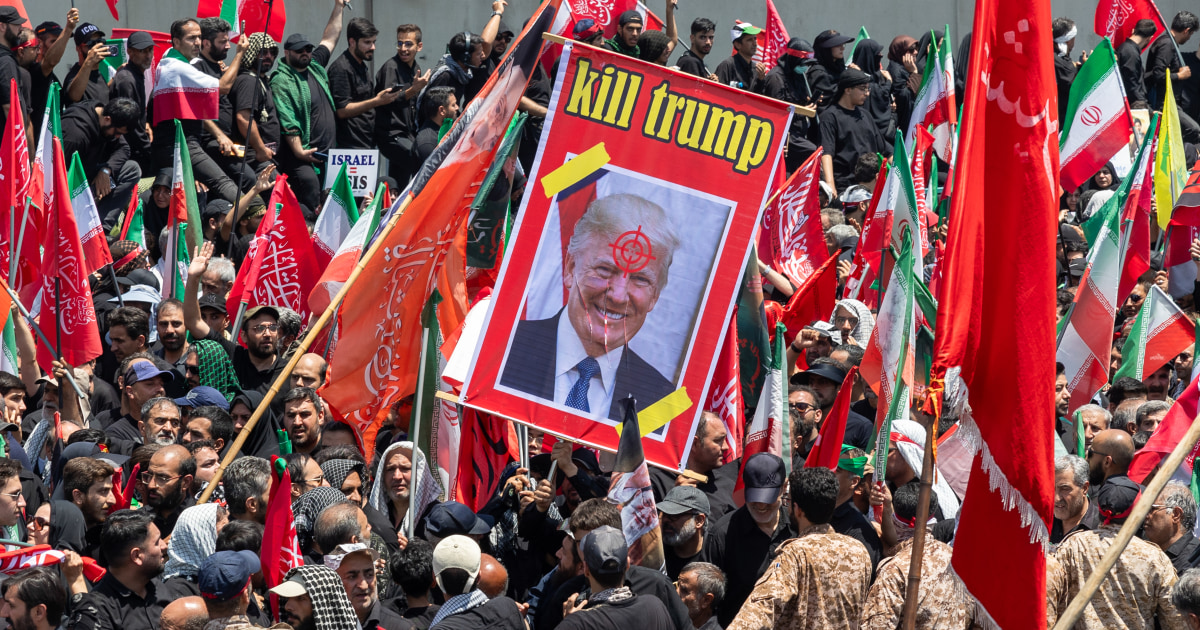
Equally important is the political and symbolic layer. NBC writes about the funeral of Ayatollah Ali Khamenei, killed in the first strikes of the war, and about how the new Supreme Leader, Mojtaba Khamenei, vowed revenge: “Revenge is the demand of our nation and must certainly be carried out.” Here, the conflict takes on an almost sacred dimension. For Iran’s leadership, it is not only about a military response, but about restoring honor; for the U.S. and Israel, it is about preventing further attacks and demonstrating strength. It is especially telling that threats were also directed at Trump: at the funeral, according to NBC, English-language banners appeared calling for him and Netanyahu to be killed, after which Trump responded with a sharp post saying that if an assassination attempt were made on him, “a thousand missiles are Locked and Loaded” and “all areas of Iran” would be destroyed. Such an exchange of threats shows that diplomatic space has nearly vanished: the sides are no longer talking about compromise, but about retribution.
At the same time, amid all these threats and responses, one theme stands out in particular—the gap between public rhetoric and real negotiations. NBC’s piece mentions a meeting between Iran’s and Oman’s foreign ministers, where the fate of the Strait of Hormuz was discussed. Oman said the sides would continue technical and political consultations. This is an important signal: even amid bombardments, a channel for mediation remains open. But it also looks extremely fragile, because Iran simultaneously demands that the strait be under its “sole control” and even says it will collect fees for vessels’ passage, even though international law considers this route an international waterway. A fundamental contradiction is at play here: Tehran wants to turn a geographic chokepoint into a political lever, while Washington and its allies try to prevent that lever from becoming a new norm.
The death of Lindsey Graham, reported by WYFF News 4 and Yahoo, adds a human and institutional dimension to this crisis. Graham was not merely a senator; he was one of the most steadfast supporters of a tough American foreign policy, especially toward Iran, Russia, and support for U.S. allies. WYFF notes that he was “one of President Donald Trump’s closest allies in Congress,” and also an influential voice on foreign policy who “often advises the president on Iran, on the Russia-Ukraine war.” Yahoo likewise points out that Graham, who criticized Trump back in 2016, later became “one of his fiercest allies and defenders in Congress.” That makes his death important not only ceremonially, but politically: a person is gone who helped Trump build a hard line while at the same time needing to talk with Israel, Ukraine, and Iran.
The tone of the coverage about Graham shows how deeply he was embedded in the system of American power. WYFF quotes Trump, calling him “one of the greatest people and senators I have ever known” and “a true American patriot.” John Thune describes him as a “strong advocate for the United States” and “strong ally to freedom loving countries across the globe.” This is not just an obituary; it is an effort to immediately record Graham’s political legacy as one of American interventionism, transatlantic solidarity, and unwavering support for allies. It is especially notable that, according to WYFF and Yahoo, he literally met with Volodymyr Zelensky in Kyiv the day before his death. In the news feed, his figure thus connects multiple lines of the global conflict at once: Ukraine, Iran, Israel, and U.S. domestic politics.
It also matters that Graham’s death could affect U.S. political mechanics at precisely the moment when they are particularly needed. WYFF reminds readers of the 17th Amendment to the U.S. Constitution and notes that if a senator dies, a governor may appoint a temporary replacement if allowed by state law. But since the seat is already up for election, the question is not only who the successor will be, but who will now represent the hard line in the Senate with the same energy. In politics, symbolic losses often have practical consequences: the disappearance of an experienced mediator—especially one closely aligned with the president—could narrow the range of acceptable options and strengthen the role of more radical voices.
Another key takeaway from all the materials is that energy, maritime security, and leaders’ personal statements in this crisis have almost completely merged. When NBC writes that Iran attacked a vessel and the United States responds with strikes on military facilities, it is no longer a separate episode—it is part of a broader struggle over who sets the rules for transit through the Strait of Hormuz. When Trump writes in an emotional, almost demonstratively religious style, and the Iranian side answers in the language of revenge and “divine mission,” the conflict becomes not only geopolitical, but also ideologically charged. This is especially dangerous because such texts create an effect of irreversibility: the more absolute the threats appear, the harder it becomes to return to negotiations without losing face.
In this sense, all three sources converge on one point: the region has entered a phase where any incident can set off a cascade of consequences. An attack on one ship triggers strikes on dozens of targets; a public threat against one leader leads to retaliatory statements about “thousands of missiles”; the death of one senator changes the context in which these decisions are made. The words “Traffic is flowing,” from CENTCOM’s statement, almost sound like a political formula meant to keep markets and allies from panicking. But the very need to repeat it suggests that freedom of navigation has already become a matter of dispute rather than an unquestioned norm.
Explanations of the more complex concepts also matter here. CENTCOM is the U.S. Central Command, a structure responsible for American military operations in the Middle East and neighboring regions. The Islamic Revolutionary Guard Corps, or IRGC, is Iran’s elite military and political force, which has its own land, missile, and naval units and plays a key role in security decision-making. “Freedom of navigation” means the principle of unhindered passage of ships along international maritime routes. An “interim deal” is a temporary agreement—that is, not a final peace, but a fragile understanding that can be derailed by any new strike. And the Strait of Hormuz is a strategically crucial maritime corridor between Iran and Oman, through which a significant share of the world’s oil and gas supplies flows—this is why any statements about closing it almost immediately become news of global significance.
Taken together, these events reveal several key trends. First, Iran is increasingly using maritime infrastructure as a means of political pressure, understanding that even limited disruption of shipping creates a global ripple effect. Second, the United States is responding not only with force but also with public assertions about the strait’s legal status, seeking to prevent Tehran from locking in a new norm of behavior. Third, personal relationships and political figures—such as Trump and Graham—remain extremely important, because it is through them that Washington’s hard line is formalized. And finally, fourth, domestic and external crises are now moving in parallel: Graham’s death, threats to Trump, the Iranian leader’s funeral, and attacks on ships are combining into one tense, extremely unstable international picture.
From a practical standpoint, the main risk is that such escalation could go beyond a manageable conflict. As long as diplomatic channels through Oman are still working, there remains a chance for at least temporary containment. But the longer mutual strikes and threats of retaliation continue, the less space there is for a deal. This is precisely what makes the current phase of the crisis especially alarming: it no longer looks like a series of separate episodes, but like a clash of two incompatible logics—the logic of coercion and the logic of a sovereign challenge. And if the Strait of Hormuz really remains “open to all vessels seeking to lawfully transit,” as CENTCOM claims, then for now it is more a statement of intent than a guarantee of security.