Across three, at first glance unrelated, news developments runs a single common thread: how quickly an everyday setting — a street, a sea corridor, an office skyscraper — turns into a risk zone when human error, violence, or institutional miscalculation gets involved. In Viña del Mar, Chile, a private car plowed into a crowd at a market; in the Strait of Hormuz, military and diplomatic logic makes a waterway into an instrument of pressure; in New York, a victim of last year’s high-rise shooting is seeking an answer from the city for what he says was an incident of negligence by a security officer who was working in the building. All three stories speak not only to the tragedy itself, but to how responsibility is allocated — or, conversely, blurred — once the incident has already occurred.
A report by The Times of India describes a deadly hit-and-run in the coastal city of Viña del Mar: “an off-duty Chilean navy member crashed his private vehicle into an open-air market,” killing several people and injuring several more. While authorities had not confirmed the exact number of victims, local media reported at least six deaths. Police say the driver claimed he “does not remember” what happened, while witnesses described a car traveling at high speed that mounted the sidewalk. What matters here is that the tragedy begins not with a premeditated crime, but with an instant, inexplicable — and possibly technical or psychological — malfunction. Even if it is later found that it was a loss of control, intoxication, a health problem, or intent, for people at the market it is already an event that underscores how vulnerable public space is to a private transport mistake.
A similar motif of vulnerability, but on a completely different scale, emerges in a report from CNN. Here, the issue is not a random incident, but a protracted standoff around the Strait of Hormuz — one of the world’s most important maritime corridors through which a significant share of global oil and gas shipments passes. CNN describes a recurring pattern: an Iranian drone attacks a vessel in the strait, the United States responds with strikes against targets on the Iranian coast, and the Islamic Revolutionary Guard Corps launches missile-and-drone strikes against U.S. allies in the Persian Gulf. This time, Qatar and Oman were targeted, with Qatar trying to intercept a missile attack in Doha. The article emphasizes that Iran sees the strait as leverage: “This strategic waterway is one of the country’s deterrent assets,” as said by an adviser to Supreme Leader Mohsen Rezai. In this context, the phrase “deterrent assets” refers to a means of deterrence — a resource that allows not so much to win a war as to prevent the opponent from taking certain actions through the threat of escalation.
The most important part of this story is not only the exchange of strikes, but also that diplomatic channels have not disappeared entirely. The report says that Qatar and Pakistan’s mediation efforts continue, and that Oman received Iran’s foreign minister, Abbas Araqchi, for talks about navigation through the strait. But, as noted by the Institute for the Study of War, the difference between Iran’s negotiators and the IRGC concerns tactics rather than strategy: the choice is between negotiations and military activity, not a fundamental refusal by Iran to control the situation. In other words, talks here do not negate the threat; they run in parallel with it. The United States, according to CNN, is asking Iran to publicly acknowledge that the strait is open to commercial shipping and to stop attacks on vessels; Tehran, meanwhile, does not want to return to the pre-war norm of full freedom of navigation. That makes the conflict especially dangerous: each side sees a concession as a strategic weakening, not a temporary compromise.
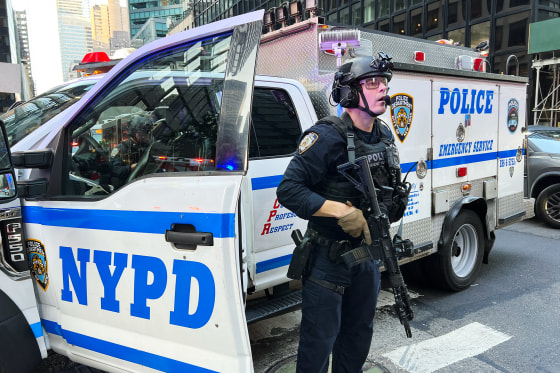
The third news item, published by NBC News, takes the question of safety to the level of legal responsibility and institutional negligence. NBC News reports that an NFL employee who was injured during last year’s shooting at a high-rise has filed a lawsuit against New York, arguing that the city is responsible for “negligence” — negligence — by an officer who worked in the building off duty and died during the attack. Here, international geopolitics or an instantaneous market accident is not the issue; instead, the same question remains: who is responsible for safety when the person tasked with it either failed to do the job or was not where they were supposed to be at the moment when violence needed to be prevented. The wording of the lawsuit shows that victims are increasingly trying not only to obtain compensation, but also to define, in legal terms, where individual error ends and systemic failure begins.
Taken together, all three reports make it clear that modern security is almost always built on a fragile balance between control and randomness. In Chile, a single car is enough to break the familiar boundary between the road and the pedestrian area. In the Strait of Hormuz, one drone or one missile is enough to set off a chain of retaliatory actions that affects global energy markets. In New York, one underestimated or improperly organized security episode is enough for the victim, later on, to try to turn the tragedy into a court dispute over systemic responsibility.
Another important conclusion is that in every case after an incident, the struggle begins not only for facts, but also for the narrative. In Chile, the driver says he does not remember what happened; in Iran and the United States, both sides use the rhetoric of control over the strait to demonstrate that they are right; in New York, the plaintiff is trying to prove that the tragedy was not just an inevitable accident, but a consequence of specific negligence. This matters particularly because public reaction to stories like these depends on whether responsibility is acknowledged or dissolved into uncertainty. Where there is no clear answer, suspicion grows, political tensions rise, and trust in institutions declines.
Finally, all three stories serve as a reminder that the term “security” does not mean the absence of risk altogether. Rather, it is the ability to recognize a threat in time, limit its consequences, and honestly allocate responsibility when the system failed. In Viña del Mar, investigators are looking for the cause of the deadly car crash and determining whether it was an accident, a mistake, or something more. In the Strait of Hormuz, security now depends not on a police response, but on whether the powers can refrain from further escalation and find a minimal functioning mode for navigation. In New York, the question is whether the city can be held responsible for a security-services failure if the person called upon to maintain order turned out to be part of the tragedy. And in all three cases, the answer to the central question — who is responsible and for what — will determine not only the legal consequences, but also how much society can trust its own protective mechanisms.
When explaining complex concepts, it is important to clarify that the “Strait of Hormuz” is a narrow maritime passage between Iran and Oman through which an enormous volume of oil shipments flows; that is why attacks there affect not only the region, but also the global economy. The “Islamic Revolutionary Guard Corps” is a separate Iranian military-political force with significant influence and often operates more harshly and autonomously than ordinary state institutions. “Negligence” in the legal sense is not just an error, but a breach of a reasonable standard of care when an official or organization failed to take measures that should have prevented harm. These are precisely the concepts that link all three stories: danger is rarely abstract; it almost always arises at the intersection of human action, institutional weakness, and realization that comes too late — when ordinary space has already become a risk zone.
The key takeaway from these messages is that the modern world lives in a state of constant vulnerability, where a private mistake, military pressure, and an institutional breakdown can have equally severe consequences. The difference is only the scale: from a market square to an international strait to an office tower. But the logic is the same — security is no longer viewed as a given; it has to be proven anew after every incident.