At first glance, we have three separate topics: the powers of the US president, the rules for counting mail-in ballots, and Europe’s water agenda. But if you look more closely, all three pieces are really about the same thing—how modern institutions are trying to strike a balance between political power and the rules meant to restrain that power. In one case, it’s about the independence of the Federal Reserve; in another, it’s about the fairness and administration of elections; and in the third, it’s about protecting a shared resource—water—where what’s increasingly needed isn’t political slogans, but system-level governance. In each storyline, the main line of today’s politics is not simply a fight over outcomes, but a fight over who exactly has the right to make those decisions, and under what conditions.
The most striking—and most telling—story is the US Supreme Court’s decision in the case of Lisa Cook, a member of the Board of Governors of the Federal Reserve System, along with a parallel case involving the Federal Trade Commission. The court, at the same time, limited Donald Trump in his attempt to fire Cook, but gave him more leeway regarding other independent agencies. The ruling looks like a subtle but important demonstration of judicial balance: the court does not deny the president power altogether, but it also does not allow him to fully subordinate every structure that Congress once created specifically as a safeguard against political pressure.
In Cook’s case, the Supreme Court effectively recognized that the Federal Reserve is a special institution. As Chief Justice John Roberts put it, accepting the administration’s argument would have meant “to essentially turn the Federal Reserve’s protection from removal at will into employment at will.” He added that such a move would be “out of step with the law Congress enacted and with the tradition of a central bank insulated from political interference.” This is the key phrase: for the first time, the court so openly separated the Fed from the broader trend in which a conservative majority in recent years has steadily weakened protections for independent agencies.
This is where the main point of the decision becomes clear. The American system is built on the principle of separation of powers, but in practice it is also a system of mutual checks. When the court writes, “Our Constitution makes three branches, but only one president,” it is not merely reciting the basics of government structure. It is asserting that the president cannot be the only center of administrative will. Yet in another case involving the Federal Trade Commission, the same court expands the president’s ability to remove members of agencies created as independent. This isn’t a contradiction in everyday terms—it is a very precise distinction: the Fed is carved out as an exception, while the general doctrine of agency independence is, in turn, weakened.
This approach matters not only to legal scholars. It directly affects the economy and trust in US monetary policy. The Federal Reserve influences interest rates, lending, inflation, and market expectations. Its autonomy has historically been seen as a condition for decisions being made not according to the electoral cycle, but according to long-term macroeconomic logic. NBC News rightly notes that global markets have long relied on the Fed’s independence, and there have been no attempts by a president to fire a top Fed official before. That is why even Cook’s temporary protection has a much broader effect than it might seem: it signals that political power has a boundary beyond which it cannot yet go.
At the same time, the court continues a line that makes it easier for the president to control other departments. That means the US fight is not only about Trump as an individual, but about a deeper legal model: should the executive branch have near-total control over the federal apparatus, or should part of the institutions be insulated from direct pressure? In the FTC decision, the majority of the justices effectively supported the first position. As a result, the balance of power shifts toward the presidential chain of command—but not equally across all sectors. A hierarchy of independence emerges: the Fed is protected separately, while other agencies are far less insulated.
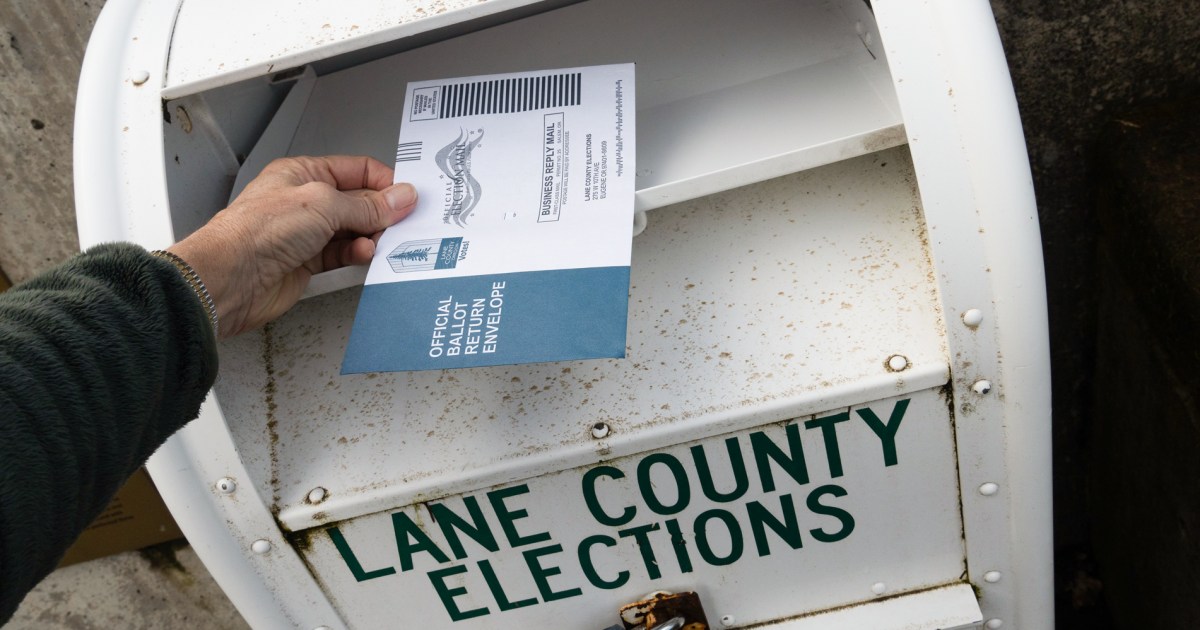
The second piece, about mail voting, shows the same problem from the other side. The Supreme Court allowed states to count ballots that arrived after Election Day, as long as they were mailed in time and have the required postmark. For the Republican Party, it is a defeat; for states’ election systems, it means the continuation of existing rules; and for American democracy, it means avoiding chaos on the eve of midterm elections. Here, too, the key conflict is not just legal. It is about who determines the practical rules for participation in politics: the federal government, the states, the courts, or the parties.
The decision, written by Justice Amy Coney Barrett, preserved the ability for 13 states to keep counting such ballots. This matters because the issue is not a technical detail—it is access to voting. Mail voting is especially significant for service members, Americans overseas, people with limited mobility, and those who live in regions where mail delivery is delayed. If the court had sided with the RNC, it would have raised questions about the votes of thousands of people who met every requirement except that the ballot physically did not arrive before midnight on Election Day. That is why NBC News notes that this could have created problems not only for domestic voters but also for overseas voters, including military personnel.
Another shared takeaway is also important here: in the US, elections are becoming more and more burdened by law. What used to be viewed as a simple administrative process is turning into a battleground for constitutional disputes. On the one hand, federal law sets Election Day for a specific date. On the other hand, states still run elections themselves, meaning they can set their own rules for counting ballots. The court did not undo this decentralization—instead, it left room for states to maneuver. The ruling stands in contrast to more hardline attempts by Republicans, including Donald Trump, to cast doubt on the legitimacy of mail voting without convincing evidence of widespread violations.
Taken together—Fed and elections—the bigger picture becomes clearer. American institutions are now both defending themselves and redistributing power at the same time. In some areas, courts slow down the concentration of power in the president’s hands; in others, they permit that concentration. In some cases, they preserve institutional autonomy; in others, they treat it as excessive. This creates a sense of legal instability, but it also shows that the struggle is not over one abstract “independence,” assessed the same way everywhere. Instead, it is over different kinds of independence—ones that society values differently. For the central bank, it is critical; for labor, safety and trade commissions, it is much less protected; and for states’ election rules, the court is inclined to leave discretion to local authorities.
Against this backdrop, Euronews’ water segment seems different in scale, but in essence it complements the same picture. Its “Water Matters” theme serves as a reminder that in Europe, pressure on water resources is growing due to pollution, droughts, floods, and ineffective wastewater management. The issue of water is also a matter of institutions and rules—just not in a judicial, but an ecological context. When the outlet says that water in Europe is “under increasing pressure,” it means that shared resources cannot be protected without coordination, infrastructure, and long-term policy. Just as protecting the Fed’s independence requires institutional insulation from day-to-day politics, water security requires governance that survives electoral cycles and responds not to rhetoric but to data.
This is especially important in the context of climate risk. Droughts and floods are no longer seen as exceptions; they are becoming the new norm, which means they require not one-off campaigns, but a systemic approach to ecosystems and wastewater treatment. Even though Euronews’ story is brief, it illustrates a shift in the public agenda: the major conflicts of the 21st century are increasingly tied not only to the distribution of power, but to the management of shared goods—whether that is monetary stability, the right to vote, or water resources.
If we combine all three pieces into one logic, it becomes clear that modern politics looks less and less like a fight over slogans and more and more like a fight over rules for access and control. In the US, it is about control over the Fed, independent agencies, and election procedures. In Europe, it is about control over water—without which there can be no health, no economy, and no regional resilience. The US Supreme Court rulings show that even the most powerful political players are forced to confront institutional limits. But at the same time, these limits are uneven: one institution is protected more strongly, another more weakly, and a third depends on how the court reads the story and the law.
The complex concepts in these pieces can be reduced to a few basic ideas. “For cause” is a legal formula meaning an official cannot be fired simply at the president’s will; specific grounds are required, such as violating the law or misconduct in office. “Independent agency” means an agency designed by Congress to be less dependent on the White House, so that its decisions do not change with political conditions. “Humphrey’s Executor” is an important 1935 precedent that long served as a foundation for protecting such agencies from presidential removal. And in an election context, disputes over ballots arriving after Election Day come down to what matters more: the moment of voting as an act by the voter or the moment the ballot physically arrives at the commission.
The main trends are clear. First, the US Supreme Court continues to redraw the boundaries of executive power, but does so selectively—protecting some institutions and weakening others. Second, American elections remain an arena of intense partisan conflict, where even the deadlines for ballot delivery become a question of political strategy. Third, Europe’s environmental agenda is increasingly built around managing resources, not just on statements about a “green transition.” In all cases, what comes to the forefront is not symbolic politics, but institutional staying power.
The conclusion can be stated simply: the modern world is living in an era when trust in systems matters more than individual wins. The US Supreme Court both reminds the president of limits and expands his influence; election rules aim to preserve citizens’ participation without creating legal chaos; and Europe’s water agenda demands long-term, disciplined coordination. These are different stories, but they share the same lesson: where pressure on institutions is growing, the question is no longer just who is louder—it is what rules will outlast the political cycle and preserve social stability.
Sources: NBC News on the ruling involving Lisa Cook and independent agencies, NBC News on counting mail ballots that arrive after Election Day, Euronews on the release of Water Matters.