Across three reports — NBC News, AP News, and ABC News — the subject matter differs, but they share one large theme: how crises that erupt at borders and in the global economy quickly turn into political tests for states. In the case of Ceuta, the test involves migration and sovereignty; in the United States, it involves inflation, an external shock, and the economy’s ability to adapt. Together, these stories show that modern states are increasingly forced to respond not to a single local crisis, but to a chain of interconnected shocks, where security, the economy, and system manageability become tied together.
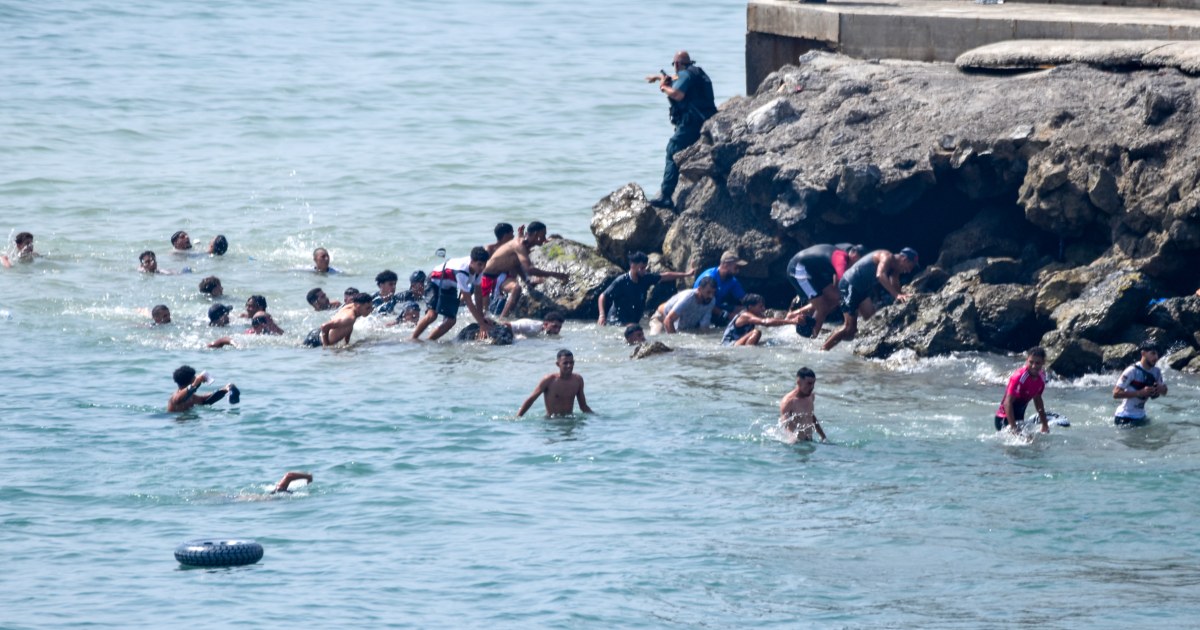
The most vivid and dramatic storyline is what happened in the Spanish enclave of Ceuta. Thousands of migrants broke into the tiny Spanish territory from Morocco, and local officials effectively acknowledged that the region cannot cope with the burden. Juan Jesús Vivas, head of Ceuta’s autonomous government, urged Madrid to declare a national state of emergency and to deploy the army to the border, saying this would ensure “the inviolability of the border and the safety of citizens.” In reports by NBC News and AP News, the scenes at Tarajal beach and along the waterfront are described as people—mostly young men, but also families with women and children—simply walking through the water and over the barriers toward the city. This visual moment is crucial: the crisis does not look like a hidden movement; it is an open, almost demonstrative breach that immediately creates a sense of loss of control.
At the same time, Spain’s central government responded more cautiously than Ceuta had expected. The Ministry of the Interior said that rules governing a national state of emergency do not treat migration flows as a threat to national security. Madrid also emphasized that authorities are coordinating “quickly and effectively,” and that, according to the Spanish side, Moroccan police are stopping “numerous people” trying to cross the border. This is an important political point: the local level frames what is happening as an issue of emergency security, while the center tries to keep the situation within legal and diplomatic bounds. In other words, the dispute is not only about migrants, but also about how far the state is willing to go in using coercive mechanisms to protect the border.
In that sense, Ceuta is not just a city, but a symbol of European border pressure. Spain has long been one of the main entry points into Europe for people seeking a better economic life or fleeing violence. But it is precisely Ceuta—and neighboring Melilla—that regularly end up on the front line: a small territory surrounded by another country becomes a point where international politics, local infrastructure, and the humanitarian factor collide literally within a few kilometers. The reminder of the crisis in May 2021, when more than 8,000 people entered Ceuta in two days, shows that this is not a one-off episode but a repeating scenario. When such spikes occur again, the conversation inevitably shifts from migration as a long-term process to migration as a threat to immediate governability.
Against this backdrop, it is especially noticeable how defensive the language in official statements has become. The reports cite wording about the need to “guarantee the inviolability of the border” and the safety of people, as well as mentions that reception centers are overcrowded and that hundreds of migrants are sleeping in the streets. This is no longer only a matter of border control, but also a question of administrative capacity: even if the government does not want to use the phrase “state of emergency,” the reality itself is pushing it toward crisis-management mode. Here, migration is not an abstract number—it is a physical overload of the city environment.
A different storyline in terms of content, but similar in the structure of the crisis, is described in ABC News: the U.S. economy slowed more than expected amid an inflation surge triggered by the war with Iran and the related oil shock. Year-on-year GDP growth was 1.5% in the second quarter—below expectations and below the previous quarter. Here, as in the Ceuta story, we see how external pressure quickly turns into internal constraints. In one case, that pressure hits the border and the migrant reception system; in the other, it hits fuel prices, borrowing costs, and consumer behavior. The U.S. is not facing a break-in of people—it is facing a break-in of inflation.
It is particularly telling that, in the American material, the economic crisis is described not as a purely financial problem, but as a consequence of a geopolitical event. After the conflict in the Middle East, the price of gasoline rose to $4.56 per gallon, and annual inflation reached 3.5%, well above the Federal Reserve’s 2% target. In other words, the external war set off a chain reaction: oil became more expensive, transportation and logistics costs increased, consumers became more cautious, and the central bank was forced to choose between fighting inflation and risking choking off growth. In this sense, ABC News presents the same fundamental storyline as the Spanish publications: the state must respond to shocks coming from outside, but the consequences are felt most strongly inside the country.
The role of structural resilience is also worth highlighting separately. The American text says that the labor market remains relatively strong, and that investments in artificial intelligence have contributed a larger share of economic growth—JPMorgan Asset Management estimates that AI spending contributed about two-thirds of GDP growth in the first half of 2025. This is an important clarification: even amid the crisis, the economy is not collapsing, because new streams of investment are sustaining it. But such resilience may be uneven, even illusory: if growth concentrates in a narrow sector while consumers face higher prices, then the overall statistics can look better than society’s lived experience. That is why, alongside rising inflation, expectations for higher interest rates intensify—and in turn, that could cool activity in the coming months. As quoted in the article, the Fed must “bring price stability,” because “persistently high prices are a burden for the American people”—“persistently high prices are a burden for Americans.”
Looking at all three materials together, a common trend emerges: states increasingly operate in a mode of ongoing crisis management, where borders—geographic, economic, and institutional—become lines of heightened tension. In Ceuta, the test is whether the country can control territory while also maintaining a humanitarian and legal balance. In the U.S., the test is whether the economy can withstand a foreign-policy blow without losing macroeconomic stability. In both cases, local and national authorities talk about the need for “urgent response,” “coordination,” and “protecting citizens,” but behind those phrases lies a deeper problem: modern governance systems often respond only after the shock has already happened.
There is also an important difference. In the migration crisis in Ceuta, the dispute is over whether what is happening should be considered a threat to national security. In the U.S. economic crisis, the dispute is over how far the Fed is willing to go in tightening policy in order to bring inflation back to its target. But the logic of these crises is similar: when pressure becomes too strong, the state is forced to choose between immediate containment and the long-term consequences of its decisions. Deploying the army at the border may restore control, but it can also heighten political tensions. Raising interest rates can rein in price growth, but it may cool the economy and the labor market.
If you need explanations of the terms: “national state of emergency” is a special legal regime under which authorities receive expanded powers to respond to a threat; in Ceuta, the debate centered on whether migration fits that category. “Year-on-year GDP growth” is a way of showing how the economy would have grown over a year if the quarterly growth rate were to remain the same; it does not mean that the economy literally grew by that exact percentage in that single quarter. “Inflation” is the general rise in prices, while the “Fed’s policy rate” is the key interest rate through which the American central bank influences lending, demand, and the cost of money. “AI” in the ABC News material means artificial intelligence; it is not about AI itself as a technology, but about large-scale investments in chips, data centers, and infrastructure that support economic growth.
The main takeaway from these publications is that crises today are rarely isolated. Migration at the Spain–Morocco border, the war in the Middle East, and the inflation shock in the United States are different events, but in every case the question is the same: how willing and able is the state to withstand a rapid rise in pressure without losing control? Ceuta and the U.S. economy both show that modern resilience is measured not by the absence of crises, but by the ability to respond to them quickly and convincingly.