The materials presented here are connected not by a single event, but by a common format of the modern news agenda: rapidly changing reports, political escalation, and the need to distinguish confirmed facts from statements and announcements. The most substantive source is an NBC News report on the U.S.-Canada trade conflict. The other two texts—the Palm Beach Post news feed and the Kyiv Post page of breaking updates—provide few concrete details, but they show how media organizations structure continuous coverage of events ranging from crime and extreme weather to war and international politics.
The central theme can be seen as growing instability—economic, political, and informational. In the NBC News article, this instability is expressed through the threat of new tariffs and Ottawa’s retaliatory measures. In the materials from Florida and Ukraine, it appears through a stream of urgent updates, inviting readers to follow events in real time.
The main story is presented in an NBC News report. U.S. President Donald Trump threatened to raise tariffs to 50% starting January 1, 2027, on cars, trucks, auto parts, and steel imported from Canada. This came in response to Canadian Prime Minister Mark Carney’s statement that Ottawa was prepared to respond in kind to new U.S. restrictions.
Trump accused Canada of having “ripped off the United States for years” and called it one of the “worst countries in the world” in terms of trade relations. These formulations are important not only as political rhetoric. They show that the trade dispute has moved from the sphere of technical negotiations into a public confrontation between leaders, in which economic measures are used both as instruments of pressure and as political signals to domestic audiences.
According to the U.S. Census Bureau, Canada is the third-largest source of U.S. imports: in 2025, the value of shipments exceeded $380 billion. The possible expansion of tariffs therefore affects not some peripheral area of trade, but one of the key supply channels for the U.S. economy. The automotive industry is especially vulnerable. The production chains of the United States, Canada, and Mexico are closely interconnected: individual parts and components may cross the border several times before a vehicle is completed. A tariff imposed at each stage could raise costs, disrupt logistics, and ultimately lead to higher prices for consumers.
The situation is further complicated by uncertainty surrounding the USMCA, the United States–Mexico–Canada trade agreement. It was concluded during Trump’s first presidential term, replacing NAFTA. However, according to the article, the administration has announced that it does not want to preserve USMCA in its current form and has shifted it toward annual reviews and negotiations. This means that the tariff conflict is developing alongside a weakening of the institutional foundation of North American trade.
It remains unclear whether vehicles and parts that meet USMCA requirements will be exempt from the new restrictions. There is also uncertainty surrounding steel: imports of Canadian steel are already subject to a 50% tariff, so Trump’s statement does not make clear whether the final rate would be 50% or 100%. In economic policy, such distinctions are crucial. Market participants need to know not only the political intention, but also the precise legal mechanism for implementing it, the timeline, the product categories affected, and any exemptions.
Canada has already introduced retaliatory measures against U.S. goods. Carney said Ottawa would match new U.S. tariffs “dollar for dollar” in order to protect workers, farmers, families, and businesses. The Canadian prime minister described the situation in these terms: “You are in a war when you are attacked. We have been attacked.” In this context, the statement refers not to a military conflict but to a political metaphor emphasizing the scale and perceived one-sidedness of the pressure.
The U.S. side, by contrast, sought to minimize the impact of the restrictions already in place. U.S. Trade Representative Jamieson Greer told CNBC that they affected only a small share of trade and declined to call what was happening a “trade war.” The gap between these assessments reflects a central problem in such conflicts: governments describe the same measures in different ways. For Washington, they may represent targeted market protection; for Ottawa, an attack on the country’s economic interests. The actual effect will depend on the scale of implementation, the duration of the tariffs, and the business response.
The potential consequences extend beyond bilateral relations. Higher tariffs could accelerate the relocation of production, force companies to change suppliers, and increase warehousing and logistics costs. In the short term, the risks are particularly high for automakers because the industry operates on a “just-in-time” basis: parts arrive at factories according to the assembly schedule and are not stored in large quantities. Even temporary delays could bring production lines to a halt.
In the long term, the conflict could undermine confidence in USMCA. Trade agreements are needed not only to reduce tariffs, but also to establish predictable rules. If companies begin to expect new tariffs after every political statement, investment decisions become riskier. This could reduce the attractiveness of the entire North American region as a unified manufacturing base.
The other two sources provide far less factual material, but they are important for understanding the modern information environment. The Palm Beach Post feed dated August 24, 2026, reports the arrest of a carjacking suspect after a high-speed chase and severe weather in Orlando that sent lounge chairs flying around a hotel. The publication emphasizes that the page will be updated regularly and combines video material with the latest news from across the state.
This is not a full article laying out the circumstances, but an aggregated “live” feed. It contains no names of suspects, information about victims, the precise location of the chase, or comments from law enforcement. The material therefore confirms only that news reports exist; it does not allow detailed conclusions about the causes or consequences of the events. This format is useful for rapid information-sharing, but it requires caution: initial reports are often preliminary and are later revised or clarified.
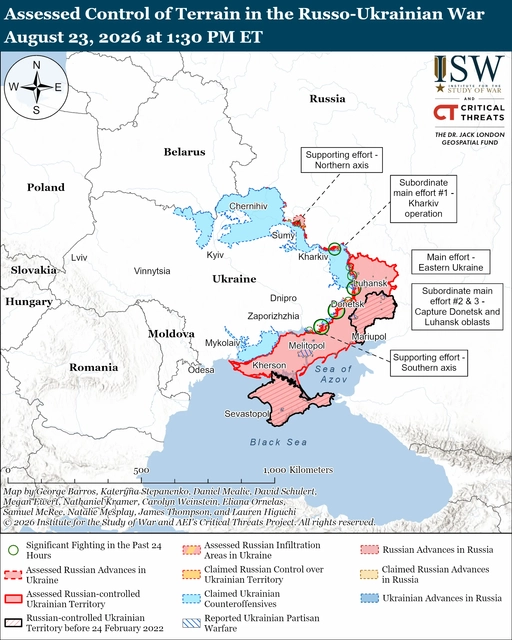
The Kyiv Post page with updates on events in Ukraine is organized in a similar way. It presents a selection of the most important news about the war, political developments, and international reactions, based on verified sources and reports from correspondents on the ground. However, the excerpt provided contains no specific information about military operations, government decisions, or diplomatic steps. It therefore cannot be used to assess the military or political situation in Ukraine; it merely illustrates an editorial model of continuous monitoring of a crisis.
This reveals a common feature of all three publications: news increasingly exists as a process rather than as a completed narrative. In the trade conflict, Trump’s statement may be only a threat, followed by negotiations, exemptions, or new measures. In Florida, an arrest after a chase is merely the beginning of a legal process, while weather information may change within a few hours. In the Ukrainian feed, the significance of each event depends on its place within a rapidly developing military and diplomatic chain.
The key conclusion is that instability manifests itself not only in the events themselves, but also in the rules for interpreting them. In the trade dispute, uncertainty is created by contradictory statements, the unclear status of the tariffs, and the future of USMCA. In breaking-news feeds, it is linked to the incompleteness of initial data. Readers need to distinguish among facts, political assessments, threats, forecasts, and unconfirmed developments.
The main trend is a shift away from stable agreements and completed news reports toward constant revisions, retaliatory measures, and updates. For businesses, this means rising regulatory risks; for governments, the need to explain rapidly changing decisions; and for audiences, the increased importance of checking sources, dates, wording, and context. The U.S.-Canada conflict is especially revealing: even between countries with deeply integrated economies, political escalation can quickly call familiar trade rules into question.
Taken together, the three materials illustrate different levels of modern instability: an international economic conflict, local incidents, and continuous coverage of a war. The most significant practical risk is associated with tariffs on automobiles and metals, since they could affect production, employment, and consumer prices across North America. But the informational conclusion is no less important: these texts demonstrate that the speed of publication does not always equal completeness of knowledge, and that a dramatic statement is not yet a final decision.