The American agenda these days looks, at first glance, fragmented: destructive storms and record heat, a tense fight for control of the Senate, a pause in the career of a legendary ice dance duo. But on closer inspection, all three stories are connected by a common theme: life under constant stress and rising extremes — climatic, political, human. The country, and individual people within it, are forced to learn to exist under permanent pressure, to find footholds and make decisions in situations where stability is more the exception than the rule.
An NBC News piece about U.S. weather describes a country literally “shaken” by the elements: record heat on both coasts and thousands of miles of thunderstorms and tornadoes across the central continent. In politics, Fox News reports that the Senate map is tightening and turning into a tense game in a few key states: any swing could change the balance of power. And in sports, NBC Sports reports that Madison Chock and Evan Bates — one of the most resilient and successful pairs in U.S. ice dance history — are intentionally hitting pause so they don’t break under the weight of their own success and expectations.
The NBC News article on U.S. weather emphasizes how climate burdens are distributed both unevenly and simultaneously across the country. On the East Coast, Friday becomes a “last hot day” when several cities — Baltimore, Washington, New York, Philadelphia and Raleigh — could set new temperature records, with Raleigh having already hit 101°F (about 38°C) the previous day, as NBC News notes. New York is opening cooling centers at what is “only” 90+ degrees Fahrenheit — which shows how seriously authorities are taking heat stress. It’s important to understand the term “heat index” here — it’s not just air temperature but the felt temperature accounting for humidity; values of 95–105°F represent a real health threat, especially to the elderly, people with chronic conditions, and those who work outdoors.
The West, per the same NBC News reporting, “catches up” to the East with a delay of a few days: record heat is expected Sunday–Monday when Portland and Seattle — cities traditionally associated with mild, moderate climates — could hit upper 90s to low 100s Fahrenheit. For regions where much of the housing stock historically lacks air conditioning, such a heat wave is not just discomfort but a systemic challenge to infrastructure and public health.
At the same time, heavy thunderstorm fronts are “creeping” across the country. NBC News gives a figure: on one Thursday there were 500 storm reports — the third-busiest day of 2026. More than a dozen tornadoes were recorded in Illinois, Indiana and Wisconsin, with houses destroyed and entire neighborhoods, like the small town of Streator, essentially wiped off the map. NBC News journalists observed rescue operations firsthand: people pinned beneath debris from their own homes, broken limbs, neighbors pulling victims out before responders arrive. Notably, despite the scale of destruction, no fatalities were reported by Friday morning: this speaks to both the development of early-warning systems and high readiness of response teams, but also to how often Americans must practice for such scenarios.
The geography of risk is very specific: on a single Friday, 66 million people in two large regions are under threat of severe storms — from the Mid-Atlantic and Appalachians up into the Northeast, and a more compact zone from western Oklahoma and the Texas Panhandle into parts of New Mexico, Colorado and Kansas. It’s useful to clarify terminology: “damaging winds” are gusts capable of toppling trees, power lines and roofs; “hail greater than 2 inches” means hail over 5 cm in diameter, which can easily penetrate cars and roofs; “tornado threat” denotes conditions in which tornado funnels can form at any time. Over the weekend the risk shifts back to the Midwest and the Plains, affecting Wichita, Kansas City, St. Louis, Des Moines and Peoria. By the end of the weekend, 23 million Mid-Atlantic residents — from Richmond and Norfolk to Washington, Baltimore and Philadelphia — again face forecasts of wind gusts over 60 mph.
All these details add up to a systemic picture: climate “extremes” in the U.S. are no longer perceived as deviations from the norm — they are the new norm. The country lives between record heat and outbreaks of extreme convective activity (severe thunderstorms with tornadoes and hail). For society, this means chronic stress, constant recovery costs, a need to modernize infrastructure, and planning life with the logic of “when, not if” the next weather event will strike your region. The key trend here is the growing multilayering of climate risk: one region overheats, another floods, a third is wiped out by tornadoes — and it all unfolds almost simultaneously.
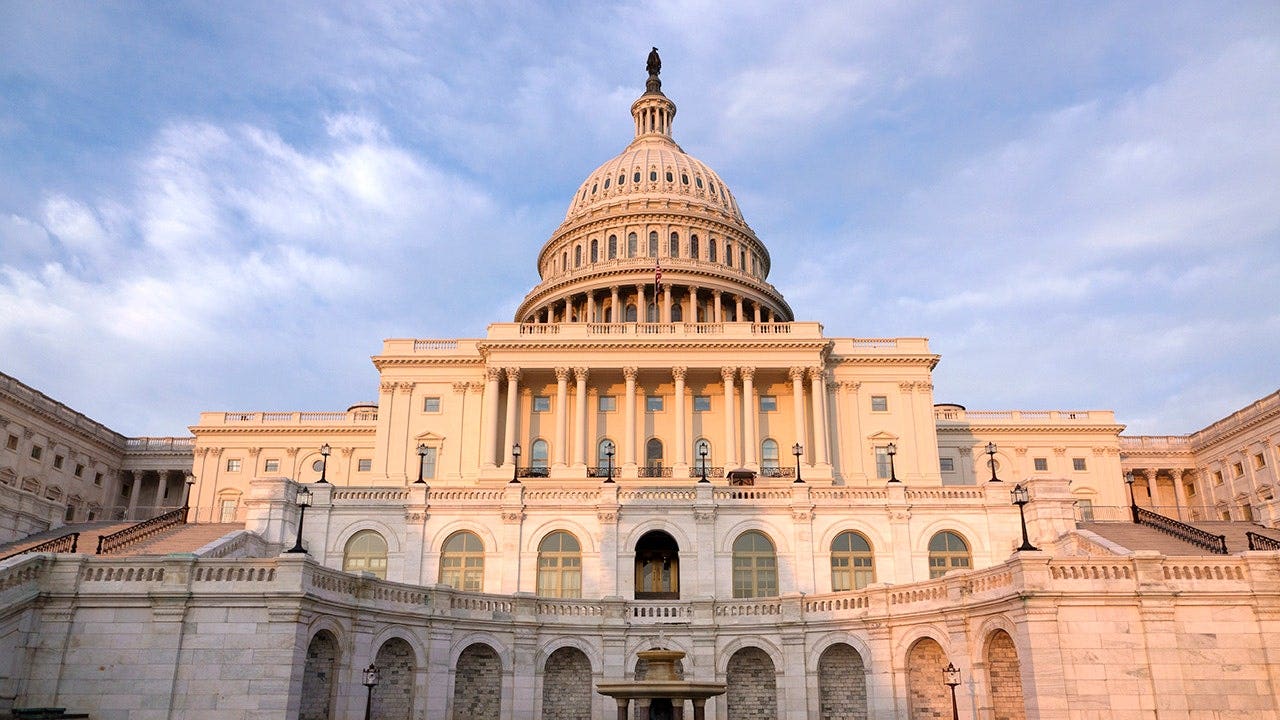
Interestingly, the political picture described in Fox News’s piece on Senate races structurally resembles the weather story: the same uncertainty, the same logic of probabilities and risk zones. In analysis by leading nonpartisan “handicapper” Sabato’s Crystal Ball at the University of Virginia Center for Politics, cited by Fox News, three Senate races have shifted toward the Democrats. The phrasing is notable: Democrats now have a “clearer path to victory,” though the overall forecast still favors Republicans.
It’s useful to explain the category system used by outlets such as Sabato’s Crystal Ball and the Cook Political Report. Races are classified as “solid” (virtually guaranteed for one party), “likely” (probable win for a party), “lean” (small advantage) and “toss-up” — essentially pure uncertainty with roughly equal chances. Moving races toward the “bluer” side means that, based on polls, demographics, fundraising and on-the-ground campaigns, Democrats’ chances are increasing.
According to Fox News, North Carolina moves from “toss-up” to “lean Democrat”: former Democratic governor Roy Cooper versus former Republican National Committee chair Mike Whatley for the seat of the retiring Thom Tillis. This is significant: the state has long been considered “purple” — balancing between parties — and any shift there has national consequences. In Alaska, the race where Republican Senator Dan Sullivan is expected to face former Democratic congresswoman Mary Peltola moves from “lean Republican” to “toss-up.” In Ohio, where appointed Republican Senator J.D. Vance faces former Democratic Senator Sherrod Brown for a full term, the rating also moves from “lean Republican” to “toss-up” — against the backdrop of a Fox News poll showing Brown ahead 53–45.
These changes are especially important given the overall configuration: Republicans control the Senate 53–47, and Democrats need a net gain of four seats to retake the majority lost in 2024. Sabato’s Crystal Ball emphasizes that the current number of “toss-up” races gives Democrats a theoretical path to reaching the decisive number of seats. But Republicans need to win just one of those coin-flip races to block the change of control. It’s like a weather forecast: even a small shift in a front’s trajectory or temperature anomaly can radically change outcomes.
The political “climate” is also described as unfavorable for Republicans. Fox News points to a “tough political climate” fueled by economic worries, persistent inflation, high gas prices, concerns linked in polls to an unpopular war with Iran, and an “underwater” approval rating for President Donald Trump — meaning disapproval exceeds approval. In classic American political logic, the party occupying the White House almost always loses seats in midterm elections, and these macro factors simply reinforce that tendency.
Intra-party moods balance cautious optimism with awareness of risk. Senate Democratic Campaign Committee chair Kirsten Gillibrand, per Fox News, sees “all the preconditions for a blue wave,” meaning a large-scale Democratic success. Her Republican counterpart, Tim Scott, concedes the “climate is becoming more complicated” but remains “extremely optimistic” about holding — and even expanding — the majority. NRSC spokeswoman Bernadette Breslin stresses that “no battleground race can be taken for granted” and offers the usual Republican narrative: Democrats allegedly “move further left for their radical base” while Republicans “focus on cutting spending and supporting American workers.”
What ties this political story to the climate one? In both cases we’re dealing with systems in high turbulence. Both use the language of probabilities, models, scenarios, and risk maps. Small shifts — a degree of temperature here, two percentage points of votes there — can fundamentally change the outcome. Society operates in a mode of constant recalculation of odds, and experts, like meteorologists, regularly update the maps — whether storm fronts or electoral forecasts.
Against this backdrop, the decision by Madison Chock and Evan Bates, reported by NBC Sports, is especially symbolic. After fifteen consecutive seasons at the elite level, three Olympic medals including recent ones in Milan — silver in ice dance and a second straight team gold for the U.S., three consecutive world titles (2023–2025), and seven national titles — they announced they will skip the next season. Formally they did not announce retirement, but they made it clear: “We weren’t even thinking that far ahead… Now it’s time to take a breath, step back and not commit too far into the future,” Bates says in an interview with Rocker Skating, quoted by NBC Sports.
This sentence vividly illustrates another side of life in the era of “extremes”: unlike climate or electoral cycles, individuals can — and sometimes must — consciously press pause. Bates speaks directly about the cost of staying at the top: “To be at this level, it’s more than a full-time job, it’s a lifestyle, it’s a 100% commitment… Every decision you make serves that pursuit of being the best in the world. We chased that dream for many years. I think we’re giving ourselves the breather we deserve.” It’s useful to explain the concept of “lifestyle sport commitment”: in elite sports, especially technical and subjectively judged ones like figure skating, it’s not only about hours of training but constant psychological pressure, limits on personal life, control of diet and sleep, and managing a media image.
Chock and Bates’s decision, NBC Sports notes, coincides with important personal milestones: the pair married in June 2024, and the pre-Olympic and Olympic cycles demanded maximum focus. Skipping the recent World Championships is a common step for Olympic medalists after a grueling season. But skipping an entire season is a qualitatively different level of self-preservation: they effectively acknowledge that to remain at the peak, you must know when to stop.
Here another key trend emerges: the ability and willingness of societies and people to prioritize mental and physical health over the inertia of success. In the climatic and political spheres, individuals and communities are more often “led” — forced to adapt to external shocks — whereas in personal and professional dimensions there are increasing examples of people deliberately setting boundaries. This doesn’t eliminate stress, but it changes the relationship to it: from passive endurance to active management.
It’s interesting how a new hierarchy is forming in U.S. ice dance following Chock and Bates’s hiatus. NBC Sports reports that the leading returning team is Emilia Zingas and Vadym Kolesnik — U.S. silver medalists, fifth at their first Olympics and third at the World Championships. This shows that the system does not collapse with the departure of leaders: like generational turnover in politics, the elite refreshes while the structure remains. There is an important message here about institutional resilience even under extreme loads.
Taken together, these three storylines form a single portrait of the modern American experience. First, a key insight: the baseline mode of existence is increasingly set by extremes rather than moderates — hotter than before, more frequent than before, less predictable than before — whether weather, elections, or demands on human endurance. Second, the importance of forecasting and risk management grows: meteorologists, political analysts, coaches and athletes live by constant scenario modeling and course correction. Third, the need for adaptation — infrastructural, institutional, psychological — intensifies.
NBC News’s climate reporting makes clear that without significant investments in resilient power grids, urban cooling systems, sensible land-use planning and evacuation protocols, the cost of extreme weather will only rise. Fox News’s political analysis shows that democratic institutions must operate amid perpetual competition and fragmentation — where a few swing states determine the fate of the whole country and elections become another cycle of societal stress. NBC Sports’s story about Chock and Bates demonstrates that a person in this world of extremes can — and should — seek space for a pause, even if the price is a temporary step away from the top.
Collectively, these trends push us to reconsider notions of normalcy. The norm becomes not stability but the ability to live in constant motion, under pressure and in uncertainty. In this world, a truly valuable skill is not mere persistence but adaptability and the capacity to consciously choose where to fight to the end and where to retreat in time, in order to return stronger.