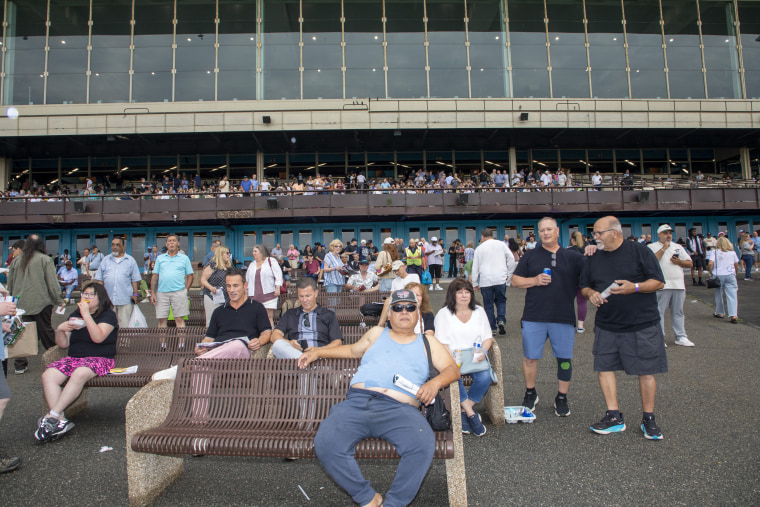
If you look at these three pieces together, they unexpectedly form a single overarching story about how climaxes always look different, yet they always demand absolute composure. In one case, it’s a historic farewell to a venue that had lasted 132 years; in another, it’s a last-minute goal that moves a football match into a new phase of the tournament; in the third, it’s no longer a sporting climax but a geopolitical one, where any mistake can trigger escalation between states. In all three stories, time plays a decisive role: it either ends an era, turns the game around, or pushes events to a dangerous edge.
The most obvious common theme here is the moment of irreversibility. In an NBC News piece about Aqueduct Racetrack, it’s not just about the last day of races, but about the end of an entire urban tradition. When the buglers played “Auld Lang Syne” and “Call to the Post,” and then jockey Jaime Rodriguez brought Assume Nothing to the finish at 5:50 p.m., it wasn’t only a sporting event but also a symbolic curtain call. NBC’s phrasing—“a curtain falls”—highlights the theatrical nature of the moment: the old, cracked, “paint-peeling” racetrack closes not just a season, but a whole era of New York, where racing had been part of the city’s memory, even as the venue showed obvious physical and institutional fatigue.
Time works differently here, but just as dramatically, in CNN’s report on Brazil’s win over Japan. The end of the match became the point where pressure, patience, and class converged in a single episode. Japan took the lead after a long ball by Kaishu Sano in the 29th minute, and for a long stretch it looked like the team that could withstand the pace and discipline against the tournament favorite. Brazil, as often happens in major tournaments, didn’t break—it kept building pressure: a shot by Bruno Guimarãres, a save by Zion Suzuki, chaos in the goalmouth, Casemiro’s goal in the 56th minute, and an almost unbelievable moment when Vinicius Junior hit the post. But the decisive turn wasn’t a beautiful one—it was a cold, pragmatic final sequence: Japan’s mistake on the approach to the box, the pass from Guimarães, and Gabriel Martinelli’s precise strike at the very end of the match. CNN emphasizes this particular nerve—“last-minute winner” and “final minute of the match”—in other words, a victory literally snatched from time. It’s not just advancing to the Round of 16; it’s a demonstration of an old football truth: great teams can be vulnerable, but it’s often exactly them that know how to find a win when the resource is almost exhausted.
The most alarming storyline, with the widest consequences, is ABC News’ report that Israel conducts strikes in Iran, IDF says. Here there’s no farewell celebration and no sporting resolution—only the threat of a direct exchange of military strikes. ABC News reports that the IDF recorded rockets launched from Iran toward Israel and activated defense systems. This episode is presented as a response to Israel’s strikes on Hezbollah-linked sites in south Beirut, which are supported by Iran. The most important detail is the speed of escalation: a statement by Iranian lawmaker Ebrahim Rezai about a “decisive and painful response” almost immediately gives way to the language of military preparedness and warnings for the civilian population. Israel, in turn, urges residents via phone messages to take cover immediately. This is no longer a metaphorical “finish line,” but a literal line between deterrence and widening the conflict.
Taken analytically, these texts all point to the same idea: the end as a moment of truth. In sport, the end most often means either triumph or defeat—but in any case it’s clear: the ball crossed the line, the clock stopped, the scoreboard recorded the result. In the Aqueduct story, the end is cultural and infrastructural decline—something that had been building for a long time and finally became inevitable. In the Middle East crisis, the end can mean not so much an ending as the start of a far more dangerous stage, because one strike triggers a response, and a response triggers the next. The same logic of the “last moment” therefore leads to completely different outcomes: to memory, to sporting advancement, and to the threat of war.
There’s another common motif as well: the clash between the old and the new. Aqueduct Racetrack looks like an artifact of an earlier America, where space, ritual, and the crowd followed different rules; the final race becomes a goodbye to a material legacy that no longer fits modern times. The Brazil vs. Japan match, in a sense, is also a dispute between a traditional and an updated football hierarchy: Brazil remains a symbol of historic greatness, but it has to prove its status not by legend, but by the quality of its play under harsh, modern conditions—against an opponent that feels rigid, severe, and almost evenly matched. In ABC’s report, this conflict takes the form of strategic wear: old deterrence mechanisms no longer guarantee stability, and so any exchange of strikes can quickly get out of control. In all cases, the outer shine gives way to the real fragility of the system.
It’s especially important that each piece includes its own kind of farewell. For NBC, it’s a goodbye to an era of city racing; for CNN, it’s one team saying goodbye to hopes of avoiding a nerve-wracking finish; for ABC, it’s a goodbye to the illusion that exchanges of signals and strikes can be kept within the bounds of manageability. That’s why these texts read not as disconnected news, but as variations on a single theme: limits. Buildings age, matches end, conflicts intensify—and in each case, the price of the final minute is different, but always very high.
There are also important implications that follow from these events. The closing of Aqueduct Racetrack means not only the loss of a symbol, but another step in the transformation of the city’s sports culture: traditional venues give way to different leisure formats and more economically sustainable models. Brazil’s win over Japan shows that in world football, the value of not just talent but also the ability to withstand psychological pressure right up to the end is rising; matches like this are increasingly decided by the details rather than by sheer dominance. In the Middle East situation, the consequences are far more serious: if further escalation is confirmed, we won’t just see a local exchange of messages and strikes, but the expansion of the conflict—with the risk of new actors getting involved and tensions increasing across the region.
Some concepts mentioned in these pieces are worth clarifying. Round of 16 in football is the playoff stage where 16 teams remain; losing there means elimination. Stoppage time is the added time granted by the referee at the end of a match due to interruptions; it’s in this period that Brazil scored the decisive goal. In ABC’s report, IDF refers to the Israel Defense Forces, the Israel Defense Army. Hezbollah is a Shiite armed group and a political force based in Lebanon and supported by Iran. The phrase “defensive systems to intercept the threat” means activating air defense and missile defense systems to intercept rockets. And “auld lang syne” is a traditional Scottish farewell song that’s often performed at the conclusion of something significant.
The main takeaway, then, is this: in all three stories, it isn’t only the event that matters, but also the moment when it happens. In Aqueduct’s final race, memory of 132 years of history entered the scene; in the last minute of Brazil’s match, it turned pressure into victory; in the current Middle East crisis, it’s the speed of response and the sequence of steps that may determine whether events stay at the level of an exchange of strikes or grow into a broader escalation. Together, these materials remind us that the end almost never is just an end—it’s either a legacy, a break point, or a warning.