
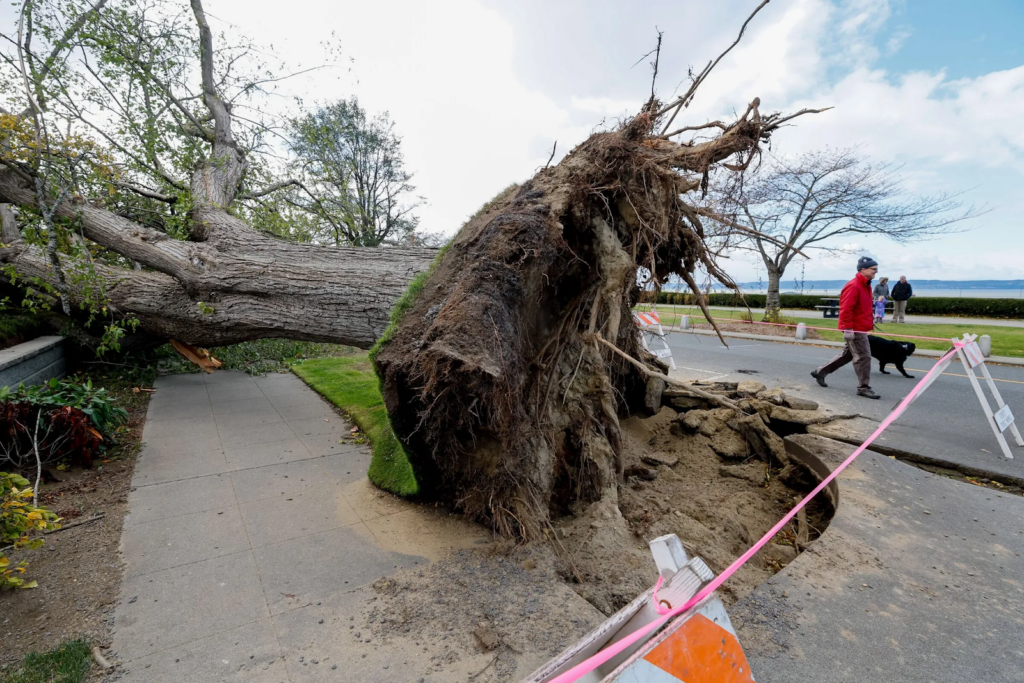
On Saturday evening, November 7, a cold front swept across western Washington, bringing heavy rain and sharp southerly wind gusts that left at least 83,000 customers without power. The largest outages were in Seattle City Light’s service area and across Puget Sound Energy territory; neighborhoods in Seattle, Burien, Bainbridge and Vashon islands, the Eastside and coastal counties were left in the dark. Although the storm’s main impact was expected to be brief, its aftermath—downed branches, trees and power lines—continued to shape the region’s night.
For Seattle, it was that familiar autumn moment when the electrical grid suddenly becomes visible: lights go out in windows, traffic signals fail at intersections, and outage alerts appear one after another on phone screens. At around 9 p.m., Seattle City Light reported more than 46,000 customers without power—the highest number among local utilities at the time.
Puget Sound Energy, which serves much of the suburbs and communities around Puget Sound, reported about 27,000 customers without power and 226 separate outages. Disruptions affected Bainbridge Island, Vashon, Bellevue and other Eastside communities—areas where lines often run among old trees, and a single fallen trunk can knock out power to an entire block.
Conditions were especially vulnerable on the Olympic Peninsula and along the coast. Clallam County PUD reported about 7,000 outages, while Grays Harbor PUD reported about 3,000. The National Weather Service issued a high-wind warning for the coast, forecasting sustained southerly winds of 25 to 35 mph, with gusts up to 60 mph. A wind advisory was in effect in the lowlands around Puget Sound, with gusts of up to 45–50 mph.
Forecasters had described Saturday’s front in advance as brief but powerful: rain was expected to spread quickly inland from the coast, while winds would strengthen in the evening and ease by Sunday. In Seattle itself, the forecast called for up to half an inch of rain overnight. But for overhead power lines, the total rainfall matters less than the combination of saturated ground, leaves still clinging to trees, and sudden strong gusts.
Meteorologists explicitly warned that winds could topple trees and damage power lines. Such warnings sound almost routine in a state where fall storms are part of the calendar, but recent years have lent them greater weight: in November 2024, a powerful cyclone left hundreds of thousands of customers without electricity in western Washington. The current storm was far smaller in scale, but it was a reminder of how quickly even a relatively short-lived front can disrupt the daily rhythm of a densely populated region.
Restoration now depends not only on when the winds die down, but also on repair crews’ access to damaged areas. Utility workers must first inspect the lines, clear debris and make sure there are no downed wires at the scene. Seattle City Light and Puget Sound Energy are continuing to update their outage maps; residents are advised to stay away from fallen lines, keep at least 30 feet away and report them by calling 911.
The storm does not bring the unsettled weather week to an end: the National Weather Service expects another wet, windy front Monday night and Tuesday. For those who spent Saturday evening by candlelight or using a phone flashlight, that means one simple but pressing task—charge devices, check battery supplies and remember that in November in Washington, power is sometimes not a given, but the result of a long night’s work in the rain.



Based on: Seattle windstorm: 83K outages reported in Western WA