
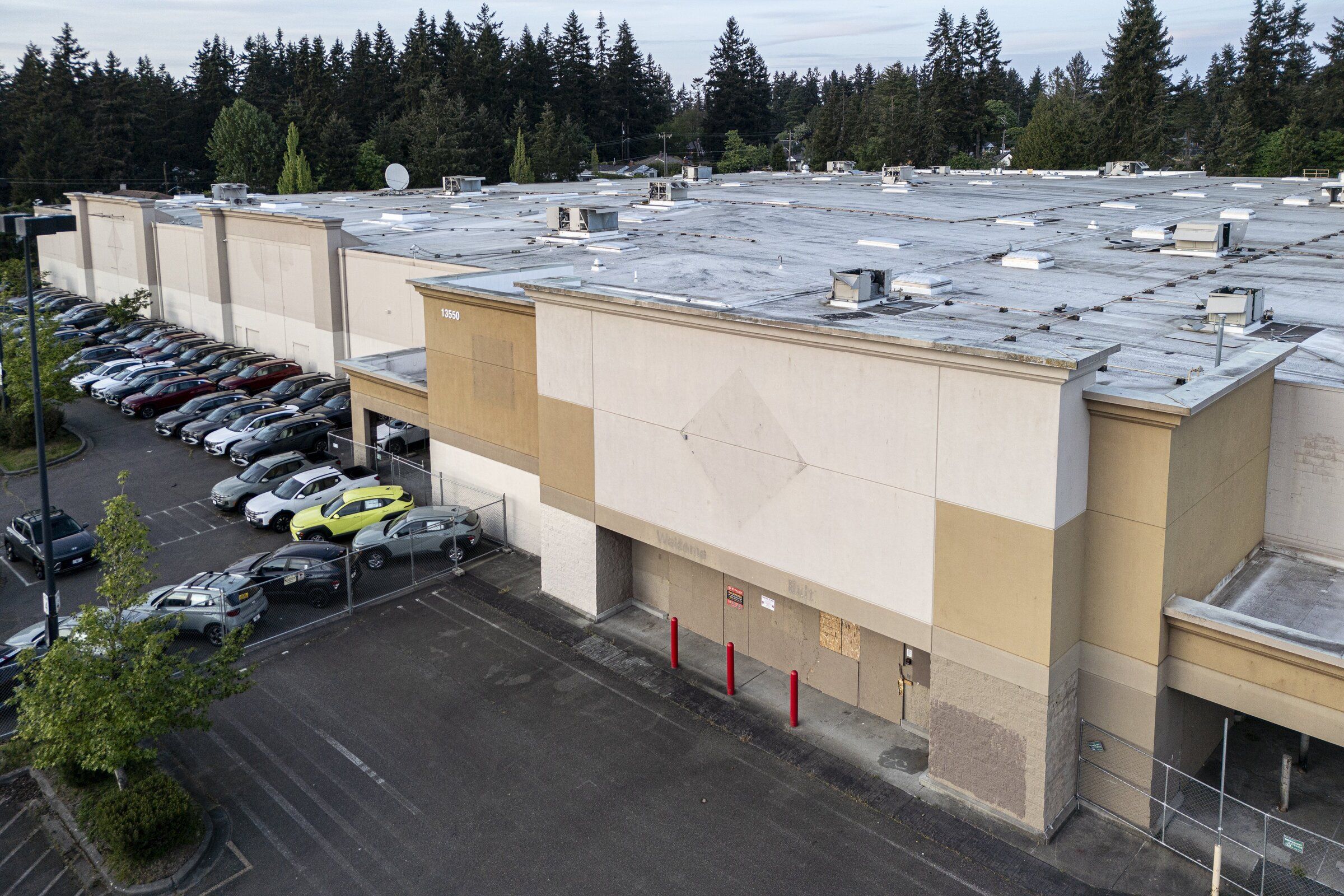
The former Sam’s Club building on Aurora Avenue North, vacant since 2018, has once again become the site of a major—but still unfinished—plan: WinCo Foods has filed new permit applications and intends to open its first Seattle store there within a year. The project promises to bring new life to the nearly 145,000-square-foot retail building and give the neighborhood a low-cost grocery option. But its earlier environmental review was overturned because the city compared the proposed store not with the currently vacant property, but with its long-closed predecessor.
On Seattle’s northern edge, the empty shell of the former Sam’s Club has long looked like a strange pause in the urban fabric: a huge parking lot, broad Aurora Avenue North, neighboring businesses and residential neighborhoods to the east. Sam’s Club closed there in 2018, and since then the roughly 145,000-square-foot building has never found a permanent new tenant. Along the Aurora corridor, where everyday grocery trips often require a car, the vacancy has been especially conspicuous.
WinCo is a Boise-based discount chain owned by its employees through an employee stock ownership program. It already has stores across Washington, but none in Seattle itself. The company has built its reputation on low prices, large packages and bulk goods; shoppers do not need a membership. That format helps explain the interest in the project: in a city where the cost of groceries has long been a distinct household-budget concern, the arrival of another budget supermarket is seen as more than just another commercial lease.
WinCo’s original plan was relatively modest by large-scale retail standards. The company intended to demolish about 17,000 square feet of the existing structure, reduce the building’s footprint, create a new south-facing façade and entrance, and redo the sidewalks, parking surface and landscaping. The project called for excavation, upgrades to underground stormwater infrastructure and 11 additional parking spaces, bringing the total to 558. Most of the nearly 512,000-square-foot site was otherwise expected to remain largely unchanged.
In October 2025, the Seattle Department of Construction and Inspections issued a determination of nonsignificance. The city acknowledged that construction and store operations would add vehicle trips, noise, emissions and runoff from paved surfaces, but concluded that existing regulations—including stormwater-management and traffic requirements—were sufficient to mitigate those effects. The permit also included separate measures to follow if archaeological materials were discovered during excavation.
Two weeks later, the Lake Washington Working Families group appealed the decision. During hearings, its representatives raised concerns about traffic, stormwater pollution and the chemical compound 6PPD-quinone, which forms from additives in vehicle tires and can enter waterways through roadway runoff. Seattle hearing examiner Ryan Vancil did not conclude that the project’s opponents had proved that significant environmental harm was inevitable. But he found a more fundamental problem with the city’s methodology: the city had used the former Sam’s Club’s operations as its baseline, even though the property had been vacant for years.
In a decision dated April 9, Vancil overturned the city’s determination. In his assessment, the environmental effects should have been compared with the site’s actual condition at the time of review—with a vacant building and an inactive retail space—not with what had once been permitted and operating there. This was not a final ban on WinCo, nor did it mean the store would necessarily cause significant environmental damage. The decision simply required the city to conduct the review again using the correct baseline.
WinCo and its project partner, JSA Civil, then attempted to challenge the decision in King County Superior Court. At the same time, the company returned to the permitting process: new applications show that it has not abandoned the Aurora address. A company representative said WinCo expects to move forward at full speed and open the store within a year, although that timeline depends on how quickly the new approvals are completed.
What matters most in this story, perhaps, is not the legal dispute but the gap between the site’s past and its present. Formally, a store in the same category as the former Sam’s Club could once again appear on Aurora. But more than seven years of vacancy have changed both the neighborhood and the significance of the future tenant. WinCo must now show the city that its return to this asphalt island can be reconciled with requirements concerning water, traffic and surrounding neighborhoods. If it succeeds, the abandoned big-box store may finally stop being a monument to the previous retailer’s sudden departure.
Based on: WinCo resumes planning for first Seattle store after legal challenge
***.