
In late summer and early fall, residents of Oregon and Washington once again begin noticing giant house spiders in their homes. Adult males leave their hiding places and set out in search of females, so they may be seen on walls, ceilings, in closets, bathrooms and showers. The spiders are not hunting people — they are simply looking for a mate, and a human home happens to lie along their route.
For most of the year, these spiders live out of sight in garages, basements, sheds, storage rooms and other dark places. They build flat webs with funnel-shaped retreats and wait for prey to wander into the trap. The seasonal “invasion” does not mean that new spiders have appeared; rather, previously hidden males have begun actively moving through buildings.
The giant house spider is native to Europe and likely reached North America through Pacific Northwest ports. Today, it is especially widespread in coastal areas of British Columbia, Washington and Oregon. The mild, wet climate allows it to survive year-round, while ports, warehouses, freight containers, urban development and transportation corridors provide abundant hiding places and routes for further spread.
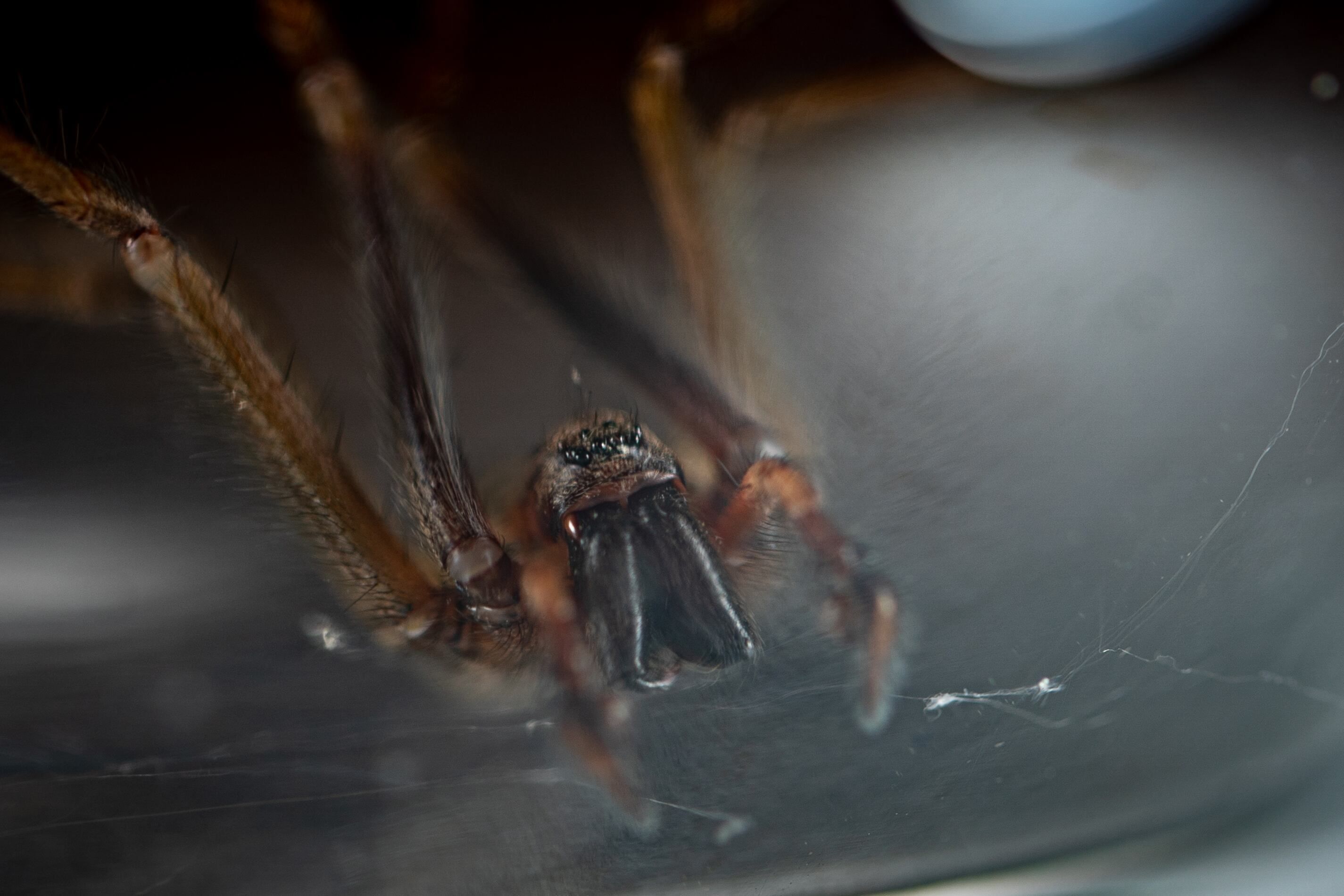
Adult males can reach a leg span of about 4 inches, while females have larger bodies. The giant house spider has long, relatively evenly colored legs and a brown body with a faint pattern. Because of its similar coloring, it can easily be mistaken for a hobo spider or other local species. Hobo spiders are usually smaller, have more noticeable dark markings, and also build funnel-shaped webs. However, reliable identification often requires a close-up photograph or help from a specialist. Most spiders in the region pose no danger to people.
Despite their impressive size and high speed, giant house spiders are nonaggressive and usually run away from people. Their record speed of about 20 inches per second is primarily useful for escape, not attack. Bites are extremely rare and generally occur only after accidental, forceful contact — for example, if a spider is pressed against clothing or skin. A study of confirmed bites in Oregon found no serious symptoms or tissue damage.
The state’s potentially dangerous spiders are primarily black widows. An adult female western black widow is noticeably smaller than a giant house spider. It has a shiny black body and a red, sometimes incomplete or orange-colored, hourglass marking on the underside of its abdomen. It prefers secluded, dry locations — woodpiles, garages and outbuildings — and usually bites only when defending itself or accidentally crushed. If a bite is accompanied by severe pain, muscle spasms, nausea or difficulty breathing, seek medical attention immediately.
Giant house spiders feed on insects and sometimes other spiders, effectively serving as free nighttime pest control. Their webs are not sticky: prey lands on the surface and reveals itself through vibrations, after which the spider rapidly rushes toward it. If a spider ends up in a bathtub or sink, it most likely came down the wall in search of moisture, fell inside and was unable to climb out over the smooth sides — the plumbing is not to blame.
It is impossible to completely prevent spiders from entering a home, but the number of encounters can be reduced. Experts recommend sealing cracks, repairing window screens, installing door sweeps and closing gaps around pipes. Firewood, plants and other items should be inspected before being brought indoors, while shoes, clothing and towels should be shaken out. Traps work best when placed on the floor in dark corners, whereas repeated insecticide spraying usually provides only temporary results.
If a large brown spider raced across the floor this summer, there is no need to panic: it most likely did not just enter the house, is not trying to chase anyone and is almost certainly attempting to escape. It is simply a male searching for a mate, poorly navigating a human dwelling and having absolutely no understanding of personal-space boundaries.
Based on: It’s happening again: PNW’s largest spider is seeking love inside people’s homes