
Washington state looks successful by many measures: it has a highly educated population, a strong economy and thriving industries that need skilled workers. Yet national comparisons show a more complicated picture. Access to public preschool programs remains limited, student performance is only slightly above the national average, and the share of students who continue their education and earn degrees is below the national level. This raises questions about how fully the state is meeting its constitutional duty to educate all children.
Washington’s Constitution calls education “the paramount duty of the state” and has traditionally been interpreted as requiring the state to fund schools from kindergarten through 12th grade, including teacher salaries and textbooks. Preschool education, however, generally does not fall within the most reliably protected funding system.
The state-funded ECEAP program is primarily intended for children ages 3 to 4 from low-income families or families with special needs. It provides instruction, developmental support, medical and dental screenings, meals and help for families accessing social services. Children are eligible for free enrollment if their families meet established income criteria, as well as if they are in foster care, experiencing homelessness, in need of special services or belong to other priority categories.
Washington ranks seventh nationally in per-child preschool spending but only 34th in program access: about 19% of 4-year-olds receive public or federally funded preschool, compared with as many as 70% in some states. ECEAP is supposed to provide places for all eligible children, but the deadlines for fulfilling that guarantee have been postponed repeatedly. An additional 10,000 places planned with support from Ballmer Group could increase coverage by roughly 60%.
At the same time, middle-income families often fall between government eligibility requirements and the high cost of private care. An income only slightly above the established threshold can make a family ineligible for ECEAP, while private preschools and child care centers in the Seattle area are expensive because of high housing and labor costs, as well as the limited number of available places. As a result, many parents do not qualify for a free program but cannot afford private child care without serious financial hardship.
K-12 education received stronger protection after the 2012 McCleary decision. The state Supreme Court ruled that Washington was violating its constitutional duty to provide a full basic education. The state substantially increased its share of funding, directing money primarily toward teacher and other staff salaries, smaller class sizes, transportation, special education programs and instructional materials. School districts became less dependent on local taxes to meet their basic obligations, although local funding remained in place.
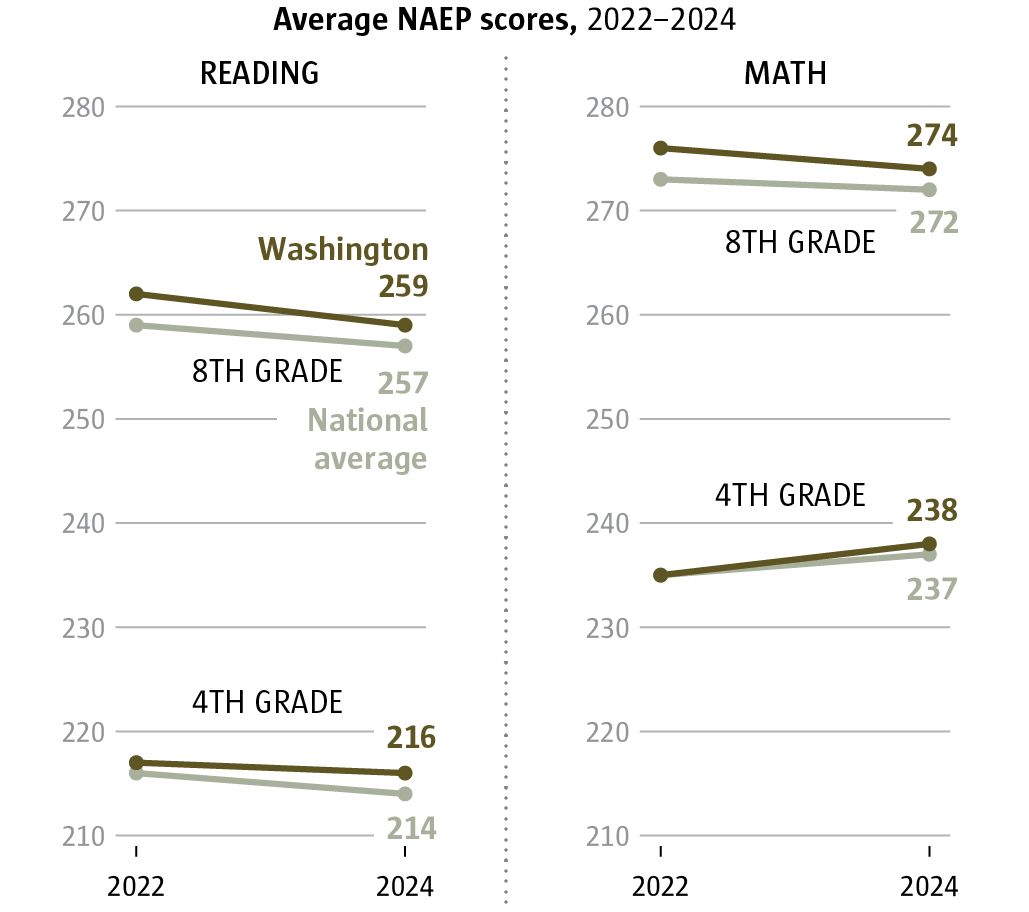
Washington had to pay a $100,000-a-day fine for three years until lawmakers increased spending. The changes helped reduce class sizes, raise teacher salaries and bring per-student spending to slightly above the national average. But the funding did not eliminate achievement gaps or make up for pandemic-era losses: students perform slightly above the U.S. average in reading and roughly at the national average in math. Just over 70% of students meet reading standards and about two-thirds meet math standards; among Hispanic fourth graders, only 42% reach the basic reading level.
Experts note that additional funding alone cannot erase the effects of poverty, racial and economic segregation, unequal access to preschool, language barriers, housing instability and unequal access to experienced teachers. In addition, funding is not always distributed in a way that fully offsets the needs of the most vulnerable students.
The state’s constitutional duty ends when students finish high school, even though the modern economy increasingly requires further education or job training. About 40% of Washington graduates earn a postsecondary credential, while an estimated 70% of future jobs will require such a qualification. At colleges, about 75% of students who began in fall 2024 returned for their second year, while the six-year graduation rate is 56.5% — one of the lowest in the country.
Amid budget cuts, a hiring freeze and possible campus consolidations, experts are urging colleges to do more to identify students at risk of dropping out. An upcoming Education Lab series will examine what the state’s major investments have accomplished and whether the constitutional guarantee of education should eventually be extended from early childhood through college graduation.
Based on: Is WA meeting its constitutional commitment to education?