
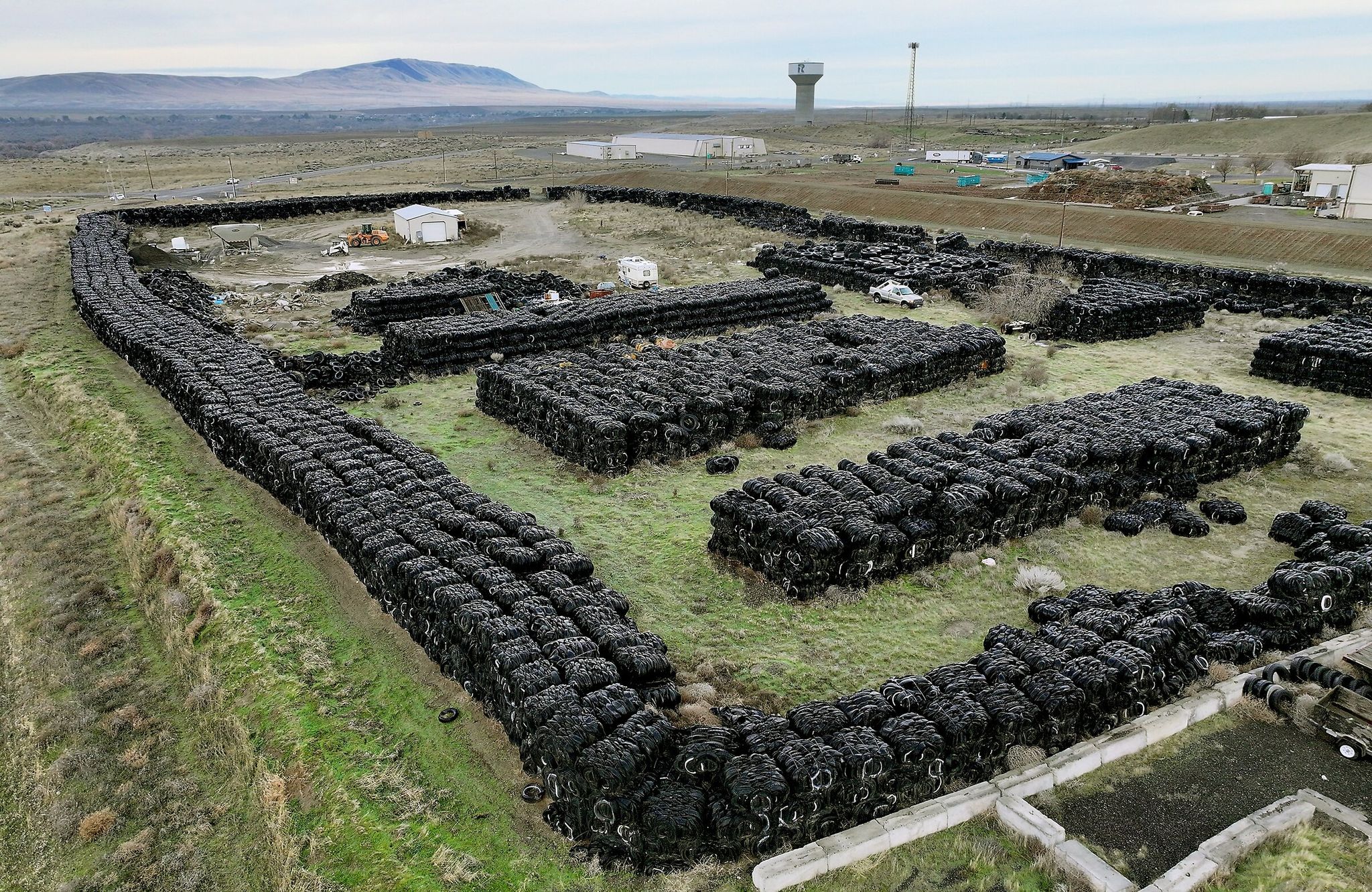
Lawmakers in Washington state have agreed to allot $3.2 million to clean up the state’s largest illegal dump of old vehicle tires. The pile is located on Twin Bridges Road near the city of Richland and contains about 7,100 tons of used tires. Richland was historically a key center for the Manhattan Project and plutonium production for U.S. nuclear weapons, and its economy long depended on the Hanford complex. Environmental concerns in that region carry special weight because of radioactive and chemical waste at Hanford — one of the largest and most complex cleanup sites in the U.S., posing potential risks to public health and the Columbia River. Against that backdrop, the giant tire dump adds a serious environmental and fire threat to nearby neighborhoods and businesses.
The accumulation of tires is not only a colossal fire hazard but also an ideal breeding ground for mosquitoes, which can carry the dangerous West Nile virus. Water that collects in the depressions of a single tire can produce thousands of insects over a season. The funding decision caps nearly three decades of local efforts to address the problem, which long remained the region’s top environmental headache.
The project funding was included in the state’s supplemental budget for 2026. Part of the money will come from a special fee charged on the sale of each new tire, intended specifically for future tire disposal. The remainder will be drawn from the hazardous substances tax, which funds environmental cleanups under the state’s toxic cleanup law. Richland’s city manager thanked local senators, including Perry Dozier, for helping advance the issue as a priority.
The legal path to cleanup was complicated. In 2023 Richland sued the property owner, a bankrupt company from Juneau, and in 2024 won court permission to remove the dump. But financing remained the main obstacle: the annual budget for the state’s tire disposal program is only about $600,000 for the whole state, and there is a long list of similar — though smaller — sites awaiting cleanup.
The history of how the tire pile originated is also notable. The site was once leased for a tire recycling business co-owned by the daughters of the late state lawmaker Shirley Hankins. Their company pressed tires into blocks for sale to shooting ranges or for construction, but the project failed due to regulatory problems. A 2007 investigation found that Hankins herself, who had been a manager at the Department of Ecology in the 1990s, used her position to promote her daughters’ business and was fined for ethical violations. The case led to stricter conflict-of-interest rules and transparency requirements for public officials, increased scrutiny of environmental projects, and reforms aimed at preventing similar conflicts in the future.
The allocation of $3.2 million marks a significant breakthrough in addressing this long-standing problem. Officials say it is a key step toward removing threats to public health and the environment and freeing the site for future economic development. Specific start dates for the work are being determined in coordination with the Washington State Department of Ecology, which regulates and oversees hazardous-waste cleanup, sets standards, issues permits, and enforces environmental rules, often in cooperation with federal agencies.
Based on: Lawmakers agree to pay $3M to remove WA’s largest abandoned tire pile