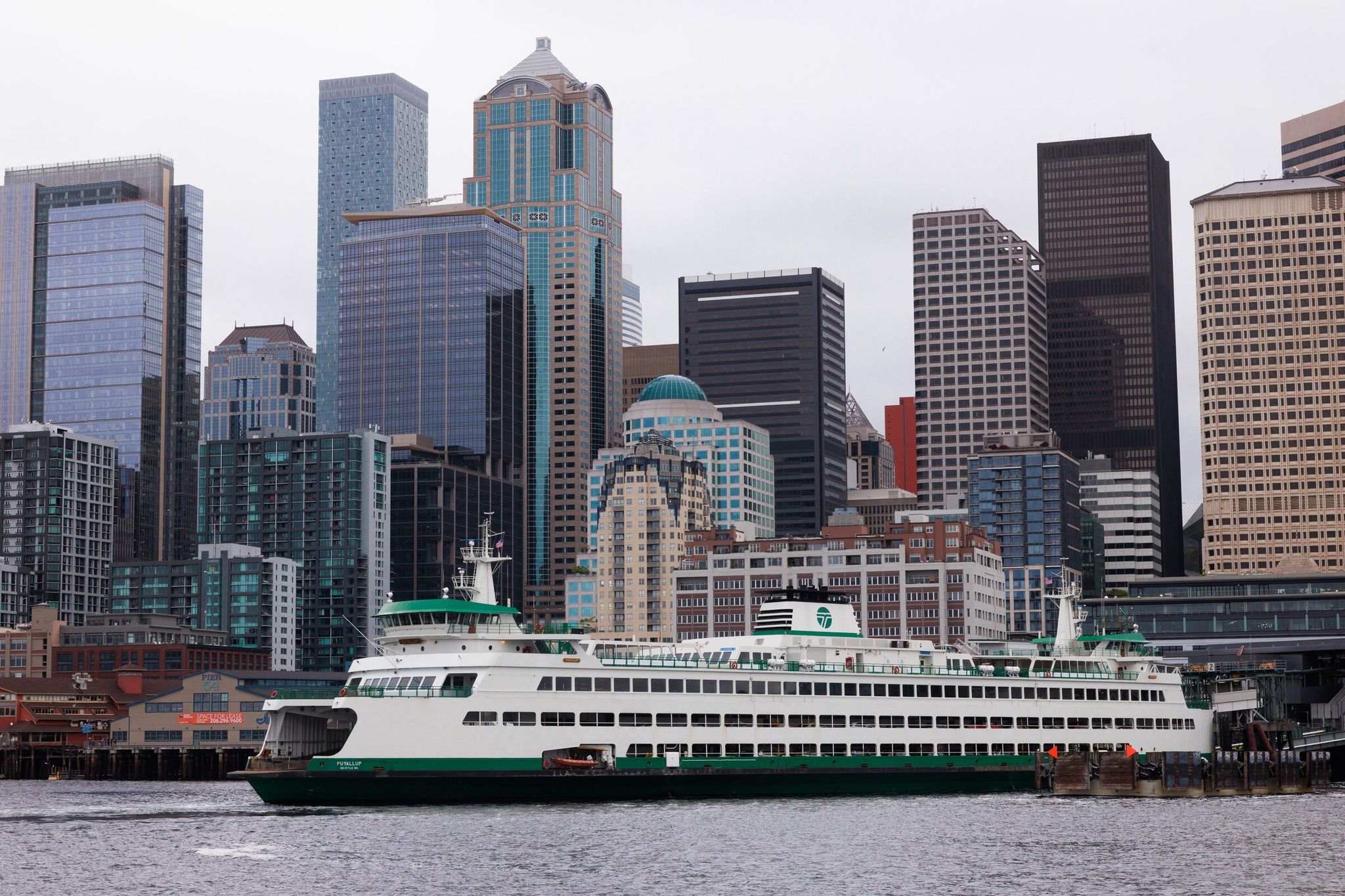
Washington state officials are preparing their ferry system for an unprecedented strain during the 2026 FIFA World Cup. While most fans will likely reach stadiums by train or bus, the state ferry service, which is marking its 75th anniversary, does not want to be the reason people miss matches. Ferries in the region are effectively “floating bridges,” connecting Seattle, the Olympic Peninsula and numerous islands where building conventional bridges is technically difficult and expensive because of the many islands and deep bays. To ensure uninterrupted crossings across Puget Sound, the state plans to keep 20 of its 21 vessels fully ready throughout the tournament’s six weeks.
That leaves the system with a two-boat buffer and the ability to quickly put a spare vessel into service in case of an unexpected breakdown. Additional crews will be on standby at the Eagle Harbor maintenance facility on Bainbridge Island to speed repairs and get backup ferries back in service. Bainbridge Island is known as an upscale Seattle suburb with scenic nature and historic homes, and the maintenance base is there for historical reasons — it was established in the 1900s when the island was a shipbuilding center. The deep, protected Eagle Harbor allows several large ferries to be repaired at once without disrupting city waterfront traffic, unlike Seattle’s crowded and expensive central waterfront. Staffing at terminals across the system will also be increased to assist passengers and manage crowds, especially on the three busiest routes connecting Seattle with Bainbridge, Bremerton and Kingston.
“We’re heading into a very busy summer. We expect a significant increase in ridership during the World Cup,” said Forrest Nichols, director of ferry operations and maintenance. He said the new plan should help reduce cancellations and service interruptions due to unforeseen circumstances. State ferries are not the only way for soccer fans to cross the sound. In addition to the state network, other operators run service: Kitsap Transit, King County Water Taxi and private companies, but only Washington State Ferries carries cars; alternative options offer passenger-only service on fast vessels.
Kitsap Transit’s fast ferries will extend service on the Bremerton–Seattle route until midnight on match days. Bremerton is one of nine official fan zones where World Cup matches will be broadcast. The fan zone in the city center will be at Quincy Square, giving fans a place to watch games together without buying stadium tickets. King County’s water taxi will also run until 11 p.m. on game nights, en route to West Seattle.
Even with passenger ferries helping, the system is operating with minimal spare capacity — the summer schedule requires 18 vessels. The state ferry service has long struggled to keep its fleet operational and maintain schedules amid aging vessels and a global shortage of mariners. Earlier this year four ferries were in planned maintenance when three more broke down due to unexpected technical problems — though they were returned to service within a few days.
Steve Nivi, who has led WSF since 2024, notes the situation has improved since the crisis year of 2021, when crew shortages led to hundreds of canceled sailings. Aggressive hiring has helped ease staffing shortages: the number of deck employees rose from 656 to 817, and engine room staff increased from 370 to 462. Although individual sailings are still canceled due to sick leave, those occurrences have become far less frequent. For drivers who find ferries out of service because of fog, storms or breakdowns, the only alternative is the Tacoma Narrows Bridge to the south, turning a 30-minute ferry ride into a two- to three-hour overland trip.
The risk of losing the most experienced employees to retirement has also declined. The share of captains likely to retire within five years dropped from 53% to 40%, and among chief engineers from 34% to 23%. “This progress is not accidental,” Nivi emphasized, noting systematic work on hiring, training and promoting staff.
The main long-term task is full electrification and modernization of the fleet by 2040. Governor Bob Ferguson, who succeeded Jay Inslee, contracted to build three hybrid-electric ferries for $714.5 million and paused projects to convert large vessels to electric propulsion. The first new ship will not arrive before 2030, and the total cost of the electrification program is estimated at $6.2 billion. That high price tag reflects the need to completely rebuild the fleet, install charging stations with high-capacity underwater cables and transformers at all terminals, and upgrade island electric grids. Battery technology for large ferries carrying up to 200 cars remains very expensive. Washington state has ambitious environmental goals: to shift entirely to renewable energy by 2050 and cut CO2 emissions by 95% from 1990 levels. Ferries are the largest source of emissions among state transportation, and their electrification is expected to eliminate about 250,000 tons of CO2 per year — the equivalent of emissions from 50,000 cars.