
On Tuesday, Oct. 6, most Washington State Ferries routes returned to their regular schedules after an exceptionally difficult Monday: Of the 18 vessels in service, 13 were unable to sail at various points during the day because of a shortage of engine-room crews. The Seattle–Bremerton route, which connects the downtown Colman Dock with Kitsap, operated on its normal schedule in the morning, but the system as a whole still depended on whether every required shift could be filled.
On Monday, the ferry network — usually perceived by Puget Sound residents almost as an extension of the state highway map — suddenly proved fragile. Twenty-three engine-room workers called in sick, while qualified replacements declined to fill in. By midday, only six ferries remained on the water. Service was fully or partially suspended on Seattle–Bainbridge, Edmonds–Kingston, Port Townsend–Coupeville and the “triangle” route connecting Fauntleroy, Vashon and Southworth.
For passengers, this was more than a schedule disruption. On the Clinton–Mukilteo route, vehicle waits reached roughly three hours. On islands where a ferry is the way to reach a doctor, a plane, work or school, a canceled sailing quickly becomes something more serious than a delay. San Juan County Council Chair Justin Paulsen said he received more than 100 messages, including reports of missed medical appointments and flights.
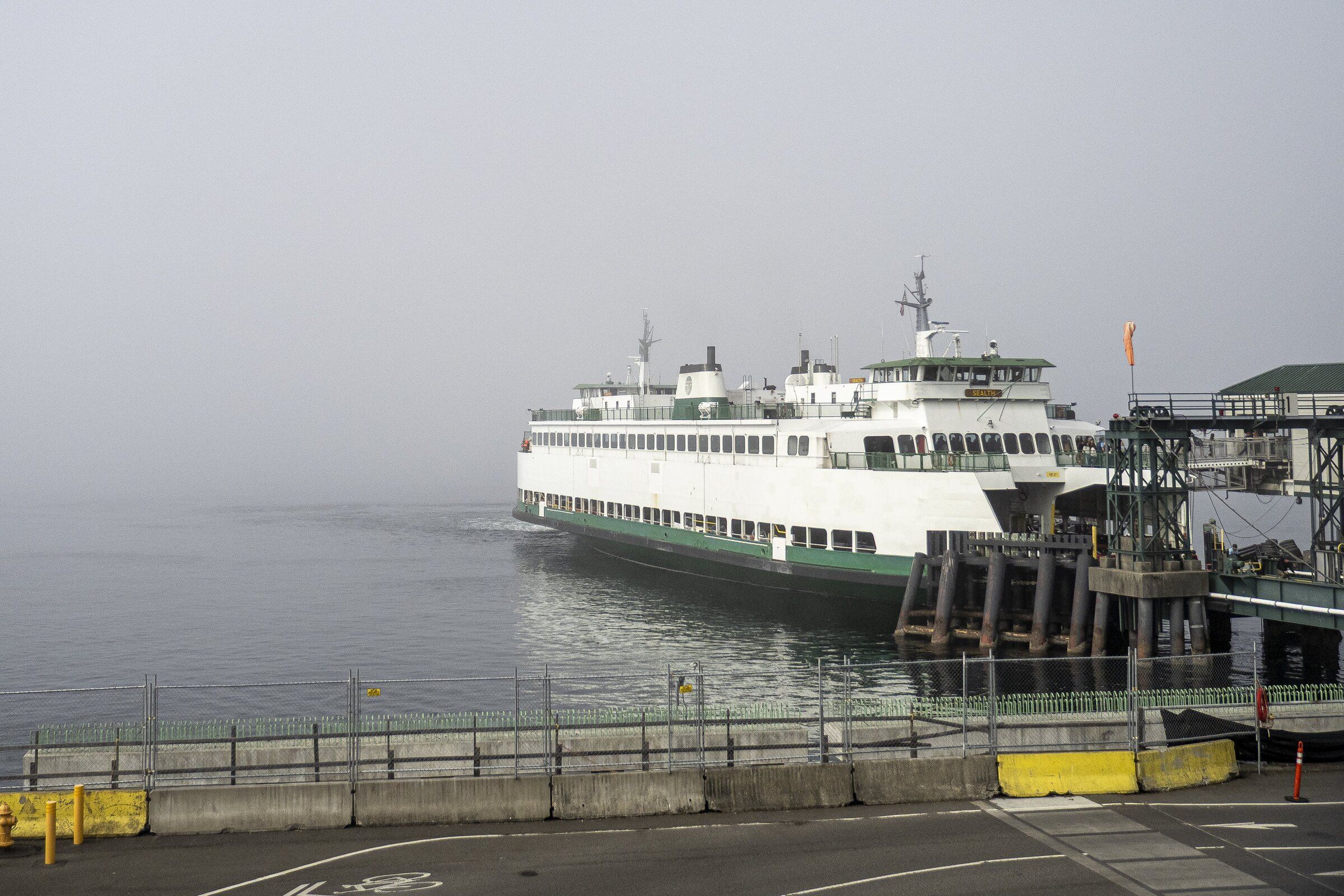
On Tuesday, the state Department of Transportation said most routes had returned to regular service. The Seattle–Bremerton route, whose ferry is shown in the photograph heading away from Colman Dock, resumed its normal schedule. The recovery was not completely seamless, however: Several sailings were canceled Tuesday morning on the Mukilteo–Clinton and Edmonds–Kingston routes, while the third, supplemental vessel, Kitsap, did not operate on the Fauntleroy–Vashon–Southworth route. That route is operating on a two-ferry schedule.
The cause of Monday’s collapse was not a damaged hull or failed engine, but the people whose work usually takes place below deck and out of passengers’ sight. A vessel cannot sail without a crew that meets federal safety requirements; an unqualified person at the terminal cannot simply fill in for a trained worker. Washington State Ferries acknowledges that filling engine-room vacancies on short notice is especially difficult when workers report their absence the day before a sailing or just minutes beforehand.
The Marine Engineers’ Beneficial Association, which represents engine-room workers, said it did not coordinate the mass absences but described the incident as a desperate signal from overworked and frustrated specialists. The union has long raised concerns about uncompetitive pay and burnout caused by overtime. In a June survey of more than 80 members, over 60% said they might retire or find another job, while more than half of respondents reported low morale among their crews.
Ferry officials respond that chief engineer positions are well paid: Base salaries start at roughly $157,000 a year, and total earnings can exceed $350,000 with overtime. But that argument itself highlights an old problem in the system: When maintaining the schedule requires constant overtime, a high final salary does not necessarily mean there are enough workers. Coordinated work stoppages by ferry employees are prohibited under state law, making the dispute over staffing and pay an especially tense legal and human issue.
Gov. Bob Ferguson met with union leaders Monday and said he intended to improve staffing levels, but called the harm to passengers an unacceptable way to pursue change. His demand — that every vessel on every route be operating from the first morning sailing Tuesday — was met only largely, not literally. Monday showed that a normal schedule in Puget Sound can return quickly on the departure boards; rebuilding trust in it will take longer.

Based on: Most Washington State Ferries routes back to regular service Tuesday