News roundup: Sound Transit is facing a multibillion-dollar shortfall that threatens key light-rail projects, while the Seattle Seahawks brace for difficult contract talks with cornerback Devon Witherspoon.
A tough task for the Seahawks: why a contract with Devon Witherspoon could be tricky
Negotiations on a new long-term contract for cornerback Devon Witherspoon could prove a more complex puzzle for Seattle Seahawks management than the recent mega-deal with receiver Jaxon Smith-Njigba, despite the smaller expected dollar value. After the club on Monday finalized a record $168.6 million, four-year deal with Smith-Njigba, attention turned to Witherspoon, whose fifth year of his rookie contract was also exercised that Friday. As noted in an analysis for Seattle Sports, although a deal for the cornerback would be cheaper, it may deliver more surprises.
The central issue is the player’s market value. The current top-paid cornerback is Trent McDuffie of the Los Angeles Rams, who recently signed a $124 million deal (an average of $31 million per year). Next is Sauce Gardner of the Indianapolis Colts at $120.4 million. Witherspoon, however, could argue for recognition as the league’s best cornerback — last season he made the Pro Bowl and was named Second-Team All-Pro, achievements neither McDuffie nor Gardner had at the time of their deals. His stats are persuasive: over three seasons he’s the only one of the three to record a pick-six in the regular season, he made the Pro Bowl each year, and he has the same number of sacks as McDuffie (4.5). Yet analytics site Spotrac values his market price more modestly — about $27.4 million per year, which would total $82.2 million over three years. That gap in valuations is the basis for potentially difficult negotiations.
Two additional factors complicate the situation. First, Witherspoon’s own negotiation posture: in 2023 he was the last draft pick of his class to sign and missed the start of training camp, showing he will stand firm to protect his interests despite a reputation as a model teammate. Second, another top cornerback — Christian Gonzalez of the New England Patriots — will soon be on the market, and like Witherspoon he is represented by agent Reginald Johnson of CAA Football. The Patriots are already preparing for extension talks. That creates a dynamic where the agent can use parallel negotiations to raise the stakes, and waiting by the Seahawks risks only pushing the price up. Technically the club has time until 2027 thanks to the fifth-year option, but in NFL reality delay rarely pays. For the Seahawks, who aim to return to Super Bowl contention, keeping a key defensive player like Witherspoon is strategically critical, but they’ll have to balance a fair valuation of his talent against a tight salary cap already burdened by Smith-Njigba’s record deal.
Three takeaways from a pivotal Sound Transit board retreat: Seattle light rail’s future in doubt
Last week’s strategic retreat of the Sound Transit board, detailed by The Urbanist, marked a turning point that exposed a deep financial and political crisis in executing the ambitious light-rail expansion program. If the headline was the shocking admission that the line to Ballard cannot be completed in the foreseeable future — a key promise voters approved in 2016 — the behind-the-scenes discussions were no less important, shaping the fate of transit construction across the region.
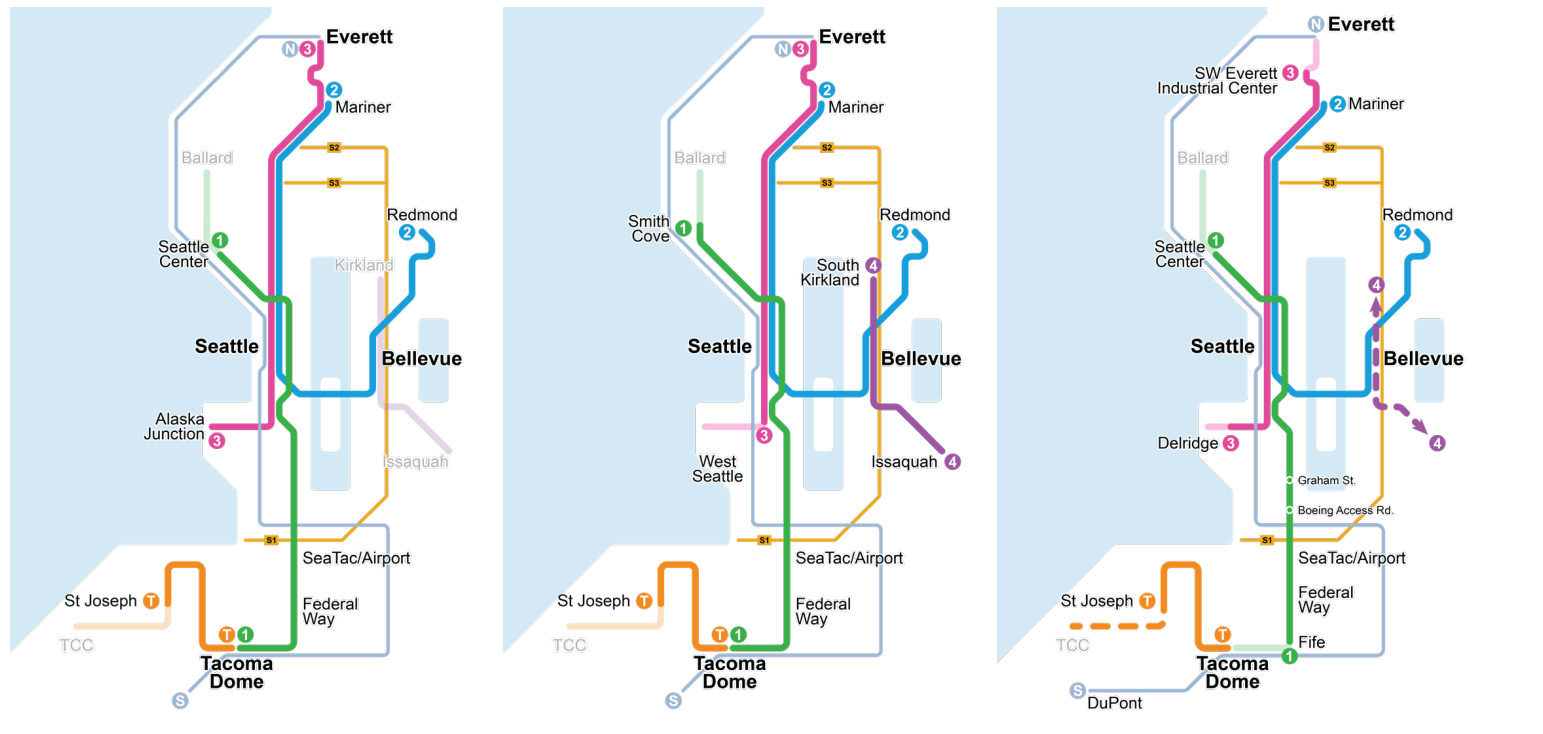
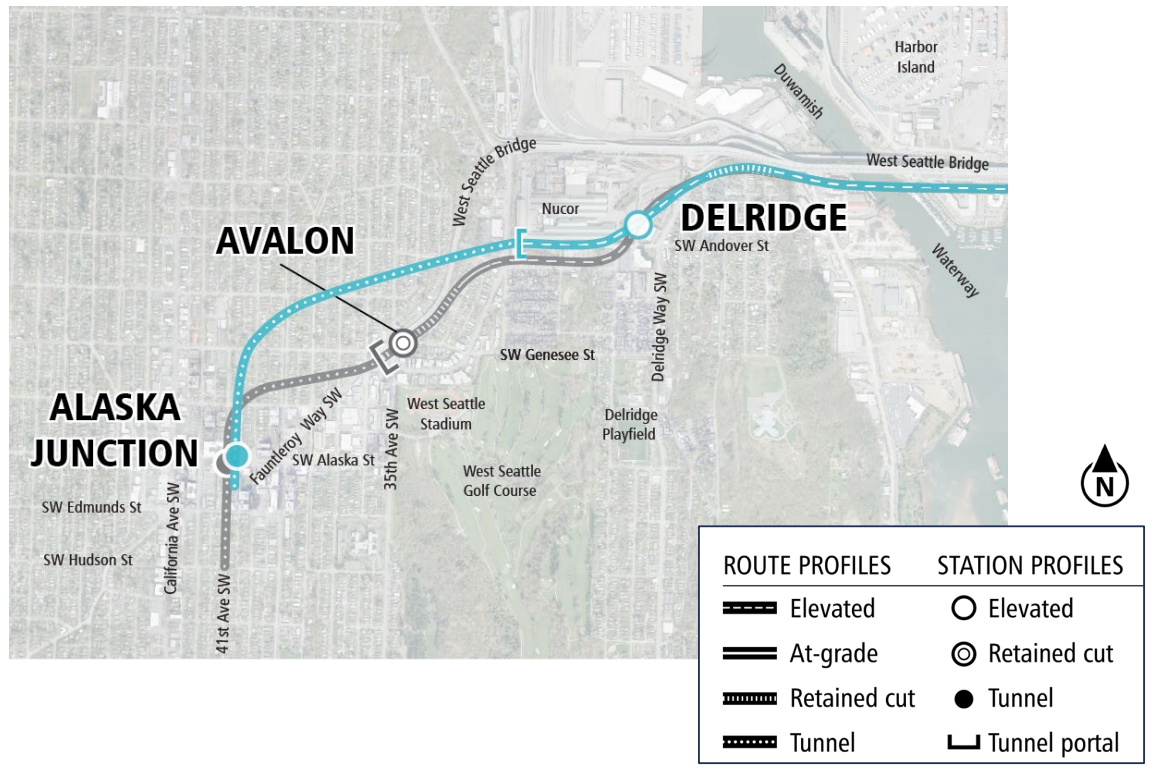
The retreat was essentially an attempt to reach consensus among board members representing different counties in the face of a colossal $34.5 billion funding gap. The three proposed approaches to “recalibrating” Sound Transit 3 (ST3) share one thing: all push back delivery of approved projects, and Ballard plans are cut back, removing at least two stations and stopping the line at either Seattle Center or Smith Cove. But other critical issues emerged during the debate. First, the West Seattle line project is uniquely well-positioned — it is “construction-ready.” As deputy CEO Terry Mestas explained, the project has cleared environmental review, and with funding in place work could begin within 90 days. Moreover, through design optimization (for example, dropping an Avalon Way station in favor of an optimized tunnel to the Junction), the project’s cost was reduced from nearly $8 billion to about $5 billion. Many view delaying such a project, whose cost will only rise with inflation, as short-sighted. Seattle Mayor Kate Wilson emphasized the importance of “continuing to show the public real results,” not freezing visible work for years. However, Everett Mayor Cassie Franklin criticized that median household income in West Seattle is twice that of Everett and the area is less diverse, calling into question the project’s priority from an equity standpoint.
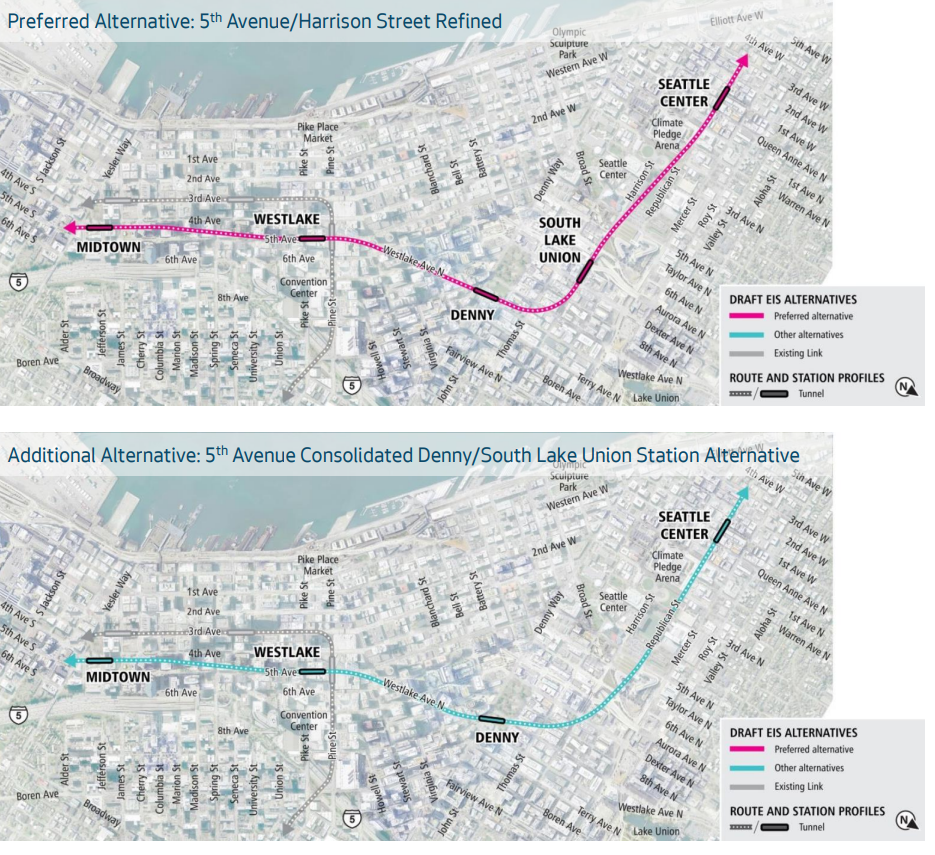
Second, the high cost of delaying Ballard planning became clear. While the West Seattle project advanced far, the Ballard branch lags and is only about 10–15% through design. One key reason was board decisions: after a preliminary environmental review in 2022, the board asked for five additional station-location options. Those options, added in 2023, responded to community resistance (especially in the Chinatown-International District) and business concerns (for example in South Lake Union) about long-term construction impacts. Ironically, the groups that pushed for changes seem likely to get their way: Sound Transit is highly likely to consolidate the Denny Way and South Lake Union stations, moving the first station off the arterial to lower costs and traffic impacts. But that means giving up a second stop in one of the state’s most densely populated neighborhoods with excellent transit access. Experts note that if Ballard planning had progressed at the same pace as West Seattle, more opportunities for savings might have been found — similar to the nearly $500 million identified for the station near Seattle Center. Importantly, even delayed projects will be developed to 30% design, allowing continued opportunities to reduce costs.
The third crucial factor hanging over the entire discussion was Sound Transit’s legislative defeat in the Washington State Legislature. The agency had desperately hoped for authorization to issue 75-year bonds (instead of the current 40-year limit) to take advantage of a new federal TIFIA (Transportation Infrastructure Finance and Innovation Act) program. As the new government-relations director Jessin Farrell explained, that would have generated $4 billion and allowed the agency to weather the expected 2030s fiscal crunch without additional state cost. A key advantage of such long-term bonds is the lack of prepayment penalties. However, especially in the State House, lawmakers blocked the initiative. Board member Hunter George bitterly noted the level of anger among some legislators, particularly from Pierce County (where Tacoma is taxed), toward Sound Transit. “They still pay higher car tabs and say the rail will never get to Tacoma. We need Olympia’s help. They’re not in the mood to help us,” George said, urging board members to work on changing public opinion. The bill’s failure — shepherded by Jake Fey of Tacoma as the chair of the transportation committee — significantly narrows the agency’s financial options.
Thus, the Sound Transit board retreat revealed not just technical and financial challenges but a deep political split and crisis of trust. On one hand is the need to deliver on promises to voters and show progress; on the other are harsh budget realities and regional conflicts. The future of light rail in the Seattle metro now depends not only on engineers and economists but on politicians’ ability to find common ground with each other, angry taxpayers, and a skeptical state legislature. Decisions the board makes in May will shape the region’s transport landscape for decades.
A golden train to nowhere: how Sound Transit’s promises cost residents $10,000 each
Seattle’s transit authorities are again asking for money, and this time the figure makes every resident of the region take notice. Sound Transit, the agency responsible for expanding light rail in the Puget Sound area, has acknowledged that completing the ambitious expansion program voters approved in 2016 requires a colossal additional $34.5 billion. That’s about $10,000 per man, woman, and child in the tax district — regardless of whether they ride the trains. And bitterly, even with that money key areas like Ballard still wouldn’t receive the promised lines.
In 2016 regional voters approved Sound Transit 3 (ST3) with a $53.8 billion budget. It promised to connect Tacoma and Everett, Seattle and Issaquah, with stops in Ballard and West Seattle. Since then the shortfall has only grown: first by $6.5 billion, then to $30 billion, and now to $34.5 billion. As commentator Charlie Harger notes in his piece for MyNorthwest.com, the hole has increased by $4.5 billion in the last six months. The tax district, known as the Regional Transit Authority (RTA), covers about 3.4 million people in the Seattle–Tacoma–Everett–Bellevue area. They shoulder the financial burden through property taxes, sales taxes, and annual car-tab payments. For comparison: a 2021 Ford F-150 owner in this district pays about $615 per year in car tabs, while in neighboring Grant County the same vehicle’s owner pays only about $108.
At the recent meeting, the Sound Transit board considered three crisis-response options, and none fulfills the original promises. They could continue current construction and delay the rest; prioritize regional connectivity at the expense of some already-started projects; or proportionally cut everything. Essentially, the conference room in Tacoma decided which voter promises will be quietly forgotten. For example, the Ballard line at best would reach only Seattle Center, stopping about a mile from the target. At worst it would end at Smith Cove, near the cruise terminal. Council member Dan Strauss, representing Ballard, called this unacceptable, pointing out that Ballard has been rezoned three times since 2016 in anticipation of light rail. Buildings were constructed and people planned their lives around the project, and now they’re told the line won’t come. According to Sound Transit’s own forecasts, that branch could serve 90,000 to 147,000 riders per day, making it the agency’s busiest line.
Other corridors face similar fates. The West Seattle line may not reach the commercial heart at the Alaska Junction, stopping in Delridge, or could be canceled altogether. The Tacoma line might terminate in the town of Fife, short of the Tacoma Dome. Stations at Graham Street and Boeing Access Road in South Seattle, and the stretch from South Kirkland to Issaquah, are also at risk. As the author wryly notes, the funding system itself is paradoxical: in 2023 the system recorded 29.8 million light-rail trips with a tax district population of 3.4 million. That’s fewer than nine trips per person per year — less than one per month. Most payers don’t use the system but still pay.
A telling managerial anecdote concerns fare gates. For a long time Sound Transit relied on passenger honesty and did not install physical barriers, viewing turnstiles as “hostile architecture” that would deter low-income riders. Instead, “goodwill ambassadors” reminded riders to pay. The result: compliance dropped to about 61%, and fare revenue fell by $4 million between 2019 and 2024 despite a 5 million increase in ridership. One of the “bold” deficit-cutting proposals now is to install conventional fare gates. This isn’t the main cause of the massive overrun, but it’s a vivid illustration of management style.
The author predicts Sound Transit will return to voters with a pared-down plan, new timelines, and a rebrand of the previously approved program. And given history — where voters have repeatedly backed the agency’s proposals — they will likely say “yes” again. But the key question isn’t just those $34.5 billion. Sound Transit has never come in on budget, and there’s no reason to think that will change. The question is what number follows the current shortfall. As residents keep paying, the counter keeps ticking and promises go unmet. That’s just how things work in these parts.