Seattle has issued a verdict in the case of a newborn’s death at a shelter, the City Council is proposing temporary developer discounts to accelerate construction, and the Mariners are discussing veteran J.P. Crawford’s future.
Seattle woman sentenced to prison for newborn daughter’s death at homeless shelter
A story that unfolded in Seattle is horrifying in its brutality while also exposing tragic gaps in the social-support system. Thirty-five-year-old Ashley “Montana” Creighton pleaded guilty to first-degree manslaughter after her newborn daughter died from starvation and drug exposure inside a former motel converted into a homeless shelter. Judge William Dixon sentenced her to 78 months in prison followed by three years of supervision. Taking time already served into account, Creighton could be released in three to four years. The tragedy raises questions about the limits of responsibility held by the state, society and the individual trapped by addiction.
According to court documents, Creighton gave birth to a girl identified in records as A.S. in May 2024 while living at the Civic Hotel in the South Lake Union neighborhood. The former motel was used by the city and King County from 2020 to 2024 as a low-barrier shelter for homeless people operated by CoLEAD. Creighton, who was addicted to fentanyl, not only used drugs during her pregnancy but also concealed the child from social workers after giving birth, fearing that hospitalization would cut off her access to drugs. For five days, she continued her normal life—eating, socializing, keeping a journal and obtaining drugs—while her premature daughter, suffering from withdrawal, starved to death. Prosecutor Christopher Anderson argued for an eight-year sentence, emphasizing that Creighton had opportunities to seek help at any time: social workers were on duty around the clock at the shelter, and she had a working cellphone. Instead, she kept a calendar in which she wrote “baby girl born” on May 18 and, on May 23, “Baby, rest in peace,” followed by extensive lines about a “beautiful bright full flower moon,” a “starry virgin goddess of purity” and the planets. Police arrived at the hotel only on May 25 in response to a call about a stillborn child, but by then the room smelled of decomposition, while the calendar and videos on Creighton’s phone left no doubt that the baby had lived for several days.
In court, Creighton delivered a remorseful statement, calling addiction a “horrible disease” and saying she hated herself for becoming a “human wreck.” “My daughter gave me sobriety. I am a good person. I am not perfect, but I have committed to becoming better every day. My baby continues to teach me faith, love, kindness and hope,” she said. Her attorney, Margaret McGuinty, asked that her client be released after completing her sentence, acknowledging her “horrible, horrible decisions” but arguing that additional incarceration would serve no purpose. “The elephant in the room is that being a drug-addicted parent in this state is not, in itself, a crime. There is no actual evidence that the child suffered, only an inference,” McGuinty said. The prosecution presented a different picture: during the five days the infant was fading, Creighton “cared for herself, ate, socialized, kept a journal, monitored her drug supply” and did nothing for the child. Creighton’s mother, Malia Zebrowski, told the court that her daughter had “disappeared into the life of fentanyl”; she did not even know about the pregnancy and never saw her granddaughter.
The internet searches recovered from Creighton’s phone add particular weight to the case. She searched: “What are my legal obligations if I give birth at home,” “How to get the placenta to detach,” “Can you put fentanyl in a Yocan Evolve,” “I gave birth to a dead baby at home, what do I do,” “Breastfeeding a baby born with addiction,” and “Washington state law on mandatory CPS reporting upon hospitalization.” These searches, along with the fact that Creighton had given birth before, undermine the defense’s argument that she was unaware of what to do. Judge Dixon was brief when imposing the sentence: “A child depends on you for everything; the responsibility is yours.” That statement draws a line under the debate about personal responsibility, but in this case it does not erase the broader context. A year earlier, KOMO News reported that the owners of the Civic Hotel were suing the city, accusing officials of allowing drug contamination of the building and failing to control residents. The low-barrier shelter, conceived as a humane solution, became a place where a newborn’s fragile life remained invisible despite the presence of social workers on duty. A.S.’s tragedy is not only the story of one person’s addiction, but also an indictment of a system that allows people like Creighton to remain invisible until it is too late.
Seattle seeks to accelerate construction: A temporary compromise instead of endless deadlock
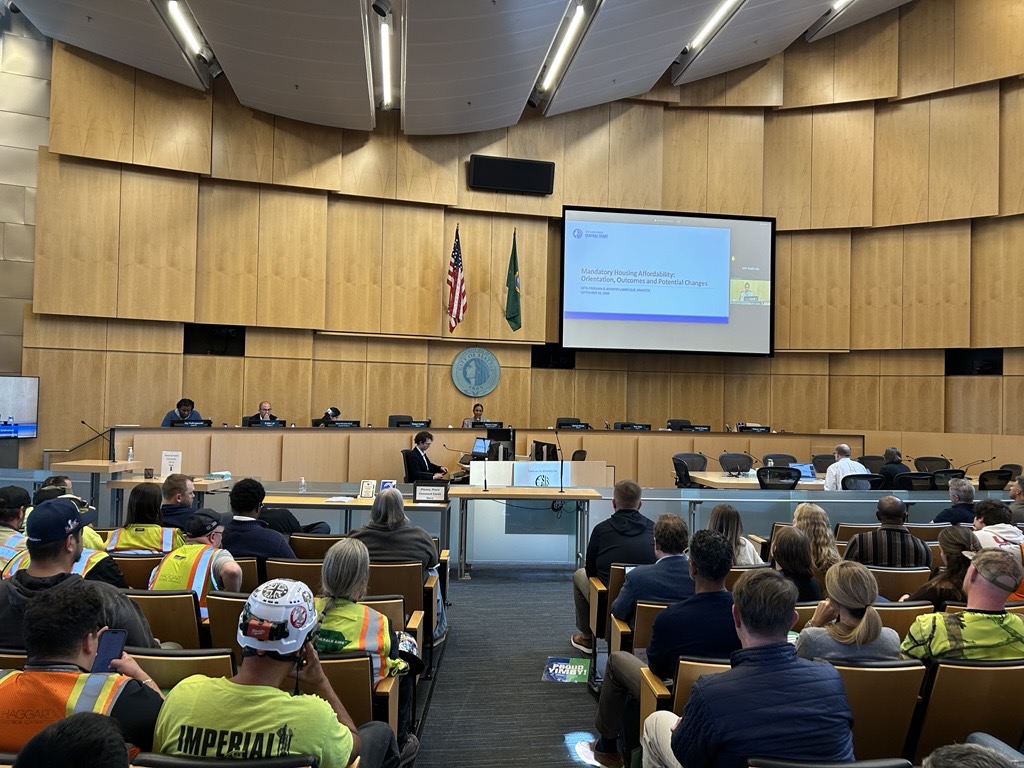
The Seattle City Council, through Councilmember Dionne Foster of Position 9, chair of the Housing, Arts and Civil Rights Committee, has introduced a plan intended to revive stalled housing projects. The proposal would temporarily reduce payments under the Mandatory Housing Affordability (MHA) program, along with a related resolution declaring the council’s intention to introduce inclusive-housing requirements in Neighborhood Residential zones in the future. In other words, the city is trying both to accelerate construction and to preserve its long-term commitments to low-income residents.
The situation itself appears paradoxical: in a city where demand for housing remains consistently high and builders say applications have fallen by nearly 95 percent since 2020, thousands of apartments are “shovel-ready” but remain unbuilt. The problem is not a lack of money among buyers, but development economics: tariffs, interest rates and fees, including MHA payments, make projects unprofitable. Foster is proposing not to eliminate MHA, but to accelerate it through temporary discounts.
The ordinance works as follows. For projects that have already reached vested status—that is, obtained certain development rights under earlier rules—the proposal would reduce the MHA in-lieu payment by 80 percent. This would not be a permanent gift: to receive the discount, a developer would have to begin construction within two years. For new projects that are not yet vested but submit a complete permit application by January 1, 2028, the discount would be 60 percent, provided that at least 25 percent of the units are family-sized, with two or more bedrooms. An exception applies to areas at high risk of displacement: there, the 60 percent discount would not be available unless the land belongs to a “legacy homeowner.” Finally, there is an accountability provision: if a discounted project does not receive its first foundation inspection within the deadline—two years for vested projects and three years for the others—the developer must pay the full MHA amount.
The accompanying resolution goes further, but more cautiously. The council says it intends to consider applying inclusive requirements to market-rate housing in Neighborhood Residential zones, where MHA currently does not apply. This would mean that new market-rate projects there would have to either include affordable units or pay an in-lieu fee. The resolution expressly states that the policy should be structured so that it “does not substantially slow development” in NR, remain unchanged for five years, encourage density through a lower per-unit fee when a site is fully utilized, and direct some future revenue toward building permanently affordable housing for households.
Support has come from unexpected quarters. Teresa Mosqueda, a King County councilmember, called MHA “a very effective tool” and pointed to “a significant national downturn in the construction market caused by factors beyond our control, such as tariffs and interest rates.” Monty Anderson of the Seattle Building & Construction Trades Council thanked Foster for “breaking the logjam” and supporting “critically needed, shovel-ready housing projects, good jobs and economic opportunity.” City Council President Joy Hollingsworth stressed the need to “accelerate both family and affordable housing.” Ben Maritz of Great Expectations SPC acknowledged “real trade-offs” and the need for resources for all types of housing. Bill Hetherington of LiUNA Local 242 spoke about “pathways to opportunity” for young people and working families. Alex Lofton of For Seattle recalled that “housing construction fell off a cliff.” Raymond Connell of Holland Partner Group cited the nearly 95 percent decline in applications since 2020 and called the discount a way to “mitigate the effects of war, tariffs and higher interest rates.”
Several key figures and terms merit explanation. An MHA in-lieu fee is a cash payment a developer makes instead of including affordable apartments in a project; the money goes into the city’s affordable-housing fund. Vested is a legal status indicating that a project has already secured development rights under the rules in effect at the time, meaning newer restrictions do not apply to it. Neighborhood Residential (NR) zones are primarily low-rise residential areas where multifamily buildings have historically been prohibited and where MHA has not applied. An inclusionary requirement mandates that affordable units be included in market-rate projects. A legacy homeowner is a homeowner whose family has owned property in a high-displacement-risk neighborhood for a long time, giving the owner protection from losing the discount.
The initiative’s central paradox is that it simultaneously reduces revenue for the affordable-housing fund and attempts to preserve that same revenue stream. The 80 percent discount for vested projects means the city will collect substantially less in payments, but it will gain the housing units themselves. The resolution, meanwhile, promises that some future revenue from inclusive requirements will go toward permanently affordable housing. The result is a temporary trade-off: construction speed today, affordability tomorrow. Critics may call it a deferred problem; supporters may argue that without construction there will be neither a functioning market nor a well-funded housing program.
Politically, the move appears to be Foster’s attempt to occupy the center. She is not eliminating MHA, which progressives support, but is giving developers something they have requested for years. The accompanying resolution is aimed at the left flank, promising to revisit inclusive requirements in NR. It is a classic political balance: a stick for some, a carrot for others, all in one package.
The next steps are already mapped out. The Housing, Arts and Civil Rights Committee has given the package its first review, Foster will continue community consultations as part of the budget process, and more detailed consideration is expected in committee later this year. If the ordinance passes, developers will have a window through 2028 to claim the discount and begin digging the foundation. If it fails, stalled projects may remain on paper, while the city risks losing housing, jobs and tax revenue. The only question is whether Seattle can build enough before the window closes.
J.P. Crawford’s return to the Mariners: Nostalgia or necessity?
The Seattle Mariners’ season is unfolding far from what fans had hoped, and against the backdrop of widespread disappointment, veteran J.P. Crawford’s play has unexpectedly emerged as a bright spot. After three separate stints on the injured list this season, the Mariners’ shortstop finally began to regain his form in September—just as the team had virtually lost its playoff chances. That coincidence—his personal resurgence and impending free agency—raises difficult questions about Crawford’s future in Seattle.
According to a Seattle Sports report, Crawford has posted numbers in September that few would have expected from a player who spent much of the season on the injured list. His slash line is .309/.426/.436, with two home runs, one double and, particularly notably, 10 walks against just six strikeouts over 15 games. Among American League players, he ranks seventh in on-base percentage and 19th in wRC+ (154) during that span. For a 30-year-old whose career has been clouded by injuries in recent years, the surge is a timely reminder of his value.
However, the analysts and hosts of the Wyman and Bob podcast are reluctant to overrate the month. Bob Stelton said plainly that Crawford is not the kind of player who can produce such numbers month after month: “He’s dealing with injuries, he’s getting older, he doesn’t have the range he used to. But he’s always had good at-bats—you rarely see him swing at the first pitch and pop it up, and he sees five, six, seven, eight pitches in every at-bat.” That description portrays a player whose value has shifted from physical ability to discipline and experience.
The key question is whether there is a place for Crawford in the Mariners’ infield for the 2027 season, particularly given that the club appears to be emphasizing young players. Dave Wyman suggested that Crawford could return as a fifth infielder, backing up Josh Naylor at first base, Cole Young at second, Colt Emerson at shortstop and Brendan Donovan at third. Crawford’s leadership qualities—he has repeatedly said he wants to finish his career in a Mariners uniform—are a significant argument in his favor. “J.P. is such a great teammate. We constantly admire him and hear stories about his leadership and how much he means to the clubhouse,” Wyman said. But, as he added, everything comes down to money and a clear understanding of how the coaching staff plans to use him.
Stelton sees the situation differently. He believes the Mariners should look for a power-hitting third baseman in the offseason and use Donovan as a utility player capable of covering both the infield and outfield. “I’d really like to see someone who is a natural third baseman with power, and Donovan isn’t that. That effectively rules out J.P. Crawford, because I really don’t know what to do with him,” the host acknowledged. The only scenario in which he sees Crawford returning is if Colt Emerson—who the club appears to have already committed significant money to—is not ready to open the season as the starter after wrist surgery. In that case, Crawford could serve as a temporary bridge until Emerson returns. But Stelton himself considers that unlikely: “I assume that by investing that kind of money in Colt Emerson, they expect him to be the starter next year.”
What do the terms that may be unfamiliar to readers mean? wRC+ is a statistic that evaluates a hitter’s performance while accounting for ballpark and era: 100 represents league average, while 154 means Crawford was 54 percent better than the average hitter in September. The slash line .309/.426/.436 refers to batting average, on-base percentage—including walks and hit-by-pitches—and slugging percentage. A walk is a way to reach base without a hit, when a pitcher throws four pitches outside the strike zone. Taken together, the numbers show that Crawford is less a power hitter than a batter who wears down pitchers and reaches base consistently.
Crawford’s situation is a classic dilemma for a club at a crossroads. On one hand, there is a respected veteran with unquestioned clubhouse authority who wants to stay and has just demonstrated that he can still contribute. On the other is a team that has invested resources in young players in recent years, and Crawford’s return could block one of their paths. His injury history this season is also a serious red flag for any long-term contract. As Stelton aptly put it, “If he comes back, I don’t think you’re breaking the bank for him. It’s not a move you’d call major.” That may be the answer: the Mariners are unlikely to offer Crawford more than a low-paid backup role, while the player, who values his place in the club’s history, might accept those terms for the chance to finish his career where it began. But if the club chooses an uncompromising path toward youth, saying goodbye to Crawford will become inevitable, and his September surge will remain only a beautiful but solitary episode at the end of a long story.