A tragedy on the Key Peninsula took five lives. A brutal knife attack and shooting occurred in Seattle. Seahawks running back Kenneth Walker signals his value ahead of free agency.
Key Peninsula tragedy: five dead after stabbing and police shooting
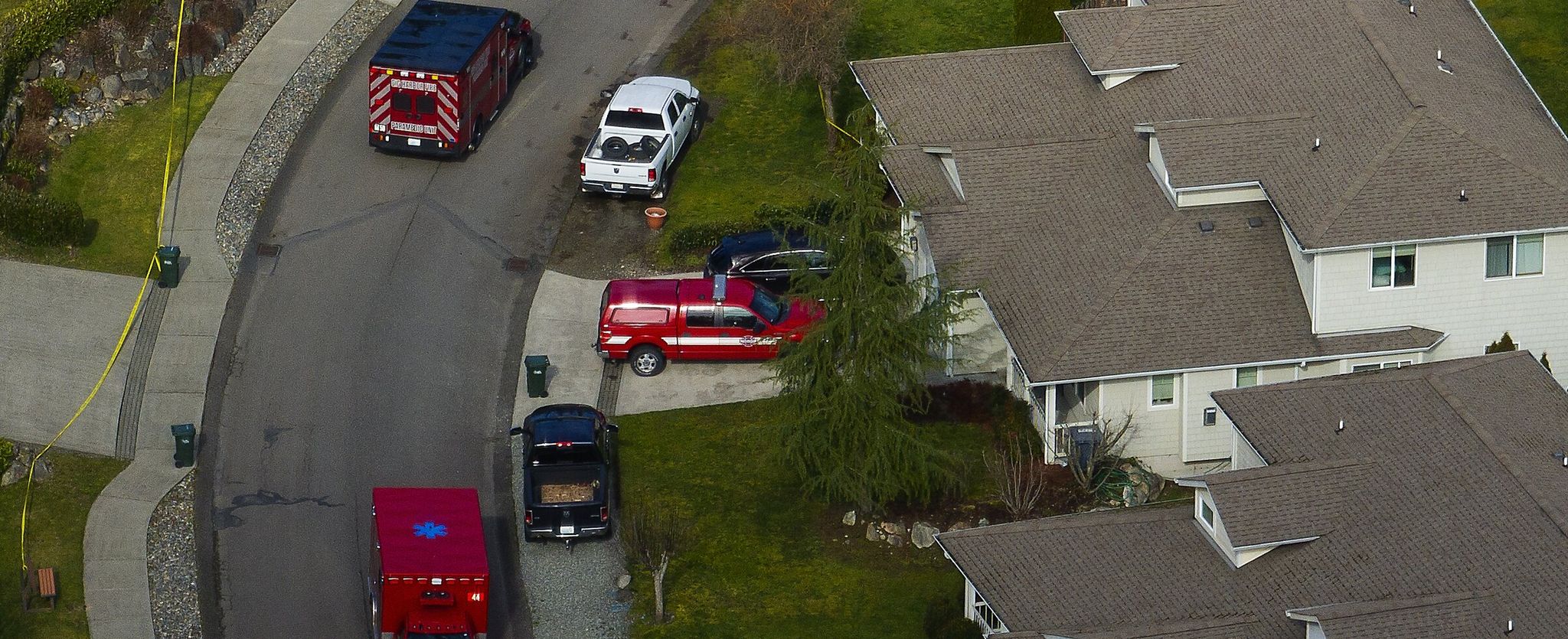
A horrific tragedy unfolded in the quiet Wauna neighborhood near Gig Harbor in Pierce County, claiming five lives. The incident, which occurred Tuesday morning, began with a report of a violation of a no-contact court order and escalated into a bloody confrontation that required sheriff intervention. Behind the sparse facts of police reports lies a years-long story of a family struggling with the son’s severe mental illness that ended in the worst possible way.
According to a joint statement from the Pierce County Sheriff’s Office and Key Peninsula Fire Department, a call came in at about 8:45 a.m. reporting that a man was violating a no-contact order. Deputies later learned that the order was not yet in effect because it had not been served to the alleged violator. Officers were heading to a home on 87th Avenue to serve a copy of the order when they received new, chilling calls: multiple people reported that the man was stabbing people near the house. A deputy who arrived on scene fired his weapon, killing the 32-year-old suspect. The Seattle Times reported the first call about “shots fired” came at 9:33 a.m. In the end, four bodies were found outside the home, including the attacker. A fifth victim died of injuries en route to the hospital in a Gig Harbor Fire Department ambulance. All deceased were adults. The victims’ identities and the precise connection between the attacker and the court order have not been officially confirmed, and the deputy who discharged his firearm has been placed on administrative leave as part of standard procedure.
Key context for this tragedy appears in court documents that reveal the family’s years-long struggle. Court records indicate a 52-year-old woman and her 32-year-old son lived in the home where the violence occurred. In May of last year, a Pierce County Superior Court commissioner ordered the son to leave the residence and to stay away from his mother for one year. In the May 2 protection order, which should have still been in effect on Tuesday, the commissioner noted the son suffered from a mental disorder and the mother had reasonable grounds to fear for her safety. He pushed her and said “her grave is already dug.” The son was prohibited from possessing firearms and was ordered to follow a treatment plan obtained from St. Joseph Medical Center in Tacoma, including taking prescribed medication. The mother filed separate protection petitions against her son starting in 2020. In one filing she said her son had mental health issues and had threatened her daughter with a knife. In another, filed in April of last year, she described coming home to find a missing cat, broken framed photos, a triggered fire alarm, and a son “acting delusional.” She said he believed he was an “Egyptian god,” threatened her, harmed her cat, and asked the court to force him to move out, bar him from possessing weapons, and order a psychiatric evaluation. Notably, available records show the man did not have felony convictions in Pierce or King County courts.
This story raises difficult questions about the domestic violence protection system, access to and effectiveness of psychiatric care, and how society and government institutions support families in crisis. Despite the mother’s repeated court filings and the orders issued, tragedy was not averted. A special Pierce County use-of-force investigation team is now probing the incident, and residents of the normally quiet Wauna neighborhood are confronting a reality more often associated with urban crime reports.
Seattle tragedy: five killed in stabbing and shooting
A shocking incident in Seattle left five people dead. The event, involving both a knife attack and gunfire, rattled the local community and prompted an active law enforcement investigation. Details of the tragic event were reported by KIRO 7 News Seattle.
Preliminary information indicates five people were killed. While the full picture is still emerging, it is known that the events included both stab wounds and the use of a firearm. The combination of attack methods indicates an extremely violent and chaotic crime. Local authorities, including the Seattle Police Department and possibly the Washington State Patrol (WSP), are working the scene, collecting evidence and determining motives and circumstances that led to such a large-scale tragedy. Incidents like this once again raise pressing questions about public safety and violence prevention measures.
A separate disturbing element that day was an alert about missing persons. The Washington State Patrol issued an endangered missing person alert for a mother and son last seen in Seattle on February 14. It is unclear whether the mass killing and the missing persons report are related, but the fact that the public learned of five dead and a simultaneous endangered missing alert in one day created a heightened atmosphere of fear and uncertainty for city residents. An endangered missing person alert is a special mechanism used by law enforcement to quickly inform the public when there is reason to believe a missing person’s life or health is in immediate danger. It is a more urgent category than a standard missing person investigation.
Key takeaways from the report are the scale of the incident (five dead), the use of multiple weapons (knife and firearm)—which could indicate multiple attackers or an extreme level of aggression by a single person—and the parallel development of a missing persons case, adding layers of uncertainty. No direct quotes or official statements were included in the excerpt provided, but it is implied that an active investigation is underway. The implications are serious: the incident will inevitably prompt reviews of emergency response, discussions about access to weapons and violence reduction strategies, and leave a deep psychological scar on a community forced again to confront senseless brutality close to home.
Kenneth Walker signals to the Seahawks ahead of free agency
In professional sports—and especially in the NFL—players’ public remarks are rarely just idle thoughts. They are often carefully calibrated signals to teams, agents, and fans ahead of crucial career moments. That appears to be the case with Seattle Seahawks running back Kenneth Walker III, who sent a clear message during a recent YouTube Q&A session, as detailed by Heavy.com. His statement, made days before the free agency market opens on March 11, reads like an assertion of self-worth and a reminder of his value to a team on the verge of a consequential financial decision.
In the video, Walker, 25, the Super Bowl MVP with whom the Seahawks won the title, candidly described the start of his season as “ass,” which led to “late-night talks” with his father. But the essence of his message was not complaint but a philosophy of acceptance. “You can’t control how many times you’re subbed out or how many carries you’re given… I can’t control that,” he said. “I can only control… what I do with my opportunities.” This is not a demand for a trade or a direct attack on the coaching staff, but it is a pointed reminder that Walker sees himself as a game-changing player and that his workload did not always reflect that. In the NFL, where a running back’s touches correlate directly with statistics and thus market value, such comments are a significant argument for the upcoming negotiations.
Timing is critical. Walker will hit the free-agent market, and the Seahawks must quickly decide on their strategy. The window to negotiate with other teams opens March 9, and he will officially be a free agent on March 11. If he reaches the market, interest in him is expected to be strong: some projections estimate his value at $8–12 million per year. His most recent season supports that valuation: 221 carries, 1,027 yards and 5 touchdowns, not to mention a key role in winning a championship. His YouTube remarks were therefore not just “talk”; they were the presentation of a player who, feeling he could not control snap counts, nevertheless maximized opportunities and helped deliver a title just before he gains the ability to choose his next team.
The Seahawks’ situation is complicated by another factor. Team running back Zach Charbonnet underwent surgery for a torn anterior cruciate ligament (ACL) and is likely to miss a significant portion of 2026. An ACL tear is a serious knee injury requiring long rehabilitation and casts doubt on a player’s availability at the season’s start. That alters the team’s calculations. Whatever the Seahawks’ running-back committee philosophy, if Charbonnet is unavailable, Walker becomes even more central—either as the lead rusher or as a star they must urgently replace. Now the Seahawks face three main options: extend Walker before the market opens with a long-term deal, let him test free agency and try to outbid others, or use the franchise tag (which multiple reports suggest is unlikely). The franchise tag lets a club retain a key free agent for one year by offering a salary equal to the average of the top players at the position, but for running backs it is often viewed as inefficient because of the position’s high cost relative to its typically short career span.
Walker’s YouTube message does not guarantee an outcome, but it positions him well for negotiations. He did not beg for more touches. He stated he stayed ready, performed when it mattered, and knows who he is as a player. With March 11 approaching, the Seahawks must decide whether they are willing to pay him his new, championship-level price or begin preparing for life after Kenneth Walker. His calm but confident rhetoric makes clear he knows his value and intends to be paid fairly for it, whether in Seattle or elsewhere in the NFL.