Today’s top stories: The Seahawks brought a rookie back to the practice squad and parted ways with their third quarterback as Sam Darnold nears a return; the emergency closure of I-5 express lanes in Seattle exposed years of underfunding for road repairs in Washington state; and, after a disappointing series in Finland, the Kraken are preparing for six games in nine days that could shape their playoff prospects.
Seahawks bring rookie back to practice squad and move on from third quarterback
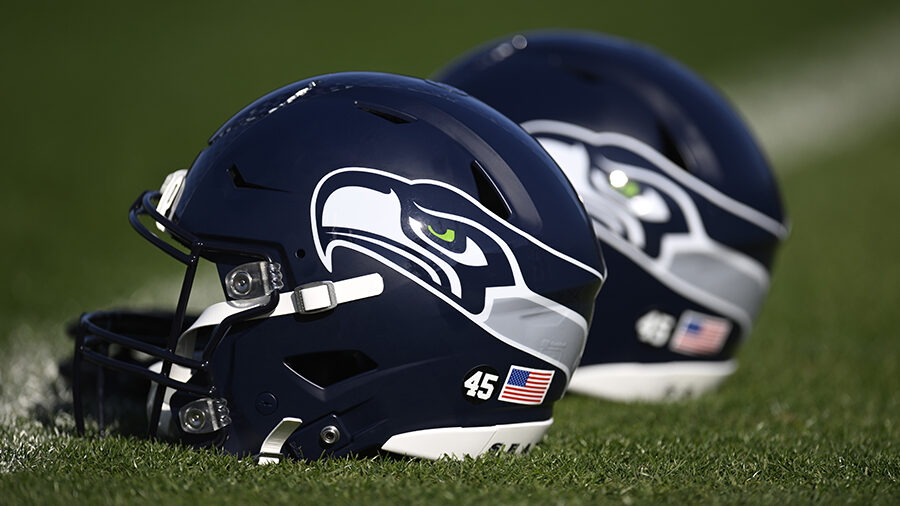
The Seattle Seahawks announced two roster moves early this week. They may look like routine transactions at first glance, but they illustrate how head coach Mike Macdonald manages roster depth in the thick of the season. As Seattle Sports reports, just one day after cutting nose tackle Deven Eastern from the 53-man roster, the team brought him back to the practice squad and, in a corresponding move, parted ways with quarterback Adrian Martinez.
Eastern, a Minnesota graduate selected by Seattle in the seventh round of the 2026 draft, was promoted to the active roster ahead of the Week 9 game against the Arizona Cardinals out of sheer necessity. Defensive veteran Leonard Williams was sidelined with a stinger, an injury to the nerve bundle in the neck and shoulder area that causes burning pain and weakness in the arm. Eastern was expected to fill the resulting gap in the interior defensive-line rotation, but he never took the field in that game and was inactive for last Sunday’s matchup with the Las Vegas Raiders. Once the emergency had passed, the Seahawks quietly returned the rookie to his proper place on the practice squad, retaining his rights while keeping the 53-man roster flexible.
The Martinez move is more interesting. He was signed to the practice squad on November 4, after starting quarterback Sam Darnold went down with two injuries: bruised ribs and a quadriceps injury. Martinez was meant to provide cover as an emergency third quarterback in case something happened to the remaining quarterbacks. But in the two games since he was signed, he was never elevated from the practice squad to the active roster, even in that role. In other words, the team kept him as a backup on paper, but never actually needed him. It is telling, too, that Macdonald said Monday that the team was “very optimistic” about Darnold returning to practice next week and starting against the San Francisco 49ers. If the starting quarterback is ready, a third backup is unnecessary.
The Seahawks are now on their bye week. Afterward, they will travel to San Francisco on November 29 for a pivotal NFC West divisional matchup. Against that backdrop, the moves look less like frantic roster shuffling and more like sensible arithmetic: free up a spot that is no longer needed and return a player to the reserve pool who could prove useful down the line. The week’s broader context also deserves attention: the team is dealing with the fallout from its win over the Raiders, in which officials made two controversial calls, and its running back has reportedly been ruled out indefinitely with an MCL sprain. Against this backdrop, the defense’s dominant play and a standout performance from Devon Witherspoon—called “dynamite” in team coverage—are reminders that roster depth and the health of key players will be decisive in the playoff race.
A few terms are worth clarifying. A nose tackle is a defensive player lined up directly across from the center on the offensive line. His job is to push through the middle and disrupt the opponent’s running game. The practice squad is a reserve group of players who practice with the team but are not part of the 53-man active roster. They can be elevated to the active roster for up to three games in a season without losing their practice-squad status. A stinger is an injury to the brachial plexus, a network of nerves in the shoulder area that can cause a loss of strength and movement in the arm. It does not require surgery, but can sideline a player for several weeks. The 2026 draft mentioned in the report is a future draft: Seattle has already secured Eastern’s rights, and calling him a “2026 draft pick” underscores that the club sees him as a long-term asset rather than a short-term fix.
The takeaway is straightforward: the Seahawks are heading into a crucial stretch of the season optimistic about Darnold and clear about who they need in reserve—and who they do not. Returning Eastern to the practice squad lets the team retain control of a promising rookie without risking losing him, while releasing Martinez signals that the coaching staff expects its starting quarterback back soon and sees no need to keep a third backup. When every roster spot matters, small but timely moves like these can be as important as big wins on the field.
A bridge held together by a promise: Why I-5 express-lane repairs are only a temporary fix
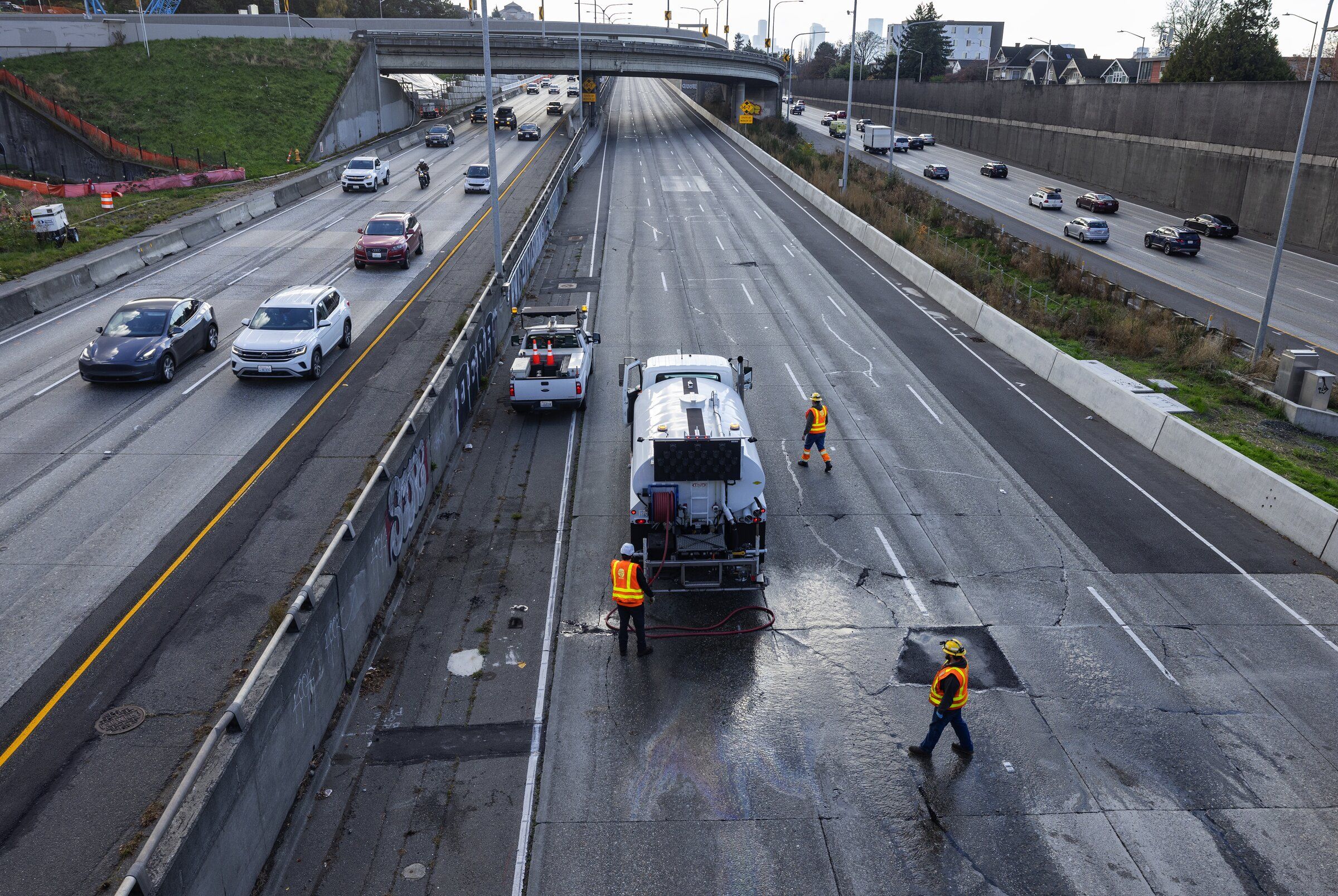
What happened on Seattle’s Interstate 5 this week was not just a road mishap or an ordinary traffic jam. It was a vivid illustration of how the infrastructure of an entire region—after decades of putting off major maintenance in favor of high-profile megaprojects—is beginning to fail beneath the wheels of thousands of cars. The I-5 express lanes, which carry an average of 42,000 cars and trucks every day, had to be closed in an emergency Monday afternoon: a chunk of concrete that had broken off the main slab was vibrating under traffic and could have come loose into the flow at any moment. The lanes reopened around 12:30 p.m. Tuesday, after crews patched the gap near the Roanoke Street overpass.
This was not an isolated incident but a symptom of a wider problem. Washington ranks 46th in the country for road condition: according to the U.S. Department of Transportation, only 68% of the state’s road surfaces are in acceptable condition. In other words, nearly a third of the asphalt and concrete we drive on every day is officially considered problematic. For drivers, that means one thing: a similar failure could happen at any time—here at Roanoke or at dozens of other locations across Western Washington.
The repair method itself is telling. Before the lanes reopened, crews applied cold-mix asphalt as a temporary measure. Under heavy traffic and trucks, however, the material can either get pressed down or crumble into pieces within days or weeks. To make the patch last longer, workers applied a hot asphalt mix around 10 a.m. It needs time to cool. “We’re confident the patch looks good,” said WSDOT spokesperson RB McKeon. That sounds reassuring, but it amounts to an admission: the state is not repairing the road so much as chasing damage.
The impact on traffic speaks for itself. On Tuesday morning, southbound drivers bore the brunt: without the express lanes, traffic was stop-and-go from Northgate to the Ship Canal, moving a little faster farther into downtown. On Monday afternoon, delays stretched to at least 50 minutes, with backups reaching from I-90 to Green Lake as all northbound traffic was forced into the general-purpose lanes. For comparison, the bridge’s upper main deck over the Ship Canal carries 186,000 vehicles a day—more than four times the express lanes’ traffic—and its deterioration is critical to the entire region.
Why did this happen? The answer lies in spending priorities over the past two decades. The state has chronically underfunded major road maintenance and preservation for nearly 20 years, despite raising the gas tax to its current 56.5 cents per gallon (74.8 cents including the federal tax)—one of the highest rates in the country—and imposing indirect carbon fees. Under pressure from local governments and businesses, as well as drivers, revenue from the higher taxes of the 2010s and 2020s went mostly to megaprojects: I-405 express toll lanes, the expansion of Highway 520, carpool lanes on I-5 in Pierce County, new expressways in SeaTac and Fife, and, of course, the Highway 99 tunnel, which replaced the aging Alaskan Way Viaduct in 2019.
Former WSDOT Secretary Roger Millar called the state’s aging highways and bridges a “slippery slope to failure” back in 2023. At the time, the annual preservation fund of $500 million covered only half of what was needed. Since then, lawmakers have increased it to about $650 million a year, with a target of $900 million by 2028. But there’s an important caveat: even that is not enough, and, more importantly, the money is allocated reactively rather than strategically.
That is why there is currently no large-scale project to fully rebuild the I-5 express lanes. Nor is there one for the deteriorating pavement in Northgate and Shoreline. Another problem section—the southbound stretch from Roanoke to Mercer Street—was supposed to be repaved in 2027, but construction inflation has eaten into the preservation fund, pushing the work back to 2028 or later. At the same time, only a limited number of lanes can be rebuilt at once; otherwise, regional traffic would simply grind to a halt.
Instead, WSDOT is patching holes one by one with $13.5 million from a regional preservation fund. Since summer 2025, 90 panels have been replaced on I-5 in Seattle and Shoreline, along with others farther north, all the way to the Canadian border. Cracks are regularly filled with sealant—the winding black marks near Roanoke that keep water from seeping in and accelerating corrosion and the deterioration of the panels.
The situation has already prompted an institutional response. In September, the Washington State Good Roads & Transportation Association again urged the next legislative session to make “road preservation and maintenance the top transportation priority” and to draw up a coherent 20-year plan. The organization accused WSDOT and lawmakers of violating the state constitution’s 18th Amendment, which requires gas-tax revenue to be spent on road projects. In the association’s view, the money is going to “non-road projects,” such as new fish-passage culverts, instead of other funding sources being used.
The dispute over culverts deserves a word of explanation: these are specially designed drainage structures built beneath roads to restore salmon migration and meet federal environmental requirements. They are not technically asphalt repairs, but they are enormously expensive—and this is where environmental obligations and road funding collide.
Even before the cracked panel was discovered, WSDOT had planned overnight closures of the express lanes this week for separate preservation work on the Ship Canal Bridge. At 7 p.m. Tuesday, the express lanes will narrow to two lanes; at 9 p.m. Tuesday, Wednesday and Thursday, they will close completely between Roanoke Street and Northeast 45th Street. They normally operate northbound at that time, but will open southbound at 5 a.m. each morning.
The takeaway is both simple and troubling. “Incidents like this underscore the value of the preservation work we’re doing in places like the Ship Canal Bridge,” McKeon said. But while major reconstruction is delayed, the state continues to spend millions patching individual panels and hoping the next slab to break off doesn’t land on a car. The question is not whether another failure will happen, but when and where. For Seattle drivers, this is no longer an abstract policy debate; it is a daily risk on the way home, as The Seattle Times reports.
Kraken face a test after Finland: How will Lambert’s team handle a packed schedule?
The Seattle Kraken’s trip to Finland was a mixed experience. On one hand, spending a week together in Europe helped bring the team closer; on the other, the Carolina Hurricanes took the Seattle team apart twice on the ice. Kraken head coach Lane Lambert admitted as much after the final game of the series. His words sounded less like consolation than a warning ahead of the toughest stretch of the schedule. The team enters this crossroads at 9-8-1, and the next few weeks will effectively determine which way it turns.
Lambert was frank in his assessment of the European trip: “Those were two games where we played very poorly. We need to find a way to regroup.” That need to regroup will be the main test, because the schedule offers no respite. On Thursday, the Kraken host the Vancouver Canucks at Climate Pledge Arena. Vancouver is the league’s worst team, with a dismal 5-17-1 record. It might seem like the perfect opponent for rebuilding confidence, but games like these often become traps for teams still searching for their form. Next comes a road game against the San Jose Sharks on Saturday, followed by home games against the Anaheim Ducks and Chicago Blackhawks, then a home-and-away back-to-back against the Edmonton Oilers.
Six games in nine days is not just a packed schedule; it is a real test of endurance, ending just in time for Thanksgiving. In North American hockey, the holiday is traditionally an early turning point: teams’ positions in the standings at the end of November usually make clear who is a genuine playoff contender and who is merely giving the appearance of a fight. This stretch matters twice as much for the Kraken. No one is calling Seattle a favorite yet—it is too early—but the team’s stated goal of remaining competitive through March will look far more realistic if it plays better over the next week or two than it did in Finland.
A few points are worth explaining. A 9-8-1 record means nine wins, eight regulation losses and one overtime or shootout loss. That is how NHL points are awarded, and the point earned for an overtime loss can prove decisive in a tight playoff race. The term “gauntlet,” used in the headline on the league’s official website, refers in sports journalism to a run of difficult games—a kind of “trial by fire.” A “back-to-back” means two games on consecutive days, often with travel between cities, which takes a significant physical toll even on the fittest hockey players. The NHL schedule gets especially demanding toward the end of the year: December is traditionally packed with games, and injuries and fatigue accumulate during stretches like this.
The key insight is simple: the team chemistry built in Finland is an intangible resource, but it could be decisive when legs are heavy and one opponent follows another. The Kraken have been jolted emotionally by two blowout losses, but the trip also gave the whole team the rare chance to spend a week together away from home. Now the question is whether Lambert can turn that experience into resilience. Thursday’s game against Vancouver, which looks like an easy win on paper, will be the first test. If the Kraken stumble against the league’s worst team, talk of “regrouping” will quickly give way to talk of a crisis. If Seattle wins and enters the Edmonton series on a high note, the goal of staying in contention through March will be more than just a statement of intent. As the coach said in the article on the NHL’s official website, the team needs to find a way to regroup—and the next nine days will show whether it has.