An Alaska Airlines plane made a steep descent over California because of a mechanical issue, Belltown was shaken by a wave of shootings that left three people dead, and experts are debating the Seattle Seahawks’ key player for the upcoming season.
Alaska Airlines flight makes emergency landing in Fresno after mechanical issue
On Sunday evening, passengers on Alaska Airlines Flight 671 from Santa Ana, California, to Seattle ended up in Fresno instead of following the scheduled route. The plane, which departed John Wayne Airport at 9:08 p.m. local time, was forced to make an unscheduled landing after the crew detected signs of a mechanical problem. The most alarming aspect of the incident was the aircraft’s rapid descent: according to tracking data, it lost about 30,000 feet, descending from a cruising altitude of 40,000 feet to approximately 10,000 feet before diverting to Fresno Yosemite International Airport.
The airline responded promptly, confirming that the flight had been diverted because of an “indication of a mechanical issue,” while emphasizing that the landing was routine and did not require emergency measures. The company said the aircraft landed safely and that passengers would be taken to their destination on another plane Monday. Although the airline did not disclose details about the malfunction, the descent from 40,000 to 10,000 feet is a standard procedure when an aircraft needs to leave its cruising altitude quickly. Even a partial loss of cabin pressure or other technical failure requires an immediate descent to a safe altitude.
For those unfamiliar with aviation procedures, it is worth explaining that a cruising altitude of 40,000 feet is a standard operating level for modern narrow-body airliners, where the air is thin and fuel consumption is minimized. Descending to 10,000 feet means returning to denser layers of the atmosphere, where oxygen deprivation is no longer a threat to passengers and crew even in the event of a loss of cabin pressure. Such a maneuver is typically carried out after pressure sensors are triggered or when other mechanical abnormalities arise and pilots decide not to take risks, instead choosing the nearest suitable airport. In this case, Fresno was the optimal choice, located roughly halfway between Southern California and Seattle.
The incident comes amid heightened scrutiny of Alaska Airlines’ safety record following a high-profile incident in January, when part of the fuselage of one of the carrier’s Boeing 737 Max 9 aircraft blew out in flight. Although Sunday’s flight involved a different type of aircraft and was unrelated to that incident, any mention of the airline in connection with “mechanical problems” is bound to raise questions among travelers. Still, experts noted that the safe completion of the flight and the swift arrangement of a replacement aircraft demonstrate that safety protocols are working: the crew followed procedures precisely, and passengers may not even have realized how serious the situation was until the plane began its descent.
Flight data published by the source indicates that the aircraft took off almost on time, meaning the delay arose during the flight itself. For an airline, incidents like this represent not only a logistical challenge but also a reputational risk, especially in an era when every event reaches social media almost instantly. Nevertheless, Alaska Airlines once again demonstrated its commitment to the principle that it is better to be safe than sorry. That is perhaps the main takeaway for passengers: even when something appears to go wrong, the aviation safety system continues to function. The only remaining question is what exactly caused the malfunction and whether the official investigation will ensure that a similar incident does not happen again.
Tragic weekend in Belltown: wave of violence leaves three dead in 24 hours
The Labor Day weekend turned into a tragedy for Seattle residents. In the heart of the city, the Belltown neighborhood was hit by a series of brazen shootings that injured seven people within 24 hours. Three of them, including a minor, died at the scene or from their injuries. A city usually associated with technological prosperity and a comfortable lifestyle once again confronted the disturbing reality of street violence, leaving police and residents shocked and bewildered.
The latest and most widely reported incident occurred late Sunday evening near the intersection of Elliott Avenue and Bell Street, just one block from the waterfront, when gunshots rang out. Officers arriving at the scene found a 17-year-old boy suffering from gunshot wounds. Despite immediate attempts to resuscitate him, medical personnel pronounced him dead at the scene. A 21-year-old man who had also been shot was nearby and was taken to Harborview Medical Center in critical condition. Investigators said the shooting was preceded by a verbal altercation, but no suspects had been arrested by Monday morning.
The incident was only the final point in a series of violent events that began early Sunday. At about 12:40 a.m., half a mile north of the site of the latest tragedy, unknown assailants opened fire on a group of people near Clay Street and Denny Way. One person was killed and three others were wounded. Just two hours later, shortly before 2 a.m., another killing shocked the city: a woman was shot inside a vehicle at the intersection of Blanchard Street and Third Avenue. Police are investigating all three incidents, but no suspects have been arrested, adding to the tension in the neighborhood.
The statistics are alarming not only because of the number of victims but also because of the geographic concentration of the crimes. Belltown is a relatively affluent and densely populated Seattle neighborhood known for its fashionable restaurants, nightclubs and modern residential complexes. It is difficult to imagine so many shootings occurring in such a short period in the center of the city, where the streets are usually crowded. For experts and criminologists, however, the pattern is not entirely unexpected: they have long pointed to links between the unregulated circulation of firearms, street conflicts—often connected to disputes between groups—and the rising number of fatal outcomes.
The death of the 17-year-old is particularly troubling. Despite Seattle’s strict gun-storage laws, young people continue to become both victims and participants in such incidents. Psychologists and social workers emphasize that tragedies like these destroy the community’s sense of security and require not only a police response but also long-term prevention programs focused on at-risk youth.
While officials urge residents to remain calm and report any information that could assist the investigation, Belltown residents are living in fear. Calls for increased patrols and more surveillance cameras have already appeared on social media. However, experience shows that street crime cannot be eradicated through enforcement measures alone. Every shooting leaves a scar on the urban fabric, and rebuilding trust between police and residents is a process no less difficult than apprehending those responsible.
In light of these events, it is worth recalling details that may have been overlooked amid the rush of the initial reports. First, the timing of all three incidents indicates that the attacks took place at night, when most law-abiding residents were already at home. Second, the crimes occurred in areas known for active nightlife, making them particularly brazen. Finally, the fact that no arrests have been made in any of the cases points to a weak evidentiary foundation at this early stage. As reported by The Seattle Times, police are continuing to interview witnesses and review surveillance footage, but no findings have yet been released. Residents are advised to remain vigilant, avoid walking alone late at night whenever possible, and immediately report suspicious activity to 911.
Who is really the Seattle Seahawks’ most important player in 2026? It’s not so obvious
When discussing a team returning 20 of its 22 starters and boasting one of the strongest defenses in the league, identifying its most important player becomes a genuine puzzle. At first glance, the answer seems obvious: quarterback Sam Darnold, who signed a record contract and is expected to lead the team to the playoffs. But a closer look suggests that the Seahawks’ fortunes this season may depend not only on Darnold’s arm but also on unexpected figures whose names few would have called central a year ago.
Seattle Sports conducted an interesting poll among its experts, and the results showed how unusual the team’s current situation is. While everything in other teams, such as Buffalo, revolves around MVP Josh Allen, Seattle is a rare example of a team with several players who could prove decisive even with a star quarterback on the roster. That speaks to the depth of the squad and shows that the team is not relying on one leader but on a system in which every component matters.
Michael Bumpus, one of the leading analysts, made an unexpected choice in favor of rookie Jadarian Price. The logic is compelling: we have already seen the “film” on Darnold—his highs, lows, interceptions and clutch drives. But what do we know about Price, a first-round draft pick? Almost nothing, and that uncertainty could become either his greatest advantage or his biggest problem. The team lost Kenneth Walker in free agency, Zach Charbonnet is expected to miss at least four weeks with an injury, and the entire running game will rest on the shoulders of an inexperienced rookie and a couple of veterans. Darnold also plays his best football when he can use play-action effectively, and that requires a consistent running game. Last season, he ranked third in the league in yards per pass attempt off play-action—a statistic directly tied to how much respect opposing defenses have for the running game.
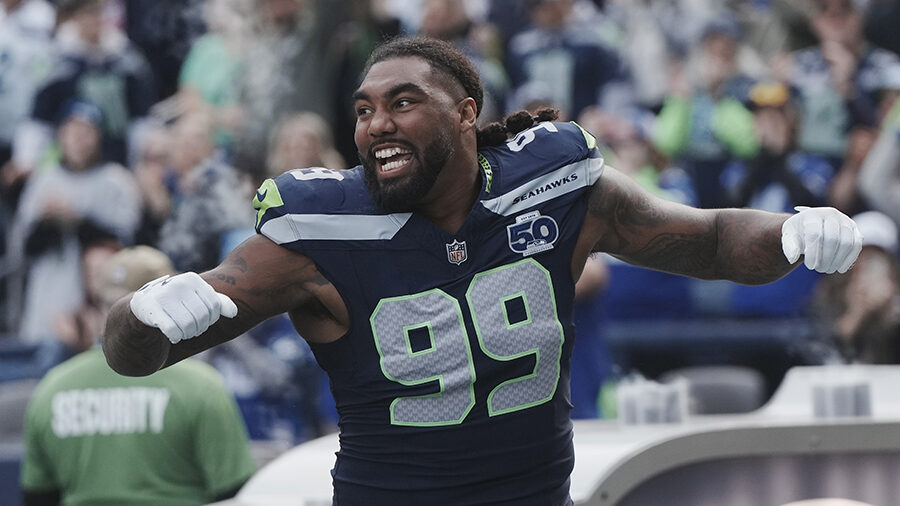
Stacy Rost offered an even less obvious choice: defensive end Leonard Williams. At first, it may seem strange to call a 31-year-old veteran the most important player on an offensive team. But a closer look at the Seahawks’ offseason moves along the defensive line makes the reasoning clear. The team has obvious concerns in its cornerback room: it signed players with questionable reputations—one is under investigation, another missed the entire training camp, and a third was acquired in a trade from another club. When a team has problems in the last line of defense, the only solution is to apply constant pressure to the opposing quarterback. That is where Williams becomes the shield protecting all the weak spots. If the pass rush works, the secondary’s shortcomings may never be exposed. If it does not, the Seahawks could face long evenings in which opposing offenses pick their defense apart.
Interestingly, both experts agree on one point: Darnold is the “correct” answer, but also the obvious one. His contribution is apparent, his mistakes are predictable and his strengths are well known. The real intrigue lies in identifying the X-factor who could turn a good team into a championship contender. Will it be a lightning-fast rookie who suddenly emerges as the season’s breakout star, or an experienced veteran who anchors the defense in crucial moments? Time will tell. One thing is certain: unlike many teams whose fate depends on a single player, Seattle is in the enviable position of having several potential keys to success. That range of possibilities may be the biggest storyline of the upcoming season.
Still, it is worth remembering that all predictions are merely theories. As experience shows, the most important player often becomes obvious only after an injury or an unexpected collapse. For now, as experts debate, the team is preparing for the season. One important detail stands out amid all the discussion: the Seahawks’ offense is bringing back all five starters from an offensive line that produced its best performance in a decade last year. So perhaps the most important player is not the one catching or throwing the ball, but the five people who create the conditions for everyone else to succeed. In its report, Seattle Sports notes that the offensive line is the foundation on which the entire structure rests—from the running game to protecting Darnold from sacks. If that mechanism breaks down, all discussions about the most important player become meaningless, because in football, as in life, everything is decided by the details and by the people who make someone else’s job possible.