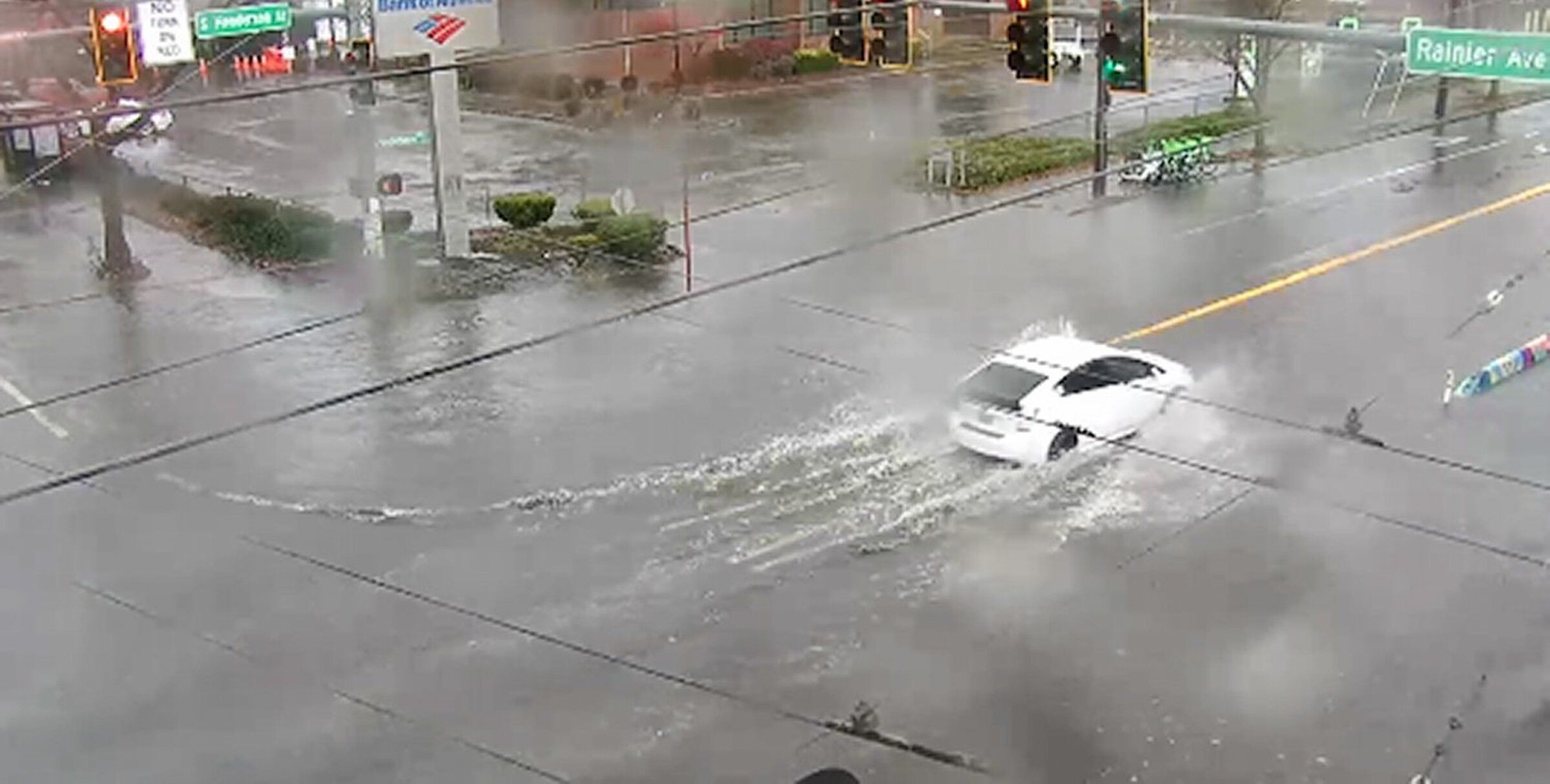
This roundup brings together Seattle’s chaotic Thanksgiving weather—a tornado warning, flooded streets and holiday work by public utility crews—as well as a story of neighbors helping one another during the storm and the dramatic situation surrounding Seattle Seahawks quarterback Sam Darnold.
Chaotic Thanksgiving Weather in Seattle: Tornado Warning, Flooding and Holiday Work by Utility Crews
On Thanksgiving, the weather around Seattle sprang an unpleasant surprise on residents and travelers: the National Weather Service (NWS) issued several hazardous-weather alerts, including a rare tornado warning for the area, stretching from Issaquah to North Bend. At the same time, streets across the city flooded, and utility crews had to work on the holiday to clear storm drains and keep roads safe.
As The Seattle Times reports, NWS meteorologist Anna Lindeman said the service’s Seattle office received a report from Renton of strong rotation and a funnel extending toward the ground. Although there was no confirmation that it touched down, meteorologists detected strong rotation on radar. “Based on that report, we decided to issue a tornado warning, especially since it was expected to cross I-90,” she explained. Residents in the affected area received emergency alerts on their phones. The warning was lifted shortly after it was issued at noon, but the service continued to warn travelers about possible landspouts—a type of tornado that forms over land—in the area from Puyallup to Carnation.
A quick explanation of what a landspout is: it’s a tornado that forms not over water or as part of a classic supercell storm, but most often beneath rapidly developing cumulus clouds when there is weak rotation in the lower atmosphere. These phenomena are rare in the Puget Sound area, but not unheard of, and their sudden formation is what makes them dangerous. It is also worth explaining the term “tornado warning”: unlike a “watch,” which means only that hazardous weather is possible, a warning means a tornado has been detected or is imminent and calls for immediate action.
Alongside the tornado threat, transportation officials and residents reported flooded roads in parts of Seattle, while traffic cameras showed cars pushing through water that sprayed out from under their wheels. The Seattle Department of Transportation (SDOT) urged drivers on social media to use caution. By noon, city crews had made significant progress clearing one of the most heavily flooded intersections, Rainier Avenue South and Henderson Street, according to SDOT. Department spokesperson Ethan Bergerson thanked the crews who gave up their holiday meal to keep drivers safe: “Instead of being at the Thanksgiving table with their families, they’re responding to flooding and other road hazards.” The Washington State Department of Transportation (WSDOT) also said crews were clearing drains on state highways to reopen lanes and reiterated the main rule: do not drive through standing water, because its depth is unknown—a vehicle could be damaged or swept away.
The chaotic conditions were caused by a combination of wind, rain and exceptionally high tides, creating flood risks across the state. Some residents of coastal areas from Birch Bay to the Olympic Peninsula evacuated as early as Wednesday. The most dangerous period, when high tides threatened to flood low-lying inland areas along Puget Sound, had passed: the corresponding advisory expired Thursday morning. But a new alert was issued for 5 to 11 a.m. Friday, when another major high tide is expected; minor coastal flooding of up to 2.5 feet (about 76 centimeters) is possible. A flood warning remains in effect in Mason County through Friday morning, as heavy rain in the Olympic Mountains has caused the Skokomish River to rise. Meteorologists expect more rain across the region, with occasional breaks, through Friday. A more sustained respite may arrive Saturday, before a new system moves into the region early next week.
The key takeaway from this story is twofold. First, it shows how vulnerable the Puget Sound region is to the combination of high tides and rainfall: even without a hurricane, several factors coming together can paralyze traffic and trigger evacuations. Second, it illustrates the cost of a holiday for utility crews—their behind-the-scenes work was essential to preventing Thanksgiving from turning into a series of serious incidents. The rarity of tornado warnings at these latitudes is all the more reason for residents and travelers to take emergency alerts on their phones seriously, even when the event seems unusual for the area.
Thanksgiving Storm: How a Flooded Intersection Became a Symbol of Neighborly Help in Seattle
In Seattle and its suburbs, Thanksgiving was less a quiet family holiday than a test of endurance against the elements: heavy rain and wind battered western Washington, knocked out power to hundreds of homes and turned streets into something like swimming pools. But amid the severe weather, what stands out is not just the damage, but people’s response—from utility crews working in the downpour to ordinary residents who took to the streets with rakes and shovels to protect their neighborhoods from flooding. That detail makes the story, published in a KOMO report, so telling: natural disasters in cities across the Pacific Northwest are increasingly testing not only infrastructure, but civic solidarity.
The report’s central episode features Burien resident Jason Jongngitirat, who was literally on all fours, chest-deep in water, trying to clear a storm drain clogged with autumn leaves. The intersection was completely flooded, he said, and passing cars splashed him with dirty water. Asked, reasonably enough, why he was doing this on a holiday when others were watching football, he gave a simple answer: “It’s my neighborhood.” Another detail speaks volumes about the situation: one neighbor asked if he wanted a beer, and Jongngitirat joked that he needed to dry off first. This exchange turns an ordinary story about flooding into a human account of mutual aid, in which the fight against the elements is waged not only by municipal crews but by residents themselves.
Other families with rakes were also seen in the area: after the heavy rain, water rose to within inches of their homes. This was not a minor inconvenience but a real threat to people’s homes, and the neighbors’ quick action appears to have helped prevent the worst. At the same time, Seattle City Light reported several power outages, leaving more than a thousand of its customers without electricity. Crews worked in difficult conditions, amid rain and wind, to restore service. Power had been restored by early afternoon. Minor flooding was also reported in Tacoma’s Browns Point neighborhood.
Several points mentioned only in passing are important for understanding the context. Seattle City Light is the municipal utility serving Seattle; reports that “more than a thousand customers” lost power mean that the outages affected more than a thousand individual households or service locations, not necessarily that many people—the count is based on connection points. The storm drains in question are a key part of the city’s drainage system: in autumn, fallen leaves can clog them, and if they are not cleared in time, water pools at intersections and can flood basements and ground floors. That is why Jongngitirat’s and his neighbors’ actions were practical, not merely desperate. The reference to “western Washington” points to the Pacific Northwest, where powerful fall and winter cyclones come in from the Pacific. These storms often bring strong winds and heavy rain at the same time, placing a double strain on power grids and drainage systems. Finally, the double rainbow over Vashon and Maury Islands at the end of the report is more than a pretty closing image: this optical phenomenon occurs when sunlight strikes at a particular angle after rain, and its appearance symbolically underscores that the storm has passed and the region is returning to normal.
The takeaways from this story go beyond a single weather report. First, holidays do not make infrastructure less vulnerable: a Thanksgiving storm puts extra pressure on utility crews even as some staff may be off work and roads are busy with holiday traffic—the article does not say this directly, but its focus on the holiday storm and the mention of holiday travel in the article’s metadata point to this risk. Second, urban drainage systems remain a weak link in the face of intense rainfall, and their condition depends in large part on how promptly residents and crews clear away leaves. Third, and perhaps most importantly, Jongngitirat’s and his neighbors’ response demonstrates a model of grassroots self-organization that is becoming ever more important as extreme weather events grow more frequent. His words, “It’s my neighborhood,” are essentially a concise expression of civic responsibility—one that can work faster than any service request to the city.
The story also serves as a reminder of how local media capture the reality of climate change through individual lives: behind the dry figures on outages and flooding are people working in the rain with rakes in hand for the sake of their neighbors. And though the power was back by evening and a double rainbow lit up the sky, the storm itself remains a warning: western Washington is entering a season when stories like this will keep recurring, and the readiness of its infrastructure and communities will be tested again and again.
Seattle Drama: Why Sam Darnold’s Story Breaks an ESPN Analyst’s Heart
The Seattle Seahawks’ quarterback situation has become the season’s main storyline, stirring far more emotion than an ordinary sports dilemma. After Sam Darnold led the team to the second Super Bowl title in its history last season, an injury knocked him out in the season opener, and Seattle has been caught in a constant state of choosing between him and backup Drew Lock ever since. Lock seized his opportunity and put together two wins to open the season. Darnold then returned but had an uneven run, and after his injury flared up again, he gave way to Lock, who shone in two wins before the break. Darnold is now expected to return to the starting lineup for a crucial road game against the division-leading San Francisco 49ers, and the decision has drawn mixed reactions.
Against this backdrop, ESPN analyst Peter Schrager said during his weekly conversation on Seattle Sports’ Brock and Salk show that he was rooting for Darnold to find his form again. He said the story breaks his heart because he knows Sam personally and has seen how far he has come. Schrager stressed that he was not pitting Darnold against Lock and did not wish the latter ill—Lock has become a great story in his own right—but he would be deeply disappointed if Sam’s career slid backward, to the point where people again start questioning his ability to play under pressure, his poor throws and whether he is really “the guy.” For a storyteller, as Schrager considers himself, the more compelling ending would be a complete arc: a man many had written off reaches the summit and tells everyone, “I told you I could do it,” without then crashing back down. That potential slide is what Schrager called the biggest disappointment.
The heart of the drama is that Darnold is a rare example of a quarterback who managed to revive his career after failing as a starter with the New York Jets and Carolina Panthers. He spent 2023 as a backup in San Francisco, then broke through: he made the Pro Bowl in 2024 with Minnesota and did so again in 2025 with Seattle, leading the team to a championship. Now, after a string of injuries and inconsistent games—including a strong performance in a win over Kansas City and a poor one in a loss to Chicago—he must prove last season’s level was no fluke. The context adds to the tension: the Seahawks are on the road against the 49ers, who lead the NFC West, and games like this are where a team’s true leader is put to the test.
A few points in the article are left unexplained but are important to understanding it. The Pro Bowl is the NFL’s annual all-star game, and being selected signals elite performance at one’s position. The NFC West is one of the National Football Conference’s four divisions, and winning it has a direct bearing on making the playoffs, which gives the San Francisco game added importance. The phrase “quarterback under pressure” refers to the ability to make good decisions when the opposing defense attacks aggressively and there is almost no time to throw—exactly the kind of situation in which Darnold has most often been criticized.
The material’s key insight is that sports analysis gives way here to a human story: even a neutral ESPN commentator openly admits to having a personal stake in a happy ending. Schrager’s comment that “this storyline breaks my heart,” and his metaphor of reaching the summit only to lose it again, show how much the NFL values a redemption narrative. At the same time, he makes clear that he is not against Lock, which preempts accusations of bias. The implication is simple: Darnold’s return to the starting lineup is not just a tactical decision by the coaching staff but a test of his own career story. If he handles San Francisco, his arc will get a worthy continuation; if he does not, talk of pressure and “poor throws” will return with renewed force, and the team will face a difficult choice for the rest of the season. The full conversation with Peter Schrager is available in the Seattle Sports podcast.