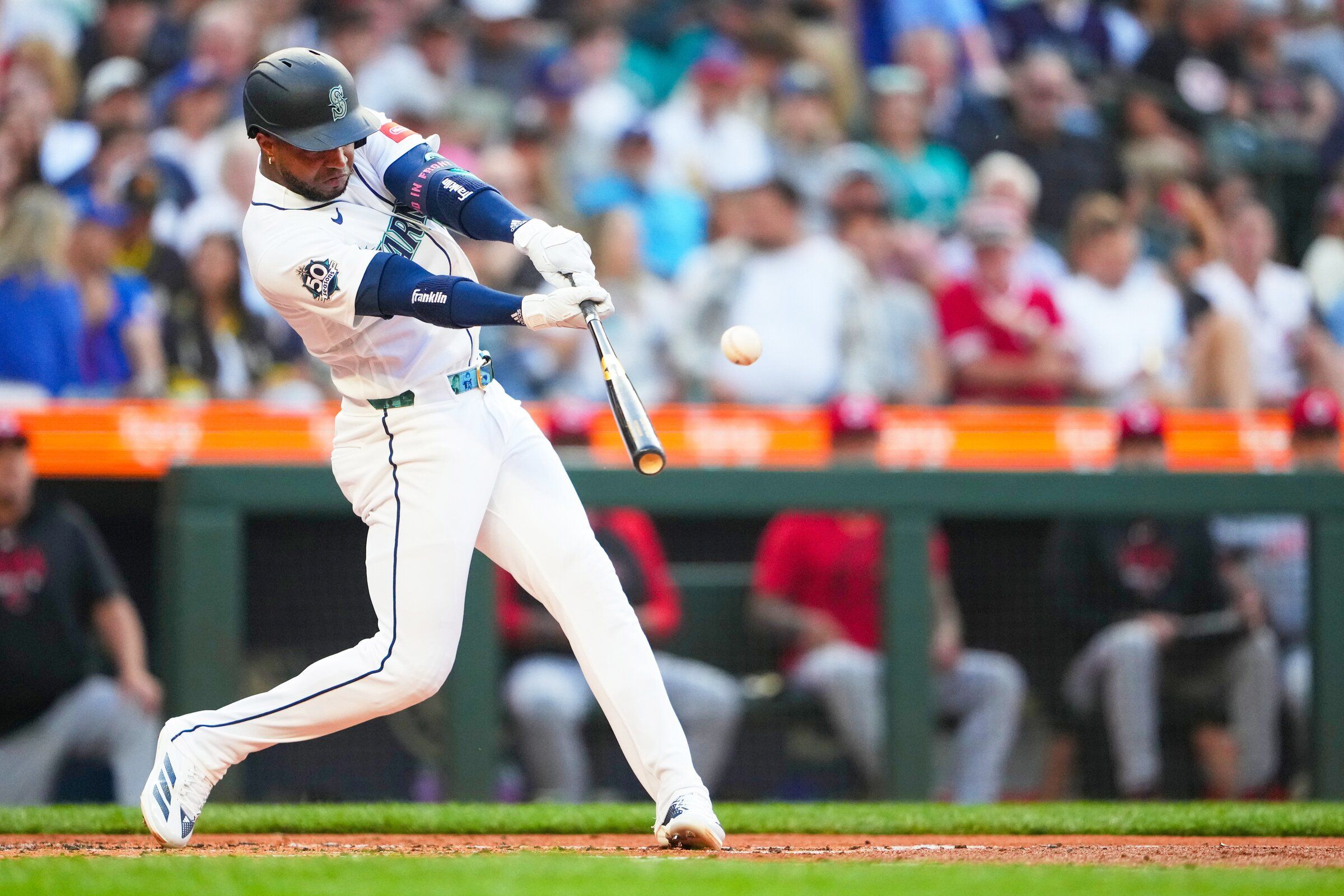
A look at the main developments: a bizarre moment in the Milwaukee–Seattle game, Robles’ return to the Mariners’ lineup, and the Seahawks’ historic deal with Witherspoon.
Milwaukee Brewers vs. Seattle Mariners: Homestand Begins with a Bizarre Moment
Last night at American Family Field in Milwaukee, the Brewers opened a homestand that, according to the schedule, will last five full games. That may sound unusual, but with the team facing such a packed schedule this season, even an extended run of home games feels like a gift from the baseball gods. The Seattle Mariners were the first opponent in the series, and the game was eventful from the very beginning.
The star of the first inning was Jake Bauers, who apparently decided to make up for Bryce Turang’s four missed days not only with his play, but with plenty of drama. With two outs in the bottom of the inning, Bauers hit a ball to right field and, taking advantage of a mistake by Victor Robles, who slipped while fielding it, raced toward second base. The sprint ended with a spectacular dive, but Jake did not stop there. William Contreras immediately sent the ball into left field, and Bauers charged forward again, this time toward home plate. However, Seattle’s Randy Arozarena made an excellent throw, and it appeared that the runner would be an easy out. That was when the real comedy of errors began.
Bauers, already preparing for the tag, accidentally knocked the ball out of catcher Cal Raleigh’s glove as he fell. The player initially ran past home plate without realizing that he had not been tagged, and only Christian Yelich’s warning brought him back to reality. He had to dive a second time, and this time his hand touched the plate a fraction of a second before Raleigh finally applied the tag. The bizarre sequence gave Milwaukee its first run—and the spectators plenty of laughs.
Aside from that, the game was a classic pitchers’ duel. The Brewers sent left-hander Kyle Harrison to the mound, who entered the season with nine wins, three losses, and a respectable 3.47 ERA. His counterpart was Seattle’s Bryce Miller, who, despite a 4–6 record, had an even better ERA of 3.39. Interestingly, the two starters rely on very different styles: Harrison is known for his ability to generate movement, while Miller more often depends on velocity. Their duel promised to be an intriguing one, especially since the Brewers entered the game with baseball’s best record—77 wins and 48 losses.
As for the lineup, Turang did indeed return. Although he did not make an impact in the first inning, his presence clearly added confidence to the offense. The starting nine also included other key players: Luis Lara started in right field, while Garrett Mitchell played center. The Mariners, meanwhile, deployed Julio Rodríguez in center and Josh Naylor at first base. Rodríguez, for his part, was one of the few players capable of changing the course of the game, but on this evening fortune was clearly on the home team’s side.
The funniest part is that this game was only the first of three against Seattle in the series, after which the Brewers will continue their homestand. Dustin May is scheduled to take the mound tomorrow, while Robert Gasser will face George Kirby on Wednesday. All games can be watched on Brewers.TV or heard on AM-620 WTMJ radio. If the first inning produced that level of excitement, the rest of the series promises to be just as entertaining. As they say, in baseball you never know where you will find a win—or where you will lose your head laughing.
For those unfamiliar with the terminology: a “homestand” is a series of games a team plays at its own stadium. A “run” is a point scored by a player who reaches all four bases. A “tag” is when a fielder touches an opposing player with the ball or with a glove holding the ball to record an out. And “ERA” is the average number of runs a pitcher allows over nine innings. The lower the number, the better.
Full statistics and video of all the key moments can be found on the publication’s official website, which provided live text coverage of the game. The main takeaway, however, is already clear: the Brewers continue to move confidently toward the playoffs, and even comic episodes like Bauers’ only highlight their team spirit and willingness to fight for every inch of the field.
Robles Returns to the Lineup, but the Mariners Face a More Serious Test
Seattle finally received some good news from the injured list: Victor Robles is back in the starting lineup, while Taylor Ward is close to returning. For a team that has spent the past several weeks teetering on the edge of an offensive collapse, this is a genuine breath of fresh air. Robles’ return should be viewed not merely as a roster upgrade, but as the restoration of the spark that has been missing from the bottom of the batting order. His speed and aggressiveness on the basepaths can single-handedly turn an inning around, even when his bat is quiet. Ward, meanwhile, adds stability to the middle of the outfield and gives manager Dan Wilson more flexibility with his rotations.
Interestingly, the club has chosen not to rush Ward, allowing him to fully regain his form. That is a sensible approach, since in a long 162-game race, rushing key players back often leads to setbacks. For now, Wilson can breathe a little easier: the roster’s depth may not be luxurious, but it is no longer disastrous. Still, no one should expect Robles’ presence in the starting lineup alone to solve all of the team’s problems at the plate. Rather, it is a foundation on which Seattle must build its game in the coming series.
The Seattle Times emphasizes that Robles’ return is not merely a line in the scorecard, but a signal to the entire organization that the playoff fight continues. His style of play—constant pressure on the defense—is contagious. When Robles reaches base, opposing pitchers begin to make mistakes and infielders lose their rhythm. These are the small details that often do not show up in the statistics but determine the outcomes of tight games. If Ward returns in the same form he showed before his injury, he could stabilize a lineup that has relied on individual performers for too long. The Mariners understand, however, that relying on recovered players is not a strategy. Systematic work is needed, and that is precisely what has been missing so far.
Witherspoon’s Record Contract: How the Seahawks Fit the Historic Deal Under the Cap
The Seattle Seahawks continue to lock up their young core of stars with long-term agreements, and this time one of the league’s top cornerbacks was next in line. Devon Witherspoon’s signing of a record contract for his position not only strengthens the team’s defense for years to come, but also prompted fans and analysts to examine the numbers closely to understand how the club plans to balance its ambitions with the salary cap. The deal, completed Saturday, immediately became the biggest topic of discussion in the NFL, as it represents the largest financial commitment ever made to a cornerback.
The new contract runs for four years and, according to figures published by Over The Cap and Spotrac, will pay Witherspoon $132 million. That figure gives him the highest average annual salary among players at his position—$33 million—surpassing the previous mark set by Denzel Ward of the Cleveland Browns, who earned $31.1 million. It is important to understand, however, that this is not simply a raise, but a complicated restructuring. The player formally had two years remaining on his rookie contract, including a fifth-year option for the 2027 season worth approximately $21.2 million. Rather than wait, the club decided to rework those amounts and incorporate them into the new agreement. As a result, if all payments Witherspoon will receive over the next six seasons are combined, the total will be approximately $158.3 million, producing an average of $26.4 million per year—a more modest figure, but still an impressive one.
The most interesting aspect for fans and financial analysts is how the cap burden is distributed from year to year. Witherspoon will be under contract with the Seahawks through 2031, while his presence will remain on the books in 2032 as a “dead” year with a small bonus. The club deliberately chose what is known as backloading—raising the cap hits toward the end of the contract, when the salary cap is projected to be significantly higher. In 2026, Witherspoon will count for only $15.4 million, and that figure will dip slightly to $14.3 million the following season. Starting in 2028, however, the pressure on the budget will increase substantially: $27.15 million, followed by $27.95 million, with the payments peaking at $36.25 million in 2030 and $39.4 million in 2031. This structure gives the Seahawks financial flexibility in the short term, but it also suggests that the club may eventually have to either re-sign the player or convert part of his salary into bonuses to spread out the cap burden.
After completing the deal, Seattle had approximately $11.2 million in cap space remaining for next season. That ranks 23rd in the league and can hardly be called a comfortable cushion, especially with unresolved questions surrounding other key players. The leading candidate for an extension is three-time Pro Bowler Leonard Williams, who is entering the final year of his current contract. General manager John Schneider has repeatedly emphasized that he prefers to keep funds available for moves during the season, since the Seahawks have been active at the trade deadline over the past three years, acquiring players such as Williams himself in 2023, linebacker Ernest Jones IV in 2024, and receiver/returner Rashid Shaheed in 2025.
Signing Witherspoon is a strategic move that makes the team more attractive to free agents and sets the tone in the locker room. By committing a record $101 million in guaranteed money, the club is demonstrating the seriousness of its championship ambitions. At the same time, such an aggressive investment in one player sets a precedent: negotiations with Williams and other leaders will now take place while the Seahawks have limited short-term flexibility. History shows, however, that smart management can turn such “heavy” contracts into tools for future restructuring, using signing bonuses and spreading payments over time. For now, fans can celebrate: their star cornerback will remain in Seattle through his prime. The question of how the club will maneuver in 2030, when Witherspoon turns 30, will remain a headache for future management.
For the present, however, everything looks optimistic. Despite their limited cap space, the Seahawks still have the ability to make targeted additions, as they have in past years. The key lesson is that the modern NFL is played not only on the field but also in the numbers, and Seattle is currently demonstrating a virtuoso command of both disciplines. More details about the deal and its impact on the club’s financial policy can be found in this Seattle Sports article, which provides a full year-by-year breakdown and analyzes the team’s next steps in the transaction market.