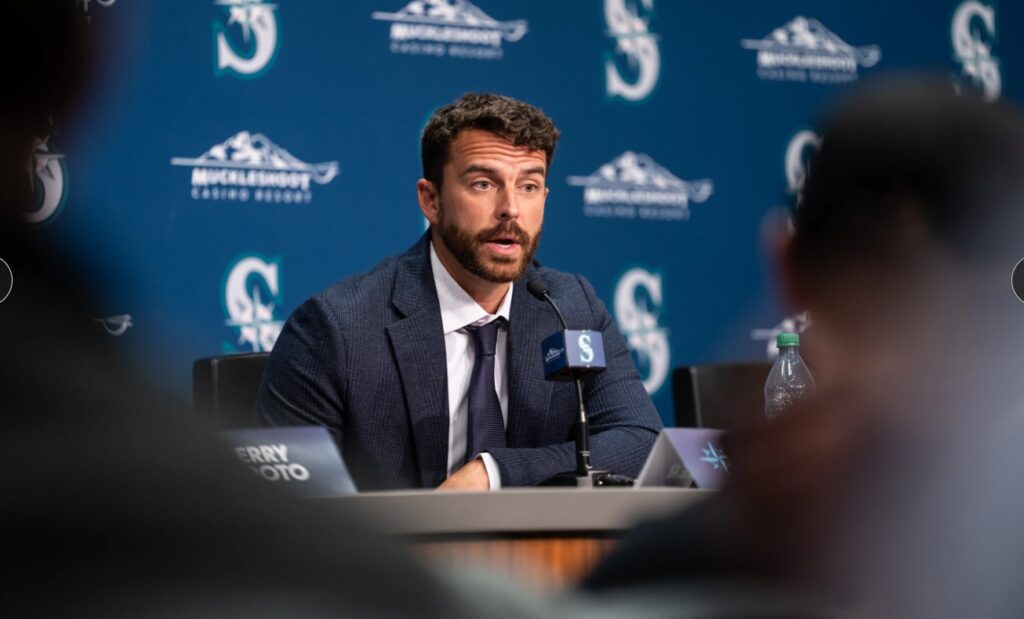
Two Seattle Mariners pitchers, Vargas and Criswell, have qualified for arbitration under the Super Two rule, a development that will affect the club’s budget by 2027. Meanwhile, Gov. Ferguson held his second meeting this year with NBA Commissioner Silver about bringing the Sonics back; a decision on league expansion is expected by year’s end. And the Portland State Vikings are beginning a four-game road trip, starting against the Seattle U Redhawks.
The Super Two ranks grow: two Mariners pitchers qualify for arbitration
Major League Baseball’s system for controlling young players’ salaries is structured so that athletes earn close to the minimum during their first few years, then gradually gain the ability to negotiate with their club through arbitration. Against that backdrop, news involving the Seattle Mariners may seem purely administrative at first glance, but it affects both the roster and the team’s budget. Right-handers Carlos Vargas and Cooper Criswell have qualified under the Super Two rule, meaning they can go to arbitration as early as the 2027 season rather than settle for the league minimum. Seattle Sports reports the news.
The rule deserves a closer explanation, since it shapes the financial futures of dozens of baseball players every year. Super Two arbitration eligibility goes to players in the top 22% for service time among those with between two and three years in the majors. They must also have accrued at least 86 days of service during the season before becoming eligible—in this case, 86 days in 2026. One important detail: time spent on the injured list—whether the 10-, 15- or 60-day list—continues to count toward service time. That matters for Vargas and Criswell, both of whom spent a significant part of last season on the injured list.
This year’s cutoff was 2 years and 133 days of service, down from 2 years and 140 days in 2025. According to FanGraphs, Vargas had 2 years and 140 days of service at the start of the season, while Criswell had 2 years and 143 days. With both pitchers included, the Mariners head into 2027 with 15 arbitration-eligible players. October projections from MLB Trade Rumors put Vargas’s salary at around $800,000 and Criswell’s at $900,000. For comparison, the current league minimum is $780,000, though that figure could change under a new collective bargaining agreement. A recent proposal from the owners would set a $1 million minimum for players with at least two years of service—and any increase to the minimum salary tends to push arbitration figures up as well.
So what do these two bring on the field? The 26-year-old Vargas opened the season on the injured list with a right lat strain and did not return until August 21. In 16 relief appearances, he pitched 19 innings, posting a 4.74 ERA, 3.94 FIP and 1.05 WHIP, with 17 strikeouts and four walks. Criswell, acquired in a January trade with Boston, made 37 relief appearances, pitching 40⅔ innings with a 3.32 ERA, 3.79 FIP and 1.40 WHIP, along with 31 strikeouts and 16 walks. The 30-year-old spent nearly three months on the injured list with a right shoulder strain and returned to the mound on August 31. The report also used material from the Associated Press.
Behind the arbitration figures is a broader dynamic worth keeping in mind. Super Two is a double-edged sword for a club: early negotiating rights can raise costs for players who have yet to become stars, but the process also gives the club greater predictability and leverage in talks over long-term contracts. For players, it is their first real chance to earn substantially more than the minimum. Paradoxically, injuries can work in their favor here, since days on the injured list continue to count toward service time. That is why Vargas and Criswell’s qualification is more than a line in a financial report: it signals how Seattle will shape its bullpen and allocate its money in the coming years.
Gov. Ferguson and NBA Commissioner Silver discuss bringing the Sonics back to Seattle: What’s behind the conversation
Washington Gov. Bob Ferguson held a virtual meeting with NBA Commissioner Adam Silver, and the conversation could prove to be a final argument in favor of bringing the league back to Seattle through expansion. According to KOMO News, it was the politician’s second conversation with the league chief this year. Both sides are making clear that the dialogue is continuing for a reason, not simply as a formality.
Silver has repeatedly said publicly that the NBA is exploring expansion to Seattle and Las Vegas, with a decision—one way or the other—expected by the end of this year. That deadline gives the meeting with the governor added significance: time for discussing prospects is running short, and the focus is shifting to concrete conditions and the makeup of ownership groups.
The key imbalance concerning Seattle lies in the investor pool. The league has already heard from several potential bidders in Las Vegas, while Seattle has only one credible group so far: the One Roof Sports and Entertainment consortium, led by Samantha Holloway, majority owner of the NHL’s Seattle Kraken. Investors include billionaire philanthropist Melinda French Gates and Amazon CEO Andy Jassy. The lack of competing buyers in the city has prompted reports from outside the market suggesting that NBA team owners are open to bringing the Sonics back. But the wording in those reports remains cautious and open to interpretation.
Ferguson’s position is deeply personal, which lends it credibility. After the meeting, his office issued a statement emphasizing that the governor is a lifelong Sonics fan who grew up attending the team’s games and Lenny Wilkens’ basketball camp, and that he is committed to bringing the team home. “The governor had another good conversation with Commissioner Adam Silver and appreciates the ongoing dialogue about the potential for NBA expansion in Seattle,” his office said.
The historical context is essential. The Sonics left Seattle in 2008 after then-Mayor Greg Nickels agreed to a deal that allowed the team’s former owners to buy out the KeyArena lease and relocate the franchise. The city has lived with a sense of injustice ever since, and bringing the team back has become something of a civic mission. It is no surprise that the issue surfaces at every level of government, including the governor’s office.
The arena is another part of the story. Silver has repeatedly called Climate Pledge Arena a world-class venue and said the league could put a team there in as little as five weeks. But Holloway and One Roof’s control of the arena creates a strategic imbalance: any other group bidding for a franchise would be a tenant, unable to capture the full value of parking, ticket revenue and concessions—the revenue streams that help recoup multibillion-dollar investments. To put the scale in perspective, NBA expansion is being discussed with the 2028–29 season in mind, and Seattle’s franchise value could exceed $6 billion. If a bidder does not own the arena, the economics of the deal become much more complicated.
Taken together, the picture is this: Seattle has a strong political advocate, a ready ownership group with some very big names, and an ideal arena, but no competing buyers to drive up the price and spur the league to act. For the NBA, that is both an opportunity and a bargaining point. The lack of alternative bids in Seattle could be used as an argument for a deal—or as leverage over the only prospective bidder. With a year-end deadline looming, further meetings like Ferguson’s could prove decisive. That is why what might seem like an ordinary conversation between a governor and a commissioner should be seen as part of the endgame, not a social call.
The Vikings begin a four-game road trip: first test in Seattle
The Portland State men’s basketball team, the Portland State Vikings, is entering one of its toughest stretches in years. On Saturday, November 7, coach Jase Coburn’s team will visit the Seattle U Redhawks at Redhawk Center. It will be the first of four road games in 11 days. All four opponents are projected by coaches to finish in the top four of their conferences: three from the West Coast Conference (WCC)—Seattle, San Francisco and Saint Mary’s—and one from the Pac-12, Colorado State. Match details and a preview are available in the official Portland State Athletics release.
The Vikings head into the test on a high note. On Tuesday, they opened the season with a 111–59 rout of Lewis & Clark, in front of a home crowd that had gathered to celebrate last year’s team, which received championship rings for winning the Big Sky regular-season title. Six players scored in double figures: K.C. Ibekwe and Luke Kearney had 17 apiece, Yaroslav Nikonov scored 14, Trevor Frank had 13, and Antonio Puzzateri and Nehemiah Pollard added 10 each. No player was on the court for more than 22 minutes, and all 13 players on the roster got at least five minutes. That kind of rotation is a hallmark of Coburn’s approach, built around bench depth and high-energy defense.
Defense and rebounding were the Vikings’ biggest strengths in the opener. Lewis & Clark shot just 27.9% from the field (19 of 68) and did not reach 30% in either half. Portland State set a Viking Pavilion record with 67 rebounds to the visitors’ 24, a 43-rebound margin. After the opening round, that put the Vikings first nationally in total rebounds per game and second in defensive rebounds and rebounding margin. Notably, 10 of the 13 players grabbed at least four rebounds, led by Ibekwe with eight. The Vikings made the most of their second chances, outscoring Lewis & Clark 25–0 on second-chance points and holding a 21–10 advantage in offensive rebounds.
The Vikings also looked convincing on offense, though there were some caveats. They made 71% of their field-goal attempts in the second half (22 of 31) and 58.7% for the game, a figure that would have ranked fourth last season. Three-point shooting was another story: they hit 11 of 28 (39.3%) after the coaching staff made a deliberate effort to add shooters in the offseason. A year ago, the team averaged 6.7 three-pointers per game on 32.5% shooting, ranking just 10th in the Big Sky in both categories. Trevor Frank, who transferred from Dallas Baptist University after making 220 three-pointers over three years, began his Portland State career with four threes in the first half. The one notable weakness was free-throw shooting: 26 of 43 (60.5%). For a team likely to get to the line often, that could be a problem in close games.
The Redhawks also rely on defense. Last season, Seattle led the WCC and ranked 20th nationally in blocks (4.9 per game); it topped the conference and ranked 15th in the NCAA in forced turnovers (14.8), and placed second in the WCC and 20th nationally in turnover margin (+3.3). The anchor of that defense is Will Hamebrodt, named the WCC Defensive Player of the Year last season. He set a program record with 90 blocks and ranked third nationally in blocks per game (2.65). Junseok Yeo, who played for the South Korean national team over the summer, joined him on the preseason all-conference team. Another returning player, Malik Errington, ranked 15th nationally in steals (2.26). In their season opener, the Redhawks lost 74–73 on the road to Hawaii after coming back from a 16-point deficit and taking the lead late, only to give up Jayden Mattingly’s game-winner with one second left. Hamebrodt and Mason Williams, who spent two years playing against the Vikings at Eastern Washington, led the team with 20 points apiece.
The head-to-head history favors Seattle. The Vikings lead the series 10–8, but the Redhawks have won the last three meetings, including two in Seattle under Coburn: 83–71 in 2022–23 and 91–74 in 2024–25. Portland State’s last win in the matchup came on November 15, 2011, when it won 66–65 at home. With four seconds left, Chayce Tapscoott completed a comeback from 58–65. The Vikings’ last road win over Seattle came a year earlier, on March 10, 2011, by a score of 81–71.
What do the figures and terms in this article mean? “Defensive rebounds” are rebounds after an opponent’s missed shot, allowing a team to end the other side’s possession and start a fast break. “Offensive rebounds” are rebounds after a team’s own missed shot, giving it another chance to score; they accounted for the Vikings’ 25–0 advantage in second-chance points. A “block” is a shot stopped by a defender, while “turnover margin” shows how many more times a team took the ball away from its opponent than it gave it away itself; a positive number means extra possessions in its favor. “Assist-to-turnover ratio” compares assists with turnovers and is a key measure of a point guard’s efficiency: freshman Gantas Krizanauskas leads the Big Sky and ranks fifth nationally, with eight assists and one turnover. Finally, “preseason polls” are predictions made by coaches and journalists before the season starts. The Vikings were picked fourth or fifth in the Big Sky, and are among the conference’s clear top five alongside Montana State, Northern Colorado and Eastern Washington.
Several players from the opener deserve special mention. Yaroslav Nikonov, who spent five years in the CSKA Moscow system and played for CSKA-2 in Russia’s Super League (averaging 17.7 points, 3.8 rebounds and 1.9 assists last season), scored 12 of his 14 points in the second half, adding five rebounds and five assists. After the opening round, he ranked in the Big Sky top 15 in seven statistical categories. K.C. Ibekwe, whose nickname stands for “King of the City,” nearly had a double-double in 16½ minutes, with 17 points and eight rebounds while making seven of eight shots. He is tied for the conference lead in offensive rebounds. Frank and Kearney set the pace from beyond the arc, Finland’s Emil Skyttä filled the stat sheet with seven points, seven rebounds and four assists, and Puzzateri—who ranked second in Division II in double-doubles last season—adds strength in the paint.
The season’s broader context adds intrigue. Coburn, named Big Sky Coach of the Year for the 2025–26 season, is in his sixth year leading the program and has an 83–75 record. He needs 17 wins this season to reach 100, which would make him the third coach in Portland State history to hit that mark and the second to do so in the fewest games. Last season was the program’s best in eight years: a 20–11 record, its first Big Sky regular-season title in 18 years, a program-record six consecutive road wins and 15 straight conference home wins. This season…