An overview of today’s news covers three key topics: the exposure of a failed bureaucratic machine in Seattle, a court proceeding in a carjacking case, and the Seattle Seahawks’ successful NFL Draft strategy.
Scandal in Seattle: Another Multi‑Million-Dollar Failed Bureaucracy
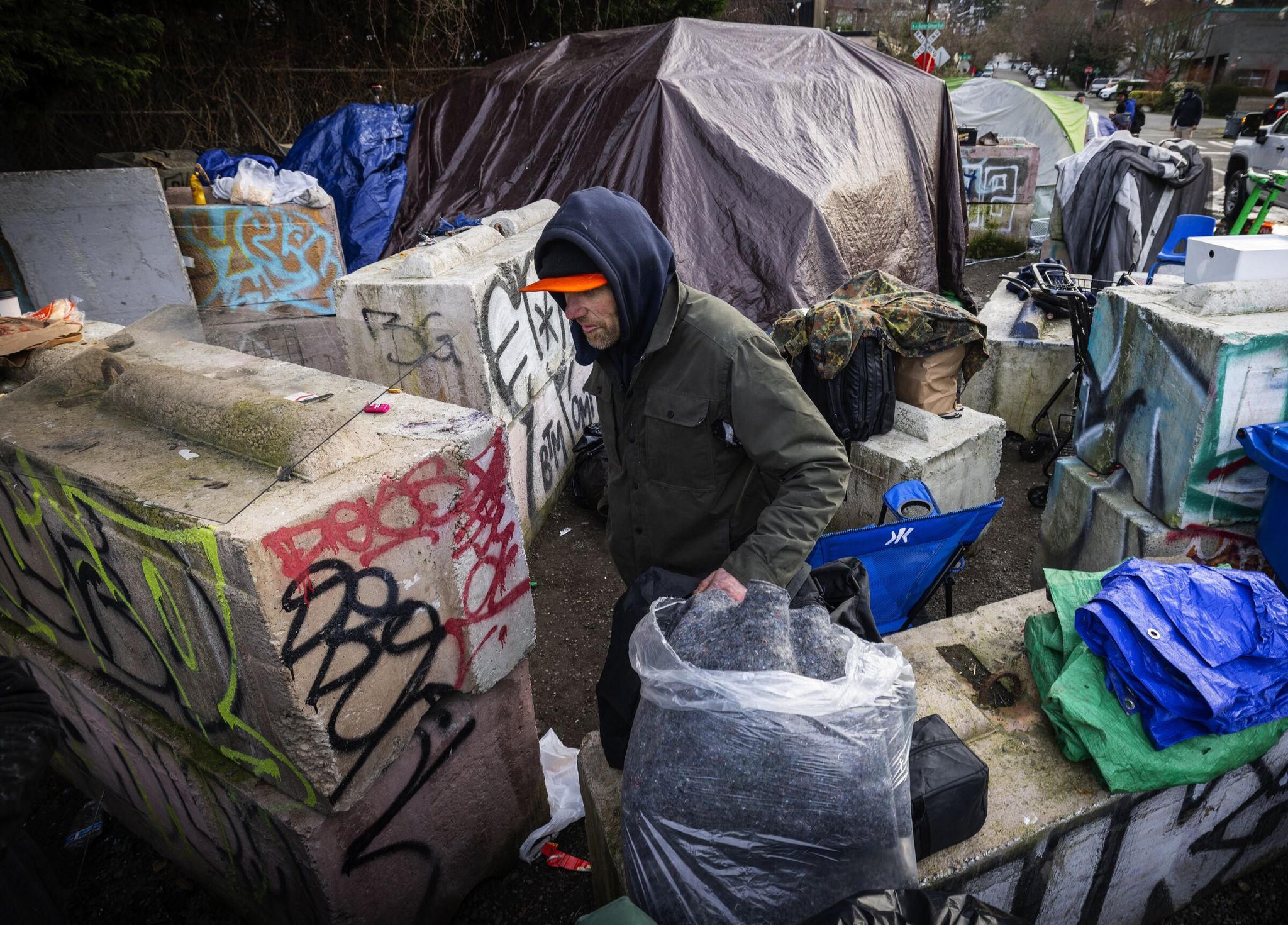
When an organization’s name promises one thing and reality is entirely different, the stench of failure becomes unbearable. That is what happened with the Regional Homelessness Authority (RHA) in Seattle, which, five years after its creation, finds itself on the brink of dissolution. The agency, intended to coordinate homelessness efforts across 39 cities in King County, not only failed to become truly regional but managed to become mired in scandals, lose control of its finances and discredit the very idea of effective public administration. The final straw was an audit that uncovered a $48 million deficit, with another $8 million simply “missing” without explanation. As the author writes in his article for The Seattle Times, officials reacted quickly, realizing this was only the tip of the iceberg of systemic problems.
The main problem with RHA, the paper notes, was baked in from the start. Despite its name, the agency was never truly regional: in the $203 million 2026 budget, the share for the 38 cities other than Seattle amounted to just 0.15% of funding. Bellevue, Kent, Federal Way and other cities sensibly refused to put resources into a bureaucratic structure that effectively served as a cover for Seattle and King County, letting them fund social programs while avoiding direct accountability. The authority’s results were dismal: it delayed payments to contractors, constantly clashed with city governments, got bogged down in internal social disputes and devoted excessive attention to the so‑called “lived‑experience” concept — the idea that only someone who has been through something can fully understand it.
That idea, the journalist writes, reached an absurd level when one of RHA’s boards tried to appoint a registered sex offender, arguing that “having committed sexual crimes is also a valid life experience.” The situation turned tragicomic when it emerged that the board member supporting his appointment had previously been his victim. Such scandals, King County Councilmember Rod Dembowski said, distracted the agency from its core mission. He noted that governing board meetings focused on internal problems and legal hearings rather than measures to reduce homelessness. To top it off, stripped of real authority, RHA could not even carry out its direct functions: Seattle’s mayor in 2024 took for herself an $11 million outreach contract for contact with people experiencing homelessness, and this year announced plans to build 4,000 housing units bypassing the agency whose main budget line was supposed to create shelters.
The key conclusion of the analysis is that RHA’s failure is not an isolated case but a symptom of a deeper malaise in modern progressive politics. The author cites Mark Dancleman’s book Why Nothing Works, which he believes perfectly describes the situation. The idea is that progressives have an internal contradiction: on one hand they want government empowered to solve large problems, and on the other they continually seek to “return power to ordinary people,” which ultimately renders government ineffective. As Dancleman writes, “our cultural aversion to power makes government incompetent, and incompetent government undermines the appeal of progressivism.” Instead of becoming an effective instrument, the bureaucracy got bogged down in side disputes. This leads to voter disappointment, who, seeing that authorities cannot get things done, turn to populists who criticize the very idea of public administration. The fate of the Seattle agency is a vivid example of how good intentions and a lack of focus on effectiveness turn bold political promises into costly failures that harm those the promises were meant to help most.
Sentencing Date Set in 2022 Triple Carjacking Case
Seattle news reports indicate that a resolution is imminent in a case tied to a series of brazen carjackings that occurred in 2022. A judge has set a date for sentencing the defendant in this high‑profile crime that shook the local community. Although the KIRO 7 News Seattle post is brief, context suggests this refers to the so‑called “triple carjacking,” in which three vehicles were stolen in a short period. Such incidents typically involve violence or threats, and the guilty party is expected to face a severe sentence.
A careful reader will notice a technical mix‑up in the body of the news item. The text on KIRO 7’s site, instead of covering the crime story, recounts an entirely different event — the Fitzpatrick brothers’ victory at the Zurich Classic. It reports that Matt Fitzpatrick and his younger brother Alex pulled off a dramatic win with a 71 (−1) in alternate‑shot format on Sunday. That victory earned Alex Fitzpatrick, who previously wasn’t a regular on the top tier of golf, membership on the PGA Tour through 2028. As noted in the original post to KIRO 7 News Seattle, this appears to be a content substitution error where the carjacking headline was partially replaced by a sports feed. Nevertheless, the key news for Seattle residents remains: justice in the 2022 carjacking spree is nearing its conclusion and a sentence will be announced soon. For those unfamiliar with golf, alternate‑shot is a format where two partners take turns playing the same ball, requiring the highest level of teamwork. Alex’s win, coming without full Tour status, is a sensation because it grants him the right to compete against the world’s best golfers for five years, a transformative boost to his professional career. All that is certainly noteworthy, but the city’s main news is the imminent resolution of the carjacking case that terrified local drivers a couple of years ago.
Seattle Seahawks Double Their Draft Picks in the 2026 NFL Draft with Four Trades
Seattle Seahawks general manager John Schneider said at a pre‑draft press conference that the team, with only four picks, intended to “add a few more bites of the apple.” Those words proved prophetic: the club not only kept its first‑round choice but doubled its total number of rookies to eight. During the draft in Pittsburgh, Schneider executed four trades — one on Friday and three on Saturday. Three of them involved trading down for additional picks, and one required using future assets.
Most notably, contrary to many expectations, the Seahawks did not give up the No. 32 pick in the first round. The team selected Notre Dame defensive back Jadarian Price. In his post‑first‑round interview published on Seattle Sports, Schneider admitted they had a chance to trade the pick, but the deal “fell apart at the last minute.” He also explained that much of the trading activity happened right in front of them, and that Price “was a head above the other” available players, which led them to keep the pick.
The first deal occurred on Friday: the Seahawks sent their third‑round pick (No. 96) to the Pittsburgh Steelers in exchange for a compensatory third‑round pick (No. 99) and a sixth‑round pick (No. 216). On Saturday the club used more complex maneuvers. Needing mid‑round picks, Schneider traded the Seahawks’ 2027 fourth‑round selection to the Cleveland Browns to acquire pick No. 148 in the fifth round. That move allowed Seattle to take guard Bo Stevens from Iowa. Also on Saturday there were two more trade‑downs: the team dropped from pick No. 188 (to the New York Jets) and from pick No. 216 (to the Green Bay Packers) in exchange for additional sixth‑ and seventh‑round picks.
Of particular interest is the geography of some acquired Seahawks picks. For example, sixth‑round pick No. 199, used to select receiver Emmanuel Henderson Jr. from Kansas, passed through five teams: it originally belonged to the Detroit Lions, moved to Cleveland, then to Cincinnati, and ultimately landed in Seattle. Pick No. 242 was initially with the Buffalo Bills and also spent time with Cleveland and the New York Jets before becoming part of the Hawks’ draft class. These complex chains of trades show how skillfully Schneider leveraged the market to maximize the value of his assets.
This active trading allowed Seattle to avoid repeating 2021, when the team had only three draft picks — the second‑smallest class in Schneider’s 17‑year tenure as GM. The reason the Seahawks initially had so few selections lies in two prior deals. Fourth‑ and fifth‑round selections had originally been sent to the New Orleans Saints in last year’s trade for wide receiver and return specialist Rashid Shaheed. In addition, a seventh‑round pick went to Cleveland in 2024 as part of the trade for center Nick Harris. Schneider thus converted four modest picks into a full and varied rookie class, a move that could have long‑term benefits for the team’s depth in the coming years.