
In the 2010s, Seattle’s rapid growth was the dominant topic of urban conversation. Now the cranes have disappeared from the skyline, and although the population continues to increase, everyone senses that the frenzied growth is behind us. New U.S. Census Bureau data for 2025 make it possible to measure precisely how much the pace has slowed.
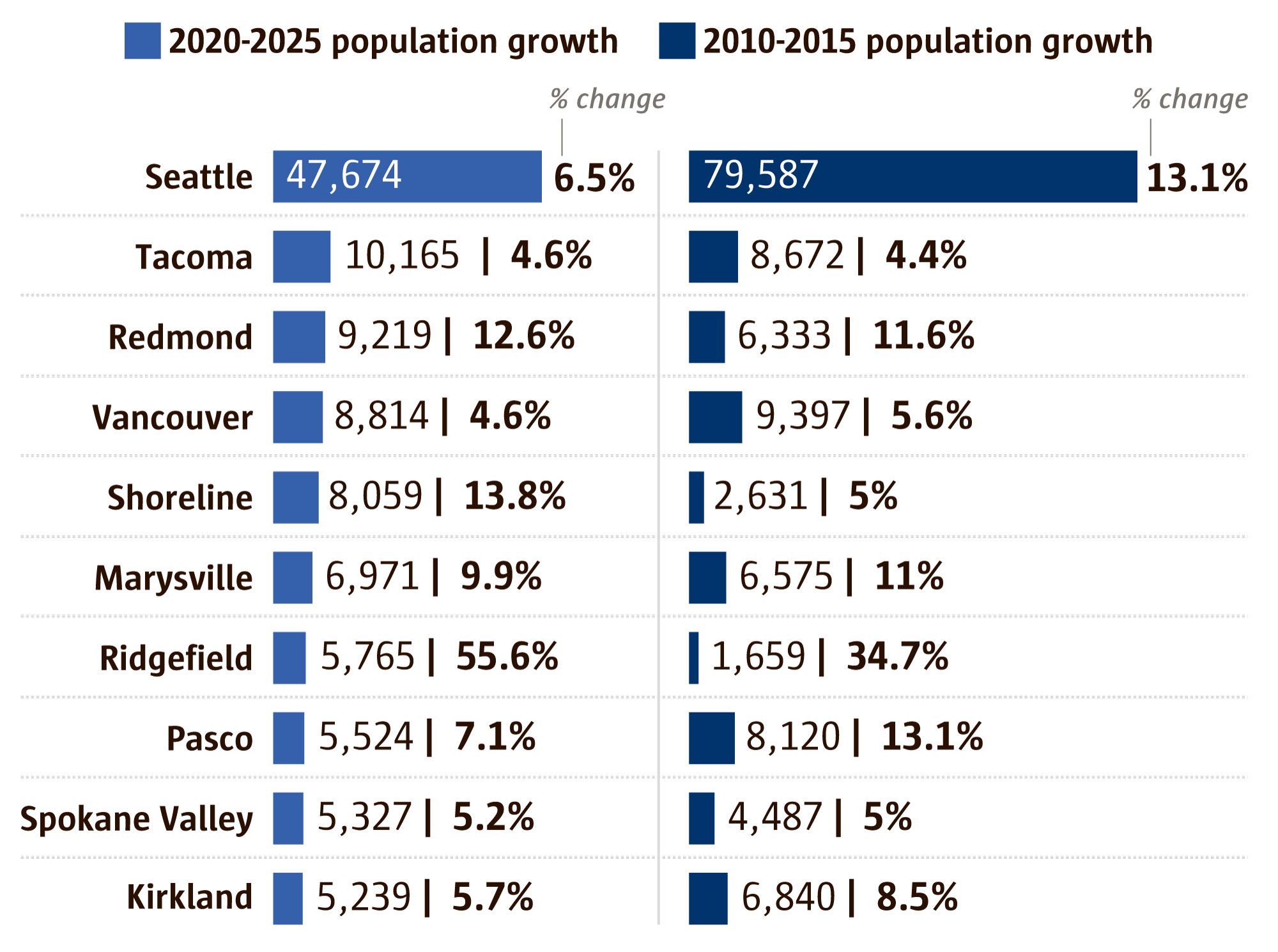
In the first half of the previous decade (2010–2015), Seattle gained nearly 79,600 residents — a striking 13.1%. But from 2020 to 2025 the city added only about 47,700 people, or 6.5%. In other words, the growth rate literally halved. For those who felt infrastructure and housing lagged behind the influx of people, this news may be a relief, but it also signals a decline in Seattle’s attractiveness as a destination for movers.
The slowdown affected more than just Seattle. In Bellevue, the county’s second-largest city, the population grew 9.4% (more than 12,100 people) between 2010 and 2015, but only 1.5% (about 2,300) in 2020–2025. The picture is even more striking in the southern King County cities: Renton, Auburn, Kent and Federal Way together lost nearly 5,800 residents over the past five years, even though their population increased by 31,300 in the first half of the 2010s. That decline is explained by a combination of high housing costs and underdeveloped infrastructure, especially in transportation. Southern suburbs are often seen as bedroom communities with limited jobs, making them less attractive to migrants.
However, some cities have successfully resisted the trend. Shoreline and Redmond show acceleration: in Shoreline, aggressive zoning updates and the launch of light rail service in 2024 produced a 14% gain (over 8,000 people). Local officials allowed mid-rise development (6–8 stories) along transit corridors, creating more affordable housing close to light rail stops. The opening of the Shoreline North/South station in 2021 shortened commute time to downtown Seattle to roughly 20 minutes, making the city competitive on price and accessibility. Redmond’s 13% growth (9,200 people) is tied to its role as Microsoft’s base, which attracts high-paid workers and spurs housing and service construction. In Mountlake Terrace (Snohomish County), the arrival of light rail also boosted growth: 19% in 2020–2025 compared with 5% in the first half of the previous decade.
The Link Light Rail central line connects Seattle with Sea-Tac Airport to the south and with Shoreline and Lynnwood to the north. But southern cities like Kent and Auburn are not yet served by the system. Planned extensions to Federal Way and east to Redmond are already stimulating growth around future stations. For the future, this means cities with well-integrated transit will gain population, while areas without it will stagnate or decline, creating “transit clusters” of development. Meanwhile, other suburbs such as Kent or Auburn have retained stricter single-family zoning, limiting their ability to attract new residents.
Rural and small towns are still booming, albeit for different reasons. Ridgefield (Clark County) has grown a staggering 55.6% since 2020, adding more than 5,700 residents. Bavarian-style Leavenworth (Chelan County), which added only nine people in 2010–2015, has now grown by nearly 1,100 people (+49%). Similar trends are visible in Black Diamond (eastern King County), Sultan (Snohomish County) and Port Orchard (Kitsap County), where growth rates have doubled.
Overall, the numbers paint a picture of restrained development: the region’s big cities have slowed, but select suburbs — especially those with new transit projects — and remote towns are experiencing a real boom. This suggests residents and businesses are redirecting toward places with more affordable housing and improved infrastructure, reshaping the familiar face of the Pacific Northwest.
Based on: How Seattle’s recent growth compares with the 2010s boom years