This digest examines Seattle’s standing as a tech hub despite record office vacancies, an alternative approach to preventing street shootings, and the controversy surrounding a Seattle Times columnist’s departure after the paper refused to publish his article.
Seattle Holds Second Place in Tech Talent Rankings, but Warning Signs Are Growing Louder
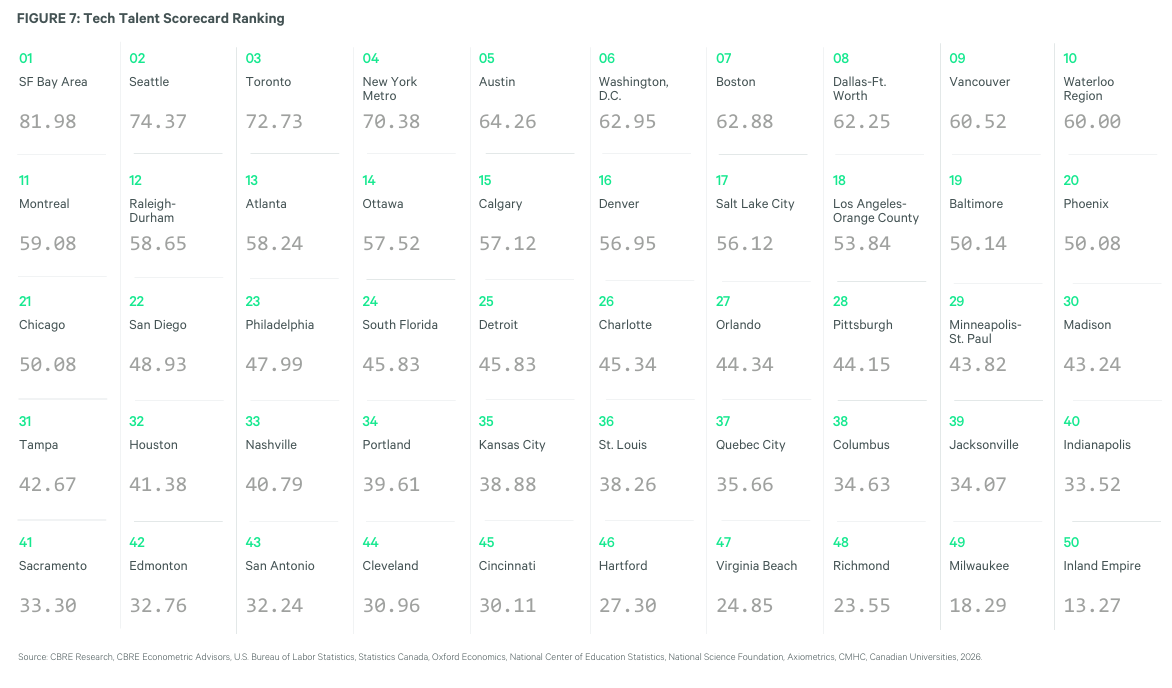
While some headlines are proclaiming that New York has overtaken Silicon Valley for the first time in the number of tech workers, a closer look at commercial real estate firm CBRE’s annual report shows that Seattle continues to hold its position as North America’s second-most important tech hub. The region, which many people associate with rain and coffee, has proved remarkably resilient: it outperformed New York, Austin, and Boston in the comprehensive ranking, trailing only the San Francisco Bay Area. Yet this achievement is no reason for complacency—the report is full of warnings that the future may not be as bright as the present.
Seattle’s secret lies not in the overall number of specialists, but in their concentration and quality. In absolute terms, the city ranks only seventh, with 213,000 tech workers, behind both New York and the Bay Area. But when CBRE factors in the density of tech workers, education levels, and salaries, the picture changes dramatically. The strongest indicator is the depth of the artificial intelligence talent pool: Seattle has 41,500 professionals with AI skills, the third-highest figure in North America, while such workers account for one in five tech professionals in the region—a share surpassed only by Silicon Valley. The technology sector represents 10.2% of total employment in the metro area, nearly twice the average across the 50 largest markets studied by CBRE.
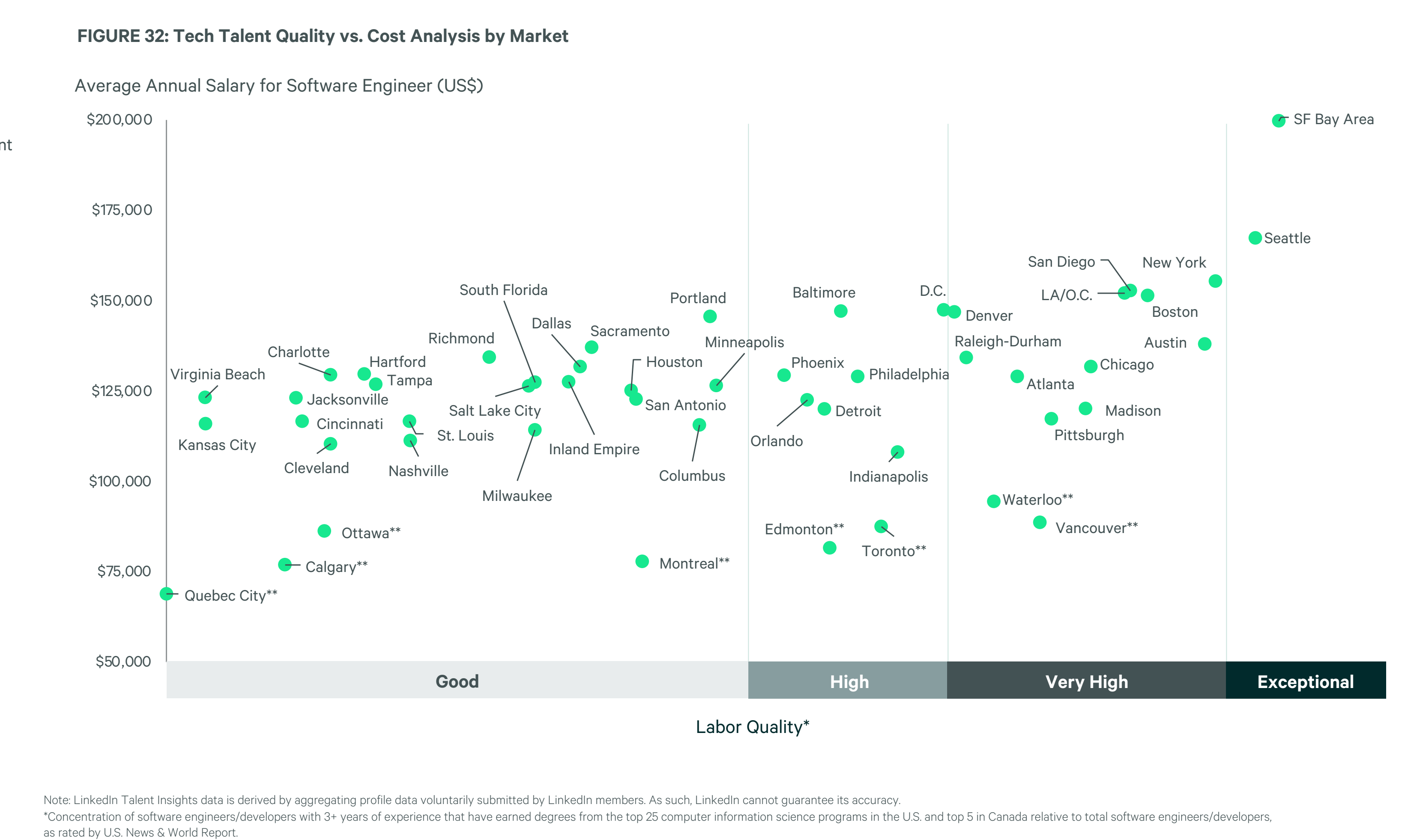
The financial picture is equally impressive. The average tech worker in Seattle earns $190,000 a year, putting the city second only to the Bay Area, where the average is $211,000. Boston, which ranks third, trails Seattle by nearly $50,000. And while Silicon Valley contracted, losing 23,900 jobs between 2022 and 2025, Seattle added 24,500 jobs over the same period—a 13.1% increase and the fifth-largest gain among all markets. This momentum suggests that the region is not merely maintaining its position but strengthening it during a period of industry turbulence.
However, a closer look at the details makes the picture less rosy. The loudest warning signal is vacant office space. Seattle’s commercial real estate vacancy rate reached a record 28.6% in the fourth quarter of 2025, the highest figure among all 50 markets included in the report. This happened despite AI companies leasing 1.9 million square feet of office space in the region since 2023. The result is a paradox: demand for talent is rising while demand for office space is falling, pointing to structural changes in how technology companies organize their work. Perhaps the era of sprawling corporate campuses is coming to an end, with Seattle among the first places to feel the effects of this transformation.
The demographic shift is no less concerning. Seattle’s population aged 20 to 29 declined between 2019 and 2024, while the share of people in their 30s rose to the highest level among all markets. CBRE analysts see this as a troubling symptom: the region attracts experienced mid-career professionals but is failing to draw young people at the beginning of their careers. This creates a risk of a break in the talent pipeline: in a few years, there may not be enough people in junior positions, which traditionally serve as the foundation for developing the industry’s future leaders. There is, however, a counterweight to this trend—the University of Washington, whose artificial intelligence program ranks fifth in the United States according to U.S. News & World Report. It is the only university in the top five located outside the Bay Area, Boston, and Pittsburgh.
The economic cost is also becoming apparent. Maintaining a 500-employee company in Seattle costs $73.9 million a year, including salaries and rent. That makes it the third-most-expensive market, after the Bay Area ($90.6 million) and New York ($73.9 million—only $24,000 more than Seattle, an almost negligible difference at this budget level). The CBRE report emphasizes that Seattle and the Bay Area are the only two markets rated “exceptional” for engineering talent—but they are also the most expensive.
It is important to note that the employment data in the report cover 2025, so the wave of layoffs that swept through the industry during the first half of this year has not yet been reflected in the figures. CBRE itself has identified a national trend: the technology industry accounted for a record 31% of all U.S. job cuts during the first half of the year, compared with just 13% over the whole of last year. As one of the largest tech markets, Seattle will inevitably find itself at the center of this storm, and only the next report will show how resilient its second-place position proves to be. Even with all the warnings, however, the region demonstrates a rare combination of talent depth, high salaries, and educational strength that few others can match. As GeekWire notes, Seattle remains a beacon for technology professionals, but its future will depend on the city’s ability to adapt to the new realities of remote work and attract younger workers.
Between Work and a Bullet: Why Seattle Needs Mentors, Not More Patrols
The tragic shooting at the Bite of Seattle food festival late last month continues to raise questions not only about apprehending those responsible, but also about how the city can prevent similar tragedies in the future. While police search for possible accomplices and officials discuss increased security measures, one nonprofit is proposing an unexpected approach: instead of increasing the number of arrests, the city should invest in people who have not yet picked up a weapon. It is a long, painstaking process that begins well before the first shots are fired.
Community Passageways, an organization focused on preventing violence among young people, says the incident at Seattle Center—which killed three people and injured four others—is an urgent warning that at-risk young people need immediate intervention. Investigators said the shooting showed signs of being gang-related. Those suspected of involvement include a 15-year-old and a 19-year-old who died at the scene, as well as a third participant who has not yet been identified. The very young ages of those involved make the problem particularly urgent.
Dominique Davis, CEO and founder of Community Passageways, believes the answer to the question of how to prevent a repeat incident lies not in increasing police patrols or imposing harsher punishments. His organization has chosen a different path: working with people closest to the epicenter of violence and trying to change the trajectory of their lives. As Davis explains, everything begins with stabilizing basic living conditions—housing, safety, and essential needs. Only then does the team bring in mentors who help teenagers envision an alternative to street life. The approach includes field camps and retreats for the most challenging participants, where they receive daily counseling and take part in workshops designed to build life skills.
Particular attention is paid to what the organization calls “hot response.” When a shooting does occur, Community Passageways staff immediately go to the scene and to hospitals to calm victims and those around them, prevent a wave of retaliation, and stop the conflict from escalating. It is a “cool-headed” tactic at the height of emotional turmoil, when one killing can easily lead to another. But Davis’s most important—and almost revolutionary—idea is that the city has a “quick fix” capable of producing an immediate effect: creating internships and professional opportunities for young people from disadvantaged neighborhoods.
Essentially, Davis wants to show these teenagers that there is “another side of life”—offices, workshops, and studios where they can build careers instead of dying on the street. In his interview with local outlet KATU, he emphasized that providing a genuine alternative is not abstract charity but a concrete mechanism for preventing violence. As the story continues to unfold, one can only hope that the voices of nonprofit organizations will be heard by officials, because the cost of failure is the lives of young people who were not given a helping hand in time. Community Passageways’ approach clearly echoes national research showing that economic hopelessness and a lack of prospects are stronger drivers of street crime than the severity of punishment. The only question is whether the city has the political will to choose this slower but more humane path.
Editorial Censorship or Audience Protection? Seattle Times Columnist’s Exit Exposes an Age-Old Conflict
When sports columnist Matt Calkins submitted his resignation from The Seattle Times after 11 years at the paper, he probably did not expect such a reaction. Yet his story quickly became a symbol of a deeper conflict between a journalist’s freedom of expression and an editorial department’s caution about angering its audience. The essence of the dispute is simple and complicated at the same time: the columnist wanted to write about two high school athletes who oppose transgender girls’ participation in women’s competitions, but the editors refused to publish the piece. Calkins, making no effort to soften his language, called the decision “silencing a voice” and said he could no longer do his job, which he sees in part as providing a platform for uncomfortable opinions.
The story began long before his resignation. In late July, Seattle hosted a WNBA game between the local Storm and the Indiana Fever. Passions surrounding the game had little to do with basketball: fans and activists gathered to support Fever guard Sophie Cunningham, who had previously spoken out against transgender participation in women’s sports. At the rally, Calkins spoke with 16-year-old runner Anahley Wilson, who said she had already competed against a transgender athlete. He later interviewed basketball player Frances Staudt, who refused to take the court against a transgender opponent. According to the girls, Storm co-owner Celeste Keaton allegedly confronted them inside the arena and, using profanity, criticized their position. The WNBA later fined Keaton and suspended her for five games, while the club issued a formal apology. Those were the events the column was intended to examine.
Calkins says he submitted the piece to his editors on Friday and then waited six days for a decision. He was ultimately told that the column would not be published. The official reason, as he relayed it from management, was that the subject had not been disclosed in advance. The journalist calls that explanation an excuse and recalls that his earlier pieces that ran counter to the “mainstream” had also often been “spiked.” He stresses that he holds no grudge against specific individuals and understands the pressure editors work under, but believes that journalists cannot avoid controversial subjects. Notably, after leaving the paper, he published the column on his own Substack platform—a natural step in an era when many journalists are moving to independent outlets.
This story is also unfolding against a broader backdrop. In November, Washington state voters are expected to vote on Initiative IL26-638, which would effectively bar students classified as “biologically male” from participating in women’s competitions and would also require gender verification through medical documentation. Supporters call the measure a defense of fairness and safety; opponents call it discriminatory and humiliating. Calkins makes no secret of the fact that his article was not neutral: he wanted to give a voice to people whom he believes are “silenced” by mainstream media. He argued that supporting separate competitions does not necessarily mean hostility toward transgender people. In that sense, his resignation is not merely a story about one journalist and one newsroom, but a reflection of a broader public debate in which each side believes it is being silenced and that the right to speak has been monopolized by the other.
The concept of “saving women’s sports” may sound like a slogan to an uninformed reader, but behind it lies a specific legal and ethical dispute. Transgender women who have undergone hormone therapy may still retain physical advantages—including muscle mass, lung capacity, and bone density—that develop during male puberty. Opponents of their participation in women’s categories emphasize this point, speaking of “biological sex.” Transgender-rights advocates insist that excluding people from sports is stigmatizing and point to the lack of compelling evidence that transgender athletes are systematically dominating elite sports. The dispute has long since moved from the realm of sports science into politics, and every new case—whether a controversy at the Olympics or a high school game in Texas—becomes a pretext for another round of confrontation. Newspaper editors across America find themselves caught between two sides: on one hand, they want to publish opinions important to conservative audiences; on the other, they fear accusations of transphobia and the loss of more progressive readers.
Calkins’s departure raises an important question about the nature of opinion writing. Unlike a news reporter, who is expected to be objective, a columnist is someone with a point of view. The columnist’s job is to provoke dialogue and express an opinion that may not coincide with the editorial board’s position. If an editorial department begins “spiking” pieces—journalistic slang for rejecting material for publication—simply because they are controversial, the columnist becomes a mouthpiece, which contradicts the very nature of the profession. On the other hand, newspaper owners have a responsibility to their communities for the content they distribute, and every newsroom has the right to establish its own boundaries. There is nothing new about Calkins and his former bosses disagreeing over where those boundaries lie, but it is telling that the incident became public and generated such a strong response. Perhaps this is a sign that the media landscape is rapidly polarizing, and that the neutral middle—where provocative but measured pieces could once be published safely—is shrinking before our eyes. Calkins does not appear ready to stop. He says he loves writing passionately and wants to continue in the same spirit, but outside the walls of traditional newsrooms. There is nothing surprising about his independent course: when a large ship cannot choose a direction, its most impatient crew members begin rowing toward their own boats. The only question is who will ultimately end up closer to the island where honest conversations about sports and society still live.