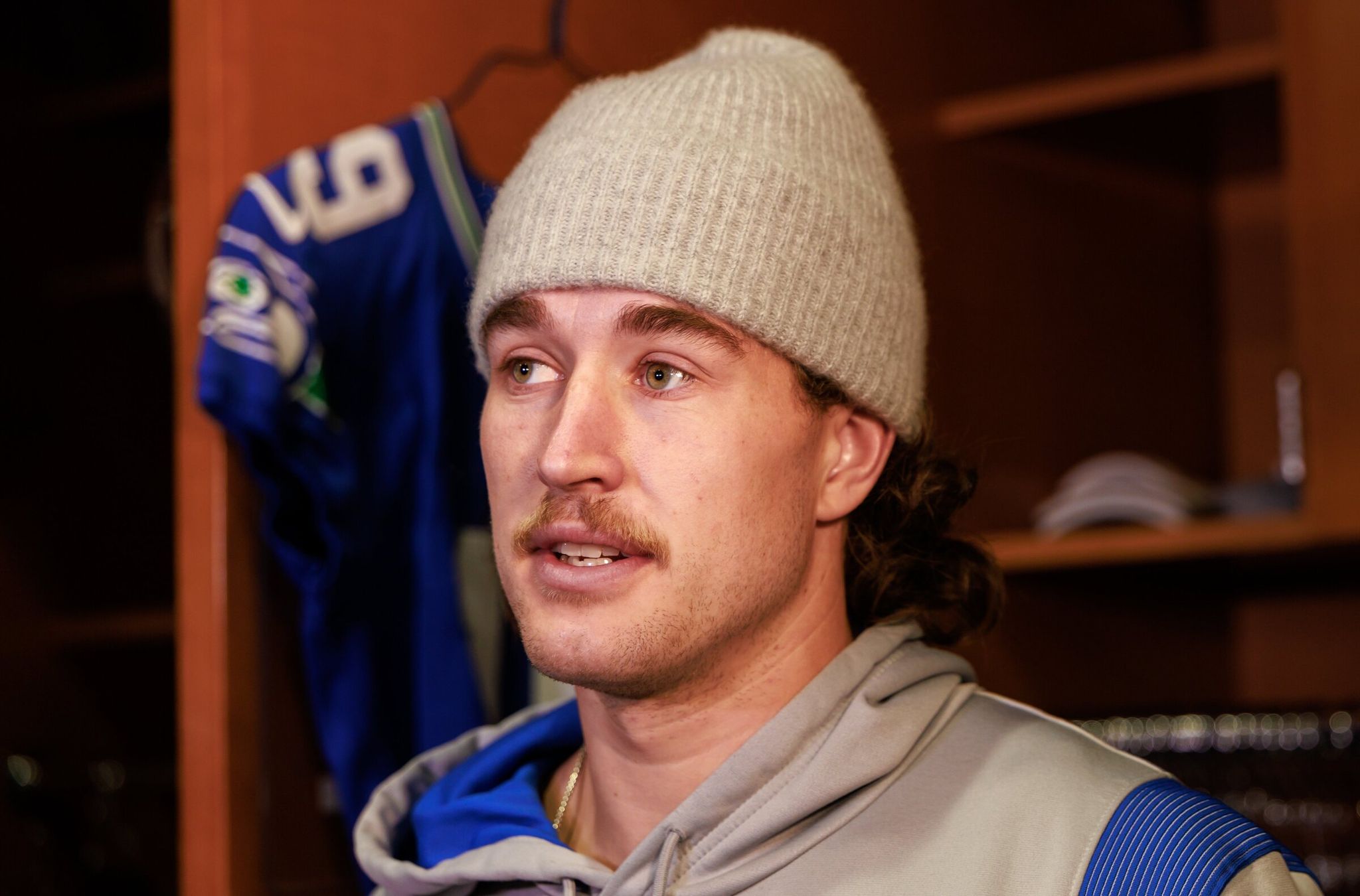
News from Seattle: the Seahawks are rebuilding after star departures, deciding Jake Bobo’s fate, and a court has issued a verdict in the murder of a pregnant woman.
Seahawks’ running back plan: life after Kenneth Walker
Seattle Seahawks general manager John Schneider signaled that the team is entering a new era, making the difficult but deliberate decision not to overpay star running back Kenneth Walker III. In his interview on Seattle Sports 710-AM Schneider stressed that, despite the desire to keep the Super Bowl LX MVP, the club must think about the team as a whole. That led to Walker’s departure to the Kansas City Chiefs on a three-year, $43 million deal. A similar fiscal discipline was applied to safety Kobe Bryant, which, according to OverTheCap projections, will net the Seahawks four compensatory draft picks in 2027. While these moves make sense from a cap-management perspective, they have created a tangible void: the team lost the primary source of explosive speed in its backfield.
The main problem is that the remaining running backs cannot fully replicate Walker’s unique style. Zach Charbonnet, who split time with him last season, is rehabbing from an anterior cruciate ligament (ACL) tear suffered in the playoffs. Surgery was only performed in late February, and he could miss a good portion of the 2026 season. Schneider expressed optimism, noting Charbonnet’s outstanding work ethic, but the fact remains: the team needs a speedster. As a power complement, the Seahawks signed Emmanuel Wilson to a one-year deal — a heavy running back from the Green Bay Packers. As Schneider noted, Wilson is a “power runner” with good feet who will fit the team’s “prove-it” culture. However, his style resembles Charbonnet’s power running more than Walker’s explosive bursts.
Hope is also placed on George Holani, who stepped up in the playoffs after Charbonnet’s injury. Schneider specifically praised his “elite” pass protection and reliability, especially in the NFC Championship and the Super Bowl. Nevertheless, Holani is not seen as the same “game-changing” threat Walker was. The numbers speak for themselves: over four seasons (including playoffs) Walker had 34 rushes of 20+ yards — the fourth-most among all running backs in the league over that span. Losing that kind of dynamism is significant for a team that, despite a high percentage of rushing plays, ranked fifth in the regular season for big gain plays (75 plays of 20+ yards).
To partially offset the loss of explosiveness, the Seahawks re-signed kick-return Pro Bowler and wide receiver Rashid Shaheed to a three-year, $51 million deal. He will be an excellent complement to Cooper Kupp and Jaxon Smith-Njigba, adding speed to the passing game. However, the question of who will provide the big plays from the backfield remains open. Kenny Mackintosh, a seventh-round pick in 2024, is also recovering from an ACL tear. Rumors about a possible trade for De’Von Achane from the Miami Dolphins were shot down, since the Dolphins do not intend to part with their speedster.
Thus, the most likely path to replenish the speed deficit is the draft. The Seahawks currently have only four picks, and ESPN already projects they could take Arkansas running back Michael Washington Jr. in the second round. As Schneider summarized: “We like the guys on our team right now, but we’ll continue to explore the position.” The Seahawks’ strategy is clear: they are building a balanced, financially healthy roster, refusing emotionally driven expensive contracts in favor of finding talent through the draft and low-cost deals to remain competitive long-term.
A decision worth millions: Seahawks could lose fan favorite Jake Bobo
The situation around Seahawks receiver Jake Bobo has escalated to a financially tense level. The Jacksonville Jaguars signed Bobo, a restricted free agent, to an offer sheet, putting the Seahawks in a difficult position: either significantly increase their spending on the player or lose him with no compensation. Details of the deal, reported by The Seattle Times, reveal high stakes in what might seem like a routine retention process.
Earlier this month the Seahawks made the standard move of tendering Bobo, as a restricted free agent, a right-of-first-refusal (ROFR) tender worth $3.52 million for the 2026 season with no guarantees. But the Jaguars changed the calculus by offering a two-year deal with a $5.5 million base and a $7 million maximum. The key element is the guarantees: $4.5 million guaranteed that Bobo would receive in any case. That’s a huge jump compared to the player’s prior earnings — he made a total of $2.705 million over three NFL seasons. For context: restricted free agents are players whose contracts have expired but who have limited league service (three seasons). Their club can make a tender — a one-year offer that gives the club the right to match any offer from another team (right of first refusal) or receive draft-pick compensation if it lets the player go. In Bobo’s case the Seahawks chose the lowest-level tender, which does not provide compensation if he leaves, leaving them exposed.
The Seahawks now have until Wednesday to decide: match the Jaguars’ offer and keep Bobo at a much higher cost, or let him walk. The Jaguars’ offer sheet includes a $1.75 million signing bonus, base salaries of $1.25 million (2026) and $2 million (2027), and up to $750,000 per season in incentives for reaching thresholds: 35 receptions, 350 yards, and 6 touchdowns. For context: Bobo has 34 regular-season receptions for 323 yards and 3 touchdowns in his Seahawks career, so the new incentive thresholds are ambitious but attainable.
The Jaguars’ interest is no accident. Shane Waldron, who was the Seahawks’ offensive coordinator in 2023 when Bobo — an undrafted rookie from UCLA — not only made the roster but became a fan favorite with the #MoreBobo movement, is now on Jacksonville’s staff. Under Waldron’s offense Bobo had his best season: 19 catches for 196 yards and 2 touchdowns. In subsequent seasons his numbers declined (13 receptions in 2024, just 2 in 2025), largely due to a string of injuries including a concussion, Achilles and calf issues, and a broken metacarpal, which he nonetheless played through to appear in the Super Bowl and score a touchdown in the NFC Championship’s winning game. His stoicism was evident when after the Super Bowl he said: “It’s part of the game... You play through broken bones. It so happened that my story became known.”
The Seahawks’ decision will be telling. They seemed to plan on keeping the receiving core intact, re-signing Rashid Shaheed to a large deal and Cody White. Losing Bobo, especially to a club connected to their former coach, would be more than the loss of a special teams contributor and reliable backup; it would be the loss of a symbol of team spirit and fan affection. As Bobo philosophically reflected on his future: “All good things come to an end... The memories we made will last forever.” Now the Seahawks must decide whether they are willing to pay millions to keep making those memories in Seattle.
Man in Seattle found not guilty by reason of insanity in killing of pregnant woman
In the U.S. legal system, some cases force society to consider not only the justice of punishment but the limits of human psyche and responsibility. One such high-profile trial was that of Cordell Goosby, which ended with a verdict of not guilty by reason of insanity. The court’s decision concerns the tragic June 2023 incident in Seattle’s Belltown neighborhood, when a pregnant woman was brutally killed at a traffic light.
According to court records, on June 13, 2023, Cordell Goosby, a Chicago native with prior convictions, allegedly carried out a random attack. At a red light he opened fire on a vehicle occupied by Sung Kwon and his pregnant wife, Eina Kwon. As a result of the attack, Eina Kwon, who was late in her pregnancy, was killed. Her baby was delivered by emergency cesarean section but also did not survive. Sung Kwon was wounded but survived. Goosby was charged with first-degree murder and attempted murder. However, after reviewing psychiatric evaluations, the court concluded that at the time of the offense the defendant could not appreciate or control his actions due to a severe mental disorder. That finding led to the verdict of not guilty by reason of insanity.
It’s important to explain what a Not Guilty by Reason of Insanity (NGRI) verdict means in U.S. jurisprudence. It is not an acquittal in the ordinary sense and does not mean the person will simply be released. Rather, it is a legal recognition that because of a severe mental illness the defendant lacked the mens rea (criminal intent) required for conviction of most serious crimes. A person found NGRI is typically committed to involuntary treatment in a secure psychiatric facility, where they will remain until a court determines they no longer pose a danger to the public. The period of such confinement can be longer than a prison term.
As KOMO News reports, the case reignited community debates about gun violence, random attacks, and the adequacy of psychiatric care systems. On one hand, the victim’s family and many citizens see the event as a monstrous crime demanding harsh punishment. On the other, the court’s verdict highlights a systemic problem: people with serious mental illnesses often do not receive needed help before committing tragic acts. The psychiatric testimony presented at trial apparently persuaded the jury to accept the defense’s arguments. The case also raises questions about access to firearms by people with prior convictions, though this report does not detail how Goosby obtained the gun. The outcome unquestionably left a bitter aftertaste for everyone involved, underscoring the irreplaceable loss suffered by the Kwon family while also framing the difficult dilemma between retribution and a medical approach to those with severe mental illness.